Rising cloud costs compel businesses to adopt open source AI models
Source:The Hindu ↗
Why It Matters
For UPSC aspirants, understanding the shift from massive, proprietary LLMs to open-source and specialized Small Language Models highlights the economic realities of adopting emerging technologies. It touches on GS3 topics like IT infrastructure, open-source platforms, and the commercial viability of AI, as well as GS2/GS3 concerns over data security and technology decoupling between nations.
Summary
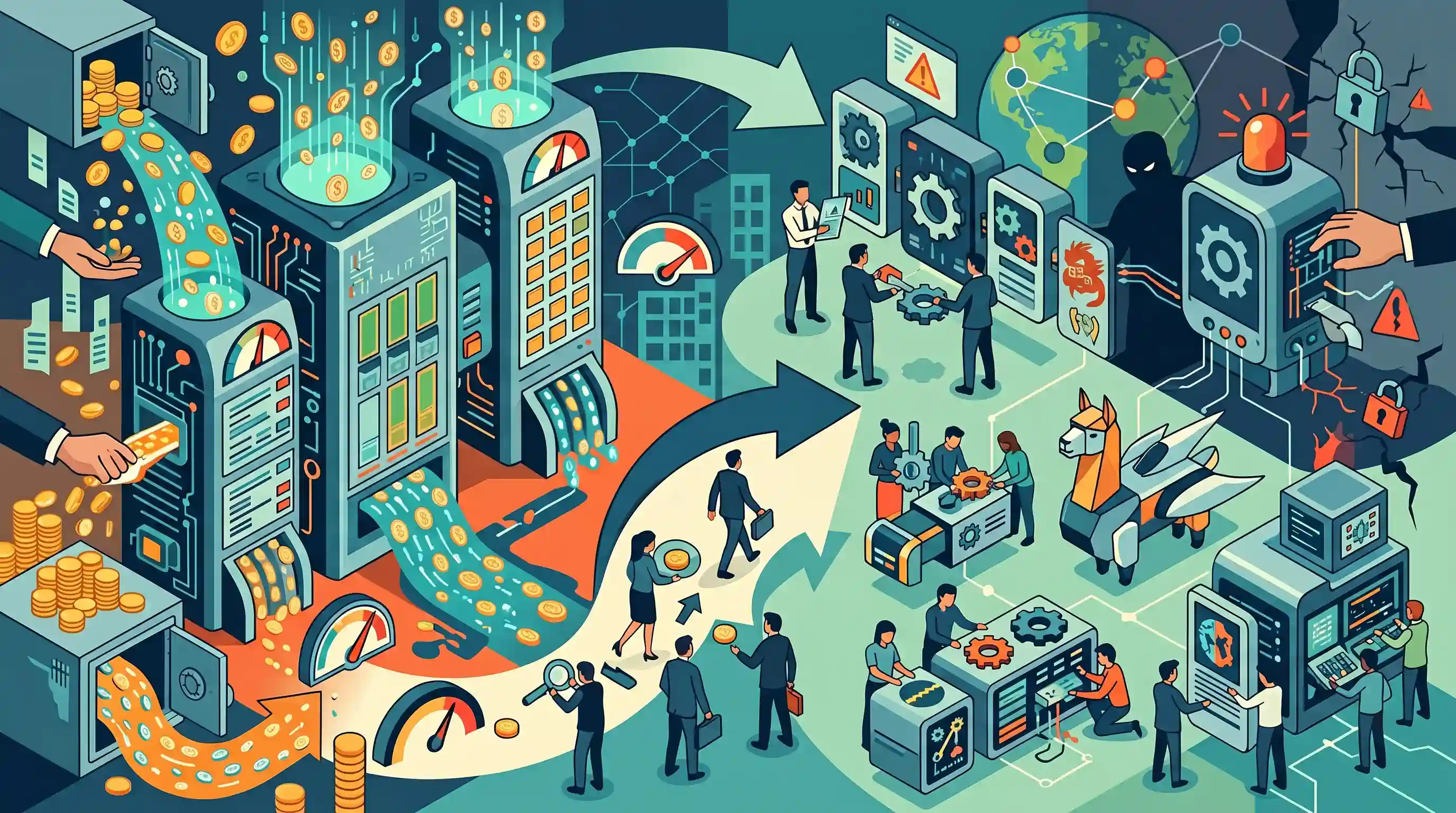
The soaring financial costs associated with leading AI models like ChatGPT and Claude are driving a paradigm shift in how businesses integrate artificial intelligence. Facing expensive cloud computing and API usage fees based on 'tokens', corporations are adopting 'tokenmaxxing' strategies to optimize expenditures. There is a growing pivot toward open-source options and Small Language Models (SLMs) such as Meta's LLaMA, Mistral, and DeepSeek. These alternatives provide sufficient capabilities for specialized enterprise tasks at a fraction of the cost of frontier LLMs. However, the reliance on models like DeepSeek also introduces new geopolitical and security calculations, given its Chinese origins.
Key Points
- Soaring costs associated with using leading Large Language Models (LLMs) like OpenAI's ChatGPT and Anthropic's Claude are forcing businesses to rethink their AI strategies.
- Companies are increasingly shifting towards open-source models and Small Language Models (SLMs) such as Meta's LLaMA, Mistral, and DeepSeek, which offer comparable performance for specific tasks at significantly lower prices.
- The practice of 'tokenmaxxing'—optimizing the number of tokens (words or word parts) processed by AI models—has become a key corporate strategy to manage cloud computing and API usage bills.
- The rapid adoption of DeepSeek has introduced geopolitical and data security considerations, as companies weigh the cost benefits of the Chinese model against potential regulatory or security risks.
Important Terms
Small Language Models (SLMs)

Compact AI models with fewer parameters trained for specific tasks, offering higher efficiency, lower costs, and on-device deployment compared to Large Language Models (LLMs).
UPSC context
GS Paper III: Science & Technology. Tests knowledge of emerging AI efficiency trends, privacy, and industrial applications.
DeepSeek
A Chinese AI firm that developed highly efficient models (like DeepSeek-V3/R1) at a fraction of the cost of Western rivals, impacting global technology geopolitics.
UPSC context
GS Paper II & III: IR/S&T. Tests understanding of technological competition, US-China rivalry, and global tech governance.
Open-source AI
AI systems whose underlying code or weights are publicly accessible, allowing users to inspect, modify, and deploy them independently to foster innovation and accessibility.
UPSC context
GS Paper III: S&T and Economy. Relates to digital sovereignty, democratization of technology, and digital public infrastructure.
Token (AI)
The fundamental unit of text (words or sub-words) processed by AI models; they serve as the basis for model computations and API-based pricing.
UPSC context
GS Paper III: Science & Technology. Essential terminology for understanding how Large Language Models operate and are commercialized.
LLaMA (Large Language Model Meta AI)
A series of open-weights large language models released by Meta (Facebook), which set the standard for accessible, high-performance AI in the open-source community.
UPSC context
GS Paper III: Science & Technology. A key example of the shift from proprietary to open-access AI frameworks.
Mistral AI
A French AI startup leading European efforts in generative AI with a focus on high-efficiency, open-weight models and regional technological sovereignty.
UPSC context
GS Paper II: International Relations. Represents European strategic autonomy in the global technology landscape.
Prelims Trap
"Tokens in the context of Large Language Models refer to blockchain-based digital assets used to pay for cloud computing."
In generative AI, a 'token' is simply a basic unit of text (a character, sub-word, or word) processed by the model, completely unrelated to blockchain or cryptocurrency.
Static Concepts Connected
What distinguishes Small Language Models (SLMs) from Large Language Models (LLMs)?
- Parameter Count: SLMs typically contain under 10 billion parameters, whereas LLMs possess tens to hundreds of billions.
- Specialization: SLMs are often fine-tuned for specialized, narrow enterprise tasks, trading generalized reasoning for high efficiency.
- Resource Intensity: SLMs require drastically less computational power, allowing them to run locally rather than relying on expensive cloud APIs.
What is Edge AI and how does it relate to SLMs?
- Localized Processing: Processing AI algorithms locally on a hardware device (like a smartphone or local server) rather than in a centralized cloud.
- Enhanced Privacy: Local processing ensures sensitive enterprise or citizen data does not traverse the internet, mitigating cybersecurity and privacy risks.
- SLM Synergy: The reduced size of SLMs makes them the primary enabler for Edge AI, eliminating constant cloud dependency.
Cross-Topic Patterns
Sovereign AI vs. Tech Dependency
DeepSeek’s rapid adoption mirrors past concerns over Huawei’s 5G. Reliance on foreign foundation models accelerates the strategic necessity for India's 'Sovereign AI' initiatives under the IndiaAI Mission.
SLMs + Edge Computing + IoT
Because SLMs have smaller parameter counts, they can be deployed directly on edge devices. This links AI cost-efficiency with Edge Computing and Industrial IoT syllabus themes.

UPSC 2026 could feature a deceptive prelims statement confusing AI 'tokens' with crypto tokens, or test the edge-deployment edge of SLMs.
Linked PYQs · 3
Linked PYQs · 3
- 2023MainsGS3
Introduce the concept of Artificial Intelligence (AI). How does Al help clinical diagnosis? Do you perceive any threat to privacy of the individual in the use of Al in healthcare?
- 2015MainsGS3
Discuss the advantages and security implications of cloud hosting of servers vis-a-vis in-house machine-based hosting for government businesses.
- 2022PrelimsGS1
Consider the following : 1. Aarogya Setu 2. CoWIN 3. DigiLocker 4. DIKSHA Which of the above are built on top of open-source digital platforms?
