Generative AI Accelerates Physics Research and STEM Innovation
Source:The Hindu ↗
Why It Matters
Understanding the applications of Generative AI in scientific research is crucial for the UPSC GS3 syllabus, which emphasizes awareness in IT, computers, and AI. It illustrates the transformative potential of technology in accelerating research and development.
Summary
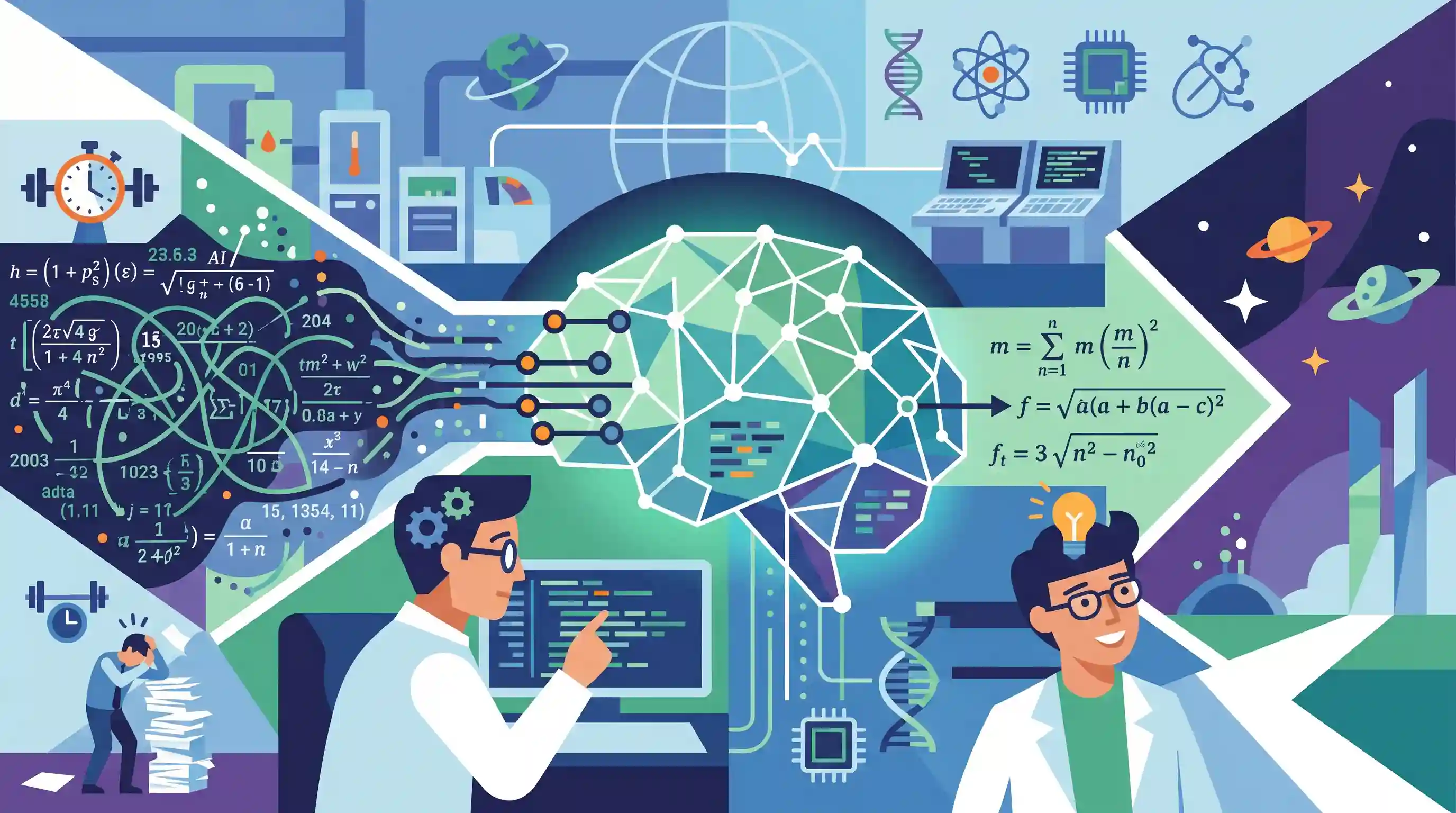
The article highlights how physicists utilized OpenAI's ChatGPT to solve a complex and computationally tedious problem in physics. This collaboration between human researchers and Artificial Intelligence underscores a significant shift in scientific methodology, where Large Language Models (LLMs) and Generative AI are employed as active research tools. By automating intricate mathematical processes and routine analytical tasks, AI allows scientists to allocate more time to theoretical and conceptual breakthroughs. This demonstrates the expanding footprint of AI applications beyond basic text generation into rigorous STEM research, a key development in the evolving landscape of global science and technology.
Key Points
- Generative AI and Large Language Models (LLMs) like ChatGPT are increasingly being utilized as collaborative tools in fundamental scientific research.
- Researchers successfully used ChatGPT to assist in solving a tedious and complex physics problem, showcasing its utility in rigorous analytical tasks.
- The integration of AI in physics and mathematics helps automate routine, time-consuming calculations, allowing scientists to focus on higher-level conceptual innovation.
- This development highlights the expanding role of artificial intelligence in STEM fields, moving beyond natural language processing into mathematical modeling and computational sciences.
Important Terms
OpenAI

A US-based artificial intelligence research organization (founded as a non-profit) responsible for developing influential models like ChatGPT and GPT-4.
UPSC context
GS Paper 3 (Science & Technology): Role of private global entities in driving AI innovation and ethical standards.
Generative AI
AI models capable of creating original content—including text, images, and code—by identifying patterns in massive training datasets.
UPSC context
GS Paper 3 (Science & Technology): Developments and their applications/effects in everyday life and industry.
Large Language Models (LLMs)
Advanced AI programs trained on enormous corpora of text to recognize, summarize, translate, and generate human-like content across various domains.
UPSC context
GS Paper 3 (IT & Computers): Foundational technology for modern AI; tests understanding of automation and technological shifts.
STEM Research
The collective fields of Science, Technology, Engineering, and Mathematics, where AI is increasingly used to automate data analysis and complex simulations.
UPSC context
GS Paper 3 (S&T): Research & Development (R&D) and advancements in fundamental sciences and digital literacy.
Scattering Amplitudes
Mathematical quantities used in particle physics to calculate the probability of specific outcomes when subatomic particles, like gluons, collide.
UPSC context
GS Paper 3 (S&T): Scientific breakthroughs and the application of computational tools in fundamental physics research.
Gluons
Elementary particles that act as exchange particles for the strong nuclear force, binding quarks together inside protons and neutrons.
UPSC context
GS Paper 3 (Science): Awareness of basic particle physics and the fundamental forces of nature.
Prelims Trap
Transformer neural networks process data sequentially, making them fundamentally slower than traditional recurrent neural networks (RNNs).
Transformers process data in parallel using 'self-attention' mechanisms, unlike traditional RNNs which process sequentially. This parallelization enables handling massive unstructured datasets efficiently.
Static Concepts Connected
What differentiates Generative AI from traditional Artificial Intelligence?
- Traditional AI: Focuses on analyzing existing data to recognize patterns, make predictions, or classify information (e.g., spam filters or recommendation engines).
- Generative AI: Creates novel outputs like text, images, or mathematical code using foundation models pre-trained on massive unstructured datasets.
- Key architectures: Relies heavily on advanced deep learning networks like Transformers, Generative Adversarial Networks (GANs), and Variational Autoencoders (VAEs).
How do Large Language Models (LLMs) understand and generate context?
- Transformer architecture: LLMs are built on deep learning models that process input data (like text) into numerical representations called embeddings.
- Self-attention mechanism: They weigh the importance of all words in a sequence simultaneously, rather than one-by-one, to capture deep contextual relationships and dependencies.
- Token prediction: Input text is broken into 'tokens', which the model analyzes to probabilistically predict and generate the next logical token in a sequence.
Cross-Topic Patterns
AI inventorship and IPR regimes
As AI accelerates STEM research, traditional patent laws face challenges. The Indian Patents Act currently assumes a human inventor, complicating intellectual property rights for AI-assisted scientific breakthroughs.
AI workloads and Supercomputing Mission
Training massive LLMs demands immense computational power. This ties India's AI innovation directly to indigenous hardware capacity building under the National Supercomputing Mission (NSM) and the IndiaAI Mission.

Expect a 2026 Prelims question contrasting 'Transformer' architectures with traditional neural networks, focusing on 'self-attention'.
Linked PYQs · 3
Linked PYQs · 3
- 2020PrelimsGS1
With the present state of development, Artificial Intelligence can effectively do which of the following? 1. Bring down electricity consumption in industrial units 2. Create meaningful short stories and songs 3. Disease diagnosis 4. Text-to-Speech Conversion 5. Wireless transmission of electrical energy Select the correct answer using the code given below:
- 2023MainsGS3
Introduce the concept of Artificial Intelligence (AI). How does Al help clinical diagnosis? Do you perceive any threat to privacy of the individual in the use of Al in healthcare?
- 2025PrelimsGS1
Consider the following statements: I. It is expected that Majorana 1 chip will enable quantum computing. II. Majorana 1 chip has been introduced by Amazon Web Services (AWS). III. Deep learning is a subset of machine learning. Which of the statements given above are correct?
