OpenAI Launches Advanced GPT Model With Adaptive Reasoning
Source:The Hindu ↗
Why It Matters
The continuous evolution of generative AI, particularly advancements like 'adaptive reasoning', presents significant implications for technological capabilities, workforce automation, and regulatory frameworks. Understanding these developments is essential for analyzing the applications and challenges of Artificial Intelligence under the GS-3 syllabus.
Summary
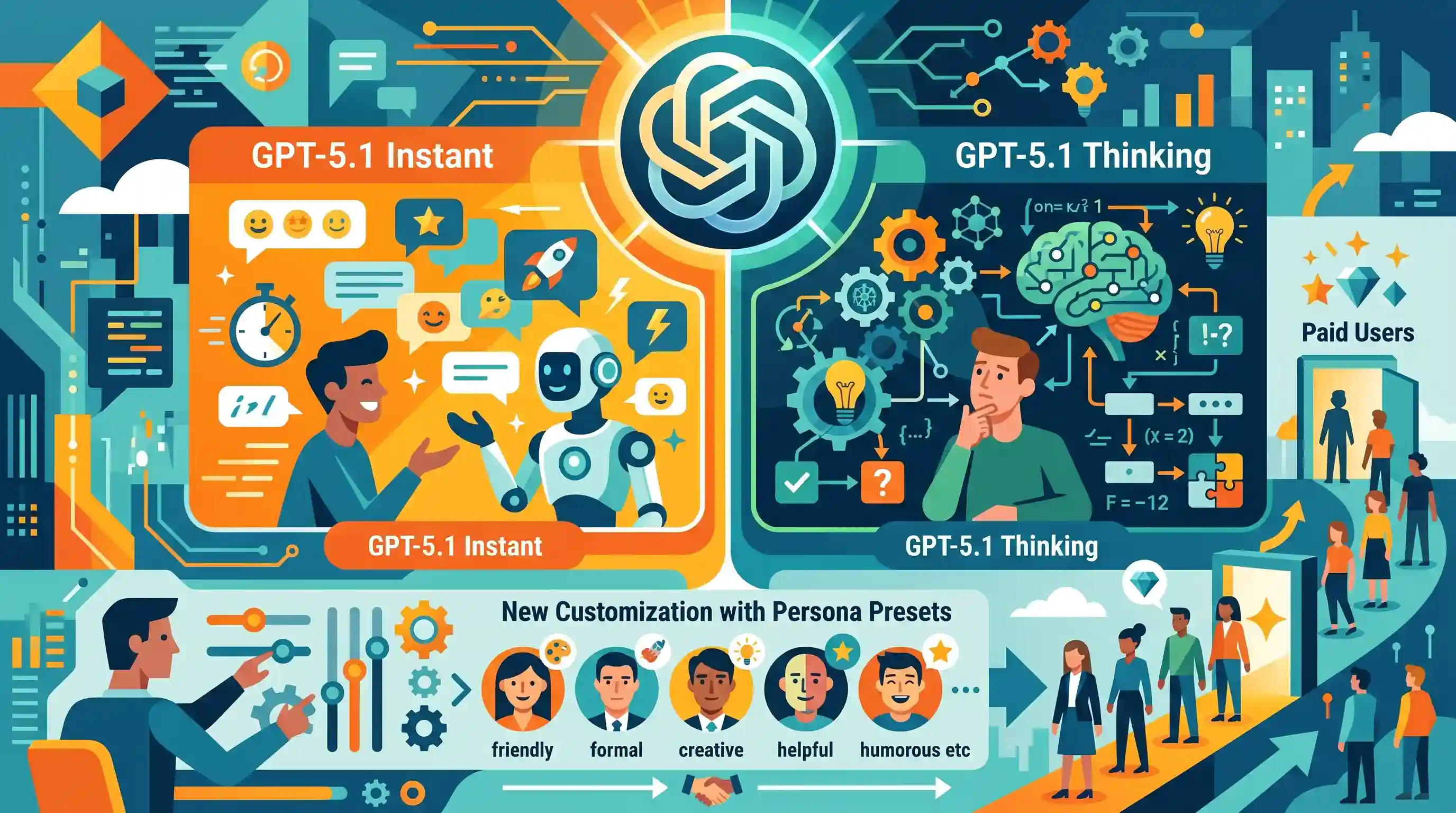
OpenAI has launched GPT-5.1, its most advanced AI model to date, introducing two distinct variants: GPT-5.1 Instant for engaging conversational interactions, and GPT-5.1 Thinking, which employs adaptive reasoning to tackle complex tasks. The update also brings new customization options through persona presets, allowing users to tailor the AI's tone. The rollout will begin with paid users, marking a significant evolution in generative AI capabilities.
Key Points
- OpenAI has launched the GPT-5.1 model series, comprising two main versions: GPT-5.1 Instant and GPT-5.1 Thinking.
- GPT-5.1 Instant is designed to be warmer and more conversational, while GPT-5.1 Thinking focuses on efficiency, clarity, and solving complex problems.
- A key feature is 'adaptive reasoning', allowing the model to dynamically decide when to 'think' or evaluate longer before responding to difficult prompts.
- Users can customize their AI experience using preset personas: Default, Friendly, Efficient, Professional, Candid, and Quirky.
- The rollout prioritizes paid subscribers (Plus, Pro, Team), with legacy models retained for three months to ease transition.
Important Terms
Generative AI

AI systems capable of creating original content—including text, images, and code—by learning statistical patterns from vast datasets rather than just categorizing existing information.
UPSC context
GS III - Science & Technology; fundamental for understanding digital transformation, automation risks, and the IndiaAI Mission.
Large Language Models (LLMs)
Sophisticated AI models trained on massive corpora to understand, summarize, and generate human-like text by predicting the next token in a sequence.
UPSC context
GS III - Science & Technology; core technology behind chatbots and search engines; relevant for data sovereignty debates.
Adaptive Reasoning
A feature in advanced models like GPT-5.1 that allows the AI to dynamically adjust its reasoning depth/complexity based on the prompt's difficulty.
UPSC context
GS III - Science & Technology; marks the evolution from simple pattern matching to multi-step logical inference.
OpenAI
A prominent AI research organization and developer of the GPT series, initially founded as a non-profit to develop safe Artificial General Intelligence (AGI).
UPSC context
GS III - S&T / International Relations; highlights private sector roles in global tech governance and standards.
Generative Pre-trained Transformer (GPT)
A neural network architecture that uses 'self-attention' mechanisms to process data sequences, serving as the foundational framework for modern LLMs.
UPSC context
GS III - Science & Technology; essential technical concept for understanding how contemporary software and AI are built.
Hallucination
The phenomenon where an AI model generates confident but factually incorrect, nonsensical, or deceptive information.
UPSC context
GS IV - Ethics / GS III - S&T; a major hurdle in AI reliability, safety, and misinformation management.
Prelims Trap
Adaptive reasoning enables LLMs to achieve Artificial General Intelligence (AGI) and conscious thought.
Adaptive reasoning simply means the model dynamically allocates more computational time for complex prompts. It relies on mathematical probability, not self-awareness or true cognition.
Static Concepts Connected
How does Generative AI differ from Predictive (Traditional) AI?
- Generative AI: Creates new, original content (text, images, audio) based on learned patterns using architectures like LLMs or GANs.
- Predictive AI: Analyzes historical data to forecast outcomes, identify trends, or classify data (e.g., spam filters, weather forecasting).
What is the core architecture behind modern Large Language Models (LLMs)?
- Transformer Architecture: Uses 'attention mechanisms' to process entire sequences of data simultaneously, weighting the context of different words.
- Deep Learning: Relies on artificial neural networks with multiple layers to process massive datasets and recognize complex text patterns.
Cross-Topic Patterns
Custom Personas & AI Ethics
The introduction of human-like persona presets blurs communication boundaries, heightening ethical concerns regarding algorithmic bias, AI alignment, and digital impersonation.
AI Architectures & Knowledge Economy
Splitting models into low-latency (conversational) and high-compute (analytical) variants accelerates automation in critical sectors like clinical diagnosis and financial modeling.

Expect a 2026 Prelims multi-statement question distinguishing Generative AI (LLMs, transformers) from Predictive AI and AGI.
Linked PYQs · 3
Linked PYQs · 3
- 2023MainsGS3
Introduce the concept of Artificial Intelligence (AI). How does Al help clinical diagnosis? Do you perceive any threat to privacy of the individual in the use of Al in healthcare?
- 2020PrelimsGS1
With the present state of development, Artificial Intelligence can effectively do which of the following? 1. Bring down electricity consumption in industrial units 2. Create meaningful short stories and songs 3. Disease diagnosis 4. Text-to-Speech Conversion 5. Wireless transmission of electrical energy Select the correct answer using the code given below:
- 2024PrelimsGS1
Consider the following statements: I. It is expected that Majorana 1 chip will enable quantum computing. II. Majorana 1 chip has been introduced by Amazon Web Services (AWS). III. Deep learning is a subset of machine learning. Which of the statements given above are correct?
