OpenAI Plans Restricted Initial Rollout for Frontier AI Model
Source:Indian Express ↗
Why It Matters
The article demonstrates the evolving regulatory landscape of 'frontier AI,' wherein advanced models are increasingly viewed as strategic national assets requiring governmental oversight. For UPSC aspirants, this highlights the intersection of technological innovation, national security, and state regulation, relevant for questions on AI governance, cybersecurity strategies, and the global geopolitics of emerging technologies.
Summary
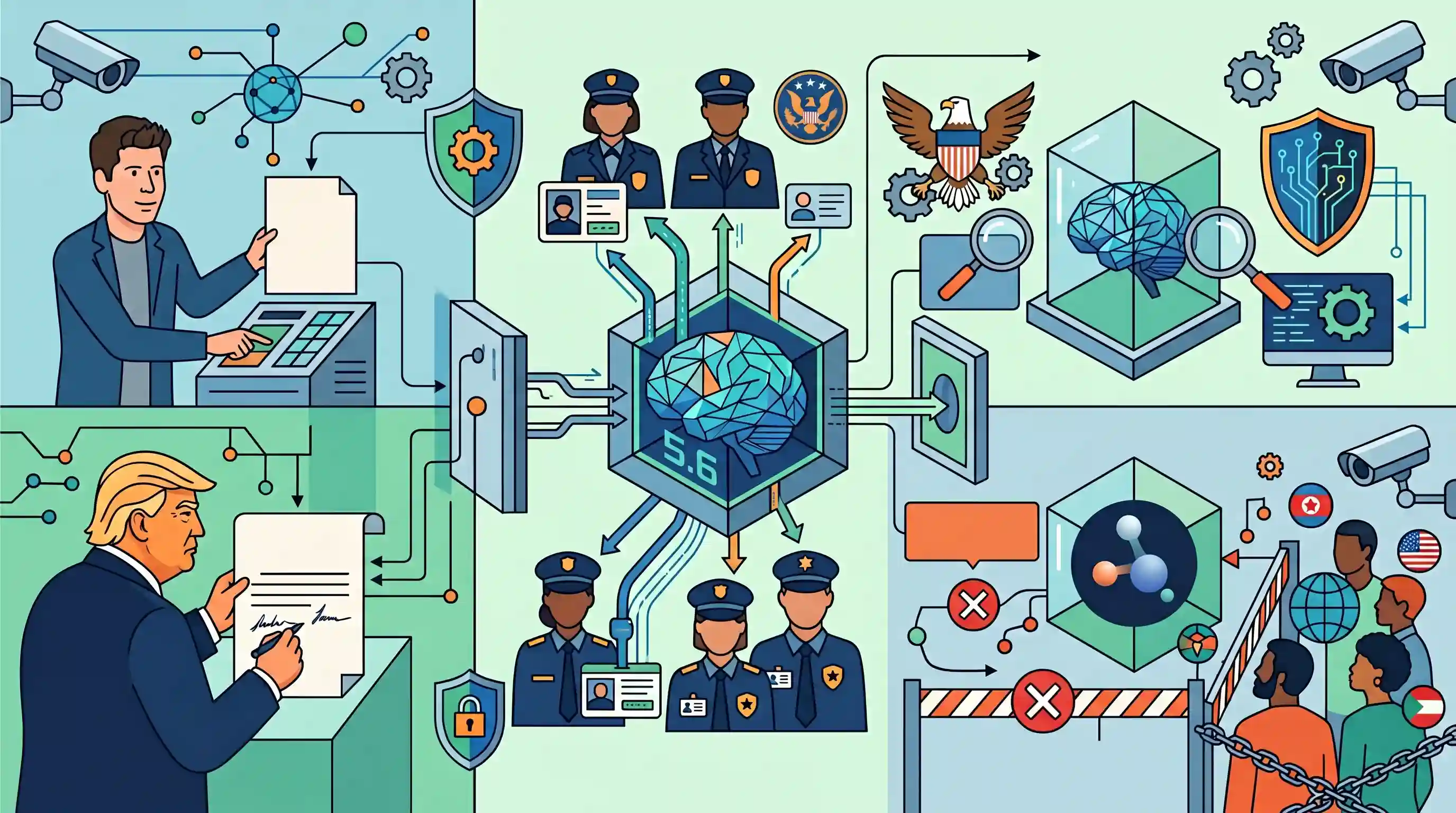
According to reports, OpenAI plans to restrict the initial rollout of its upcoming ChatGPT 5.6 model to a select group of US government-approved customers. Prompted by an internal memo from CEO Sam Altman and aligning with an executive order from Donald Trump, the move facilitates a voluntary federal review of the frontier AI model by agencies like the Department of Commerce and the Office of the National Cyber Director. This targeted deployment, alongside similar access suspensions for foreign nationals by rival firm Anthropic, underscores the growing regulatory scrutiny and national security concerns surrounding advanced artificial intelligence technologies.
Key Points
- OpenAI intends to release its upcoming advanced model, ChatGPT 5.6, to a limited number of US government-approved users prior to a full public launch.
- The limited rollout is structured to comply with a recent executive order by US President Donald Trump, which encourages voluntary federal reviews of frontier AI models.
- Several US federal agencies, including the Office of the National Cyber Director and the Department of Commerce, will participate in assessing the model's capabilities and safety.
- This approach signals a broader industry trend of treating advanced AI as a matter of national security, as seen when rival Anthropic suspended access for foreign nationals due to similar concerns.
Important Terms
Frontier AI Models

High-stakes, highly capable AI systems at the cutting edge of development that pose significant risks to public safety, cybersecurity, and national security due to their advanced reasoning and generative abilities.
UPSC context
GS Paper 3: Science and Technology. Essential for understanding risks, regulatory debates, and international safety norms in emerging tech governance.
Executive Order 14409
A June 2026 presidential directive establishing a framework for voluntary federal review of advanced AI models, requiring developers to provide 30-day early access to government agencies before public release.
UPSC context
GS Paper 2/3: Governance and Cybersecurity. Tests knowledge of international regulatory models and state-led oversight of critical emerging technologies.
Office of Science and Technology Policy (OSTP)
A White House advisory body that provides the President with scientific and technical analysis and coordinates federal science policy, including the development of national AI strategies and safety standards.
UPSC context
GS Paper 2: Governance/Institutions. Relevant for comparing institutional mechanisms for science policy and emerging technology oversight between the US and India.
Office of the National Cyber Director (ONCD)
A federal agency that advises the U.S. President on cybersecurity strategy and coordinates the implementation of national cyber policies, focusing on deterring malicious activity and securing emerging technologies.
UPSC context
GS Paper 3: Internal Security. Important for studying institutional frameworks for cyber defense and technology-led national security strategies.
US Department of Commerce
The executive department responsible for promoting economic growth and innovation; its agencies, like NIST, manage the AI Safety Institute and enforce export controls on sensitive technologies.
UPSC context
GS Paper 3/2: Economy and IR. Tests understanding of how trade, innovation, and national security intersect in global technology supply chains.
Anthropic
An American AI safety and research company known for its "Claude" models, emphasizing 'constitutional AI' and subject to recent federal directives limiting model access to foreign nationals.
UPSC context
GS Paper 3: Science and Technology. Represents the 'safety-first' approach in the AI industry and the impact of geopolitics on tech firms.
Prelims Trap
The United States regulates artificial intelligence through a statutory, risk-based legislative framework.
The US relies on voluntary federal reviews and executive orders (an innovation-first approach), unlike the European Union's legally binding, statutory risk-based AI Act.
Static Concepts Connected
What are 'Frontier AI' models in the context of emerging tech?
- Definition: Highly advanced, large-scale foundational models (like GPT-4 or ChatGPT 5.6) exhibiting emergent abilities to perform complex, autonomous tasks.
- Dual-Use Nature: They possess capabilities that can be utilized for both civilian innovation and malicious applications (e.g., automated cyberattacks or bio-weapon design).
- Governance Challenge: Their unpredictable capabilities make traditional ex-post regulation ineffective, necessitating pre-deployment safety evaluations by national security agencies.
What are the three distinct global approaches to AI governance?
- European Union: Employs the 'AI Act', a statutory, tiered risk-based legislative framework imposing strict legal obligations on high-risk models.
- United States: Favors an innovation-led approach utilizing executive orders, voluntary safety reviews, and sector-specific guidelines rather than blanket legislation.
- India: Adopts a hybrid, use-case driven advisory framework while heavily investing in indigenous 'Sovereign AI' capacity via the IndiaAI Mission.
Cross-Topic Patterns
AI Techno-nationalism & Tech Export Controls
Restricting AI access mirrors US policies on semiconductor export bans to China, transforming computational power into a strategic sovereign asset rather than an open global public good.
Dual-Use Tech & Cybersecurity Threats
Frontier AI's automated reasoning accelerates both defensive cyber-auditing and offensive malware generation, pulling AI policy directly into the GS3 Internal Security and cyber warfare syllabus.

Expect a 2026 multi-statement prelims question contrasting the EU's statutory AI Act, US voluntary reviews, and India's Sovereign AI.
Linked PYQs · 3
Linked PYQs · 3
- 2023MainsGS3
Introduce the concept of Artificial Intelligence (AI). How does Al help clinical diagnosis? Do you perceive any threat to privacy of the individual in the use of Al in healthcare?
- 2020PrelimsGS1
With the present state of development, Artificial Intelligence can effectively do which of the following? 1. Bring down electricity consumption in industrial units 2. Create meaningful short stories and songs 3. Disease diagnosis 4. Text-to-Speech Conversion 5. Wireless transmission of electrical energy Select the correct answer using the code given below:
- 2022MainsGS3
What are the different elements of cyber security ? Keeping in view the challenges in cyber security, examine the extent to which India has successfully developed a comprehensive National Cyber Security Strategy.
