Uttarakhand directs officials to ensure smooth Char Dham Yatra
Source:india-com ↗
Why It Matters
Religious tourism and the cultural geography of pilgrimage shrines (such as the Char Dham, Panch Prayags like Karnaprayag, and state-specific Sikh sites like Hemkund, Reetha Sahib, and Nanakmatta) are major recurring themes in the UKPSC PCS Prelims General Studies Paper.
Summary
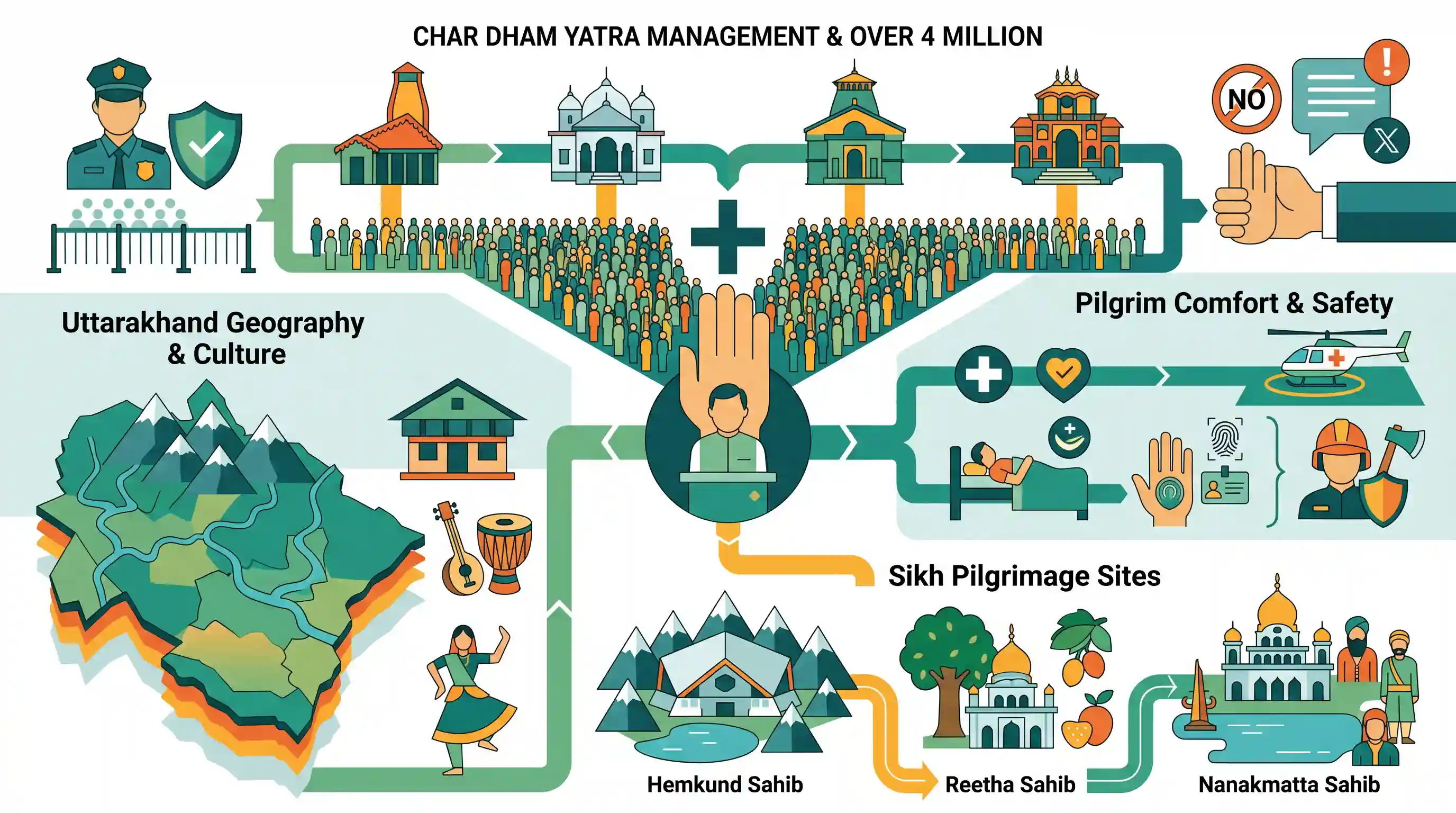
Chief Minister Pushkar Singh Dhami directed officials to ensure pilgrim comfort and safety during the Char Dham and Hemkund Sahib Yatras in Uttarakhand. Highlighting that over 4 million tourists visited the Char Dham shrines this year, the CM emphasized maintaining law and order, countering social media rumors (citing incidents in Karnaprayag and Nagarasu), and showcasing Uttarakhand's heritage, including the three key Sikh pilgrimage sites—Hemkund Sahib, Reetha Sahib, and Nanakmatta Sahib.
Key Points
- Over 4 million pilgrims visited the Char Dham shrines in Uttarakhand so far in 2026.
- During the initial phase of the Hemkund Sahib Yatra, the number of pilgrims was 25,000 higher than the corresponding period last year.
- Uttarakhand houses three major sacred Sikh sites established by Sikh Gurus: Hemkund Sahib (Chamoli district), Reetha Sahib (Champawat district), and Nanakmatta Sahib (Udham Singh Nagar district).
- Chief Minister Pushkar Singh Dhami warned against elements spreading malicious rumors on social media to disrupt communal harmony, referencing recent incidents in Karnaprayag and Nagarasu.
- Key administration heads, including BKTC Chairman Hemant Dwivedi and Hemkund Sahib Management Trust Chairman Narendrajit Singh Bindra, attended the high-level coordination meeting.
Important Terms
Char Dham Yatra

A revered Hindu pilgrimage circuit in the Garhwal Himalayas of Uttarakhand, comprising four sacred high-altitude shrines: Yamunotri, Gangotri, Kedarnath, and Badrinath.
UPSC context
GS Paper I (Art & Culture, Himalayan Geography) and GS Paper III (Infrastructure and Disaster Management in fragile ecosystems).
Hemkund Sahib Yatra
An annual high-altitude Sikh pilgrimage to Gurdwara Sri Hemkund Sahib, situated beside a glacial lake in Uttarakhand's Chamoli district, dedicated to the tenth Guru, Gobind Singh.
UPSC context
GS Paper I (Sikh Heritage and Cultural Geography) and GS Paper III (Tourism Management and high-altitude safety).
Badrinath-Kedarnath Temple Committee
A statutory body established under a 1939 Act to administer, fund, and manage the rituals, infrastructure, and security of the Badrinath and Kedarnath temples, alongside 45 subordinate shrines.
UPSC context
GS Paper II (Statutory Bodies, Governance, and Freedom of Religion) and GS Paper I (Temple Architecture and Cultural Management).
Hemkund Sahib Management Trust
The primary administrative body responsible for organizing infrastructure, lodging, security, and free community kitchens (langar) along the challenging trek to the high-altitude Sikh shrine in Uttarakhand.
UPSC context
GS Paper II (Governance of Religious/Charitable Trusts) and GS Paper III (Ecotourism and High-Altitude Disaster Preparedness).
Prelims Trap
The Chief Priests (Rawal) of both Badrinath and Kedarnath must be native Garhwali Brahmins to preserve local Himalayan temple customs.
Actually, Badrinath's Chief Priest must be a Nambudiri Brahmin from Kerala, and Kedarnath's belongs to the Veerashaiva (Lingayat) community of Karnataka, demonstrating pan-Indian cultural integration.
Static Concepts Connected
What are the key geographic and cultural features of Uttarakhand's three major Sikh shrines?
- Hemkund Sahib: Located in Chamoli at 15,000+ feet, next to a glacial lake fed by Sapt Shring and Hathi Parvat peaks, draining into Laxman Ganga.
- Nanakmatta Sahib: Located in Udham Singh Nagar; historically called 'Gorakhmata', marks Guru Nanak's debates and syncretism with local Nath Yogis.
- Reetha Sahib: Located in Champawat district, Kumaon; adjoins the Dhernath Temple, signifying ancient cultural dialogue between early Gurus and Nath ascetics.
What is the historical administration and priestly tradition of the Badrinath and Kedarnath temples?
- Statutory Framework: Governed by the Badrinath-Kedarnath Temple Committee (BKTC), established under the UP Shri Badrinath and Shri Kedarnath Temples Act, 1939.
- Badrinath Priest: The Chief Priest (Rawal) must be a Nambudiri Brahmin from Kerala, a tradition tracing back to Adi Shankaracharya's pan-Indian synthesis.
- Kedarnath Priest: The Rawal must belong to the Veerashaiva (Lingayat) community from Karnataka, highlighting historic southern links to northern Shiva worship.
Cross-Topic Patterns
Sikhism + Nath Siddha syncretism
The evolution of Gorakhmata into Nanakmatta illustrates medieval philosophical dialogues and spatial transitions between early Sikh Gurus and Nath panthic yogis in northern India.
Pilgrimage + Himalayan carrying capacity
Surging footfalls at fragile glacial shrines like Hemkund Sahib (15,000 ft) highlight the ecological trade-offs between spiritual tourism and waste/landslide management in the Western Himalayas.

Statements testing the geographic locations and historical Nath-Sikh syncretism of Nanakmatta and Reetha Sahib are highly likely in GS-1.
Linked PYQs · 2
Linked PYQs · 2
- 2016UKPSC_PRELIMSGS1
Which one of the following shrines of Uttarakhand was visited by maximum number of tourists in the year 2015?
- 2024UKPSC_PRELIMSGS1
Hindu religious pilgrimage place named 'Purnagiri' is situated in which of the following districts of Uttarakhand ?
