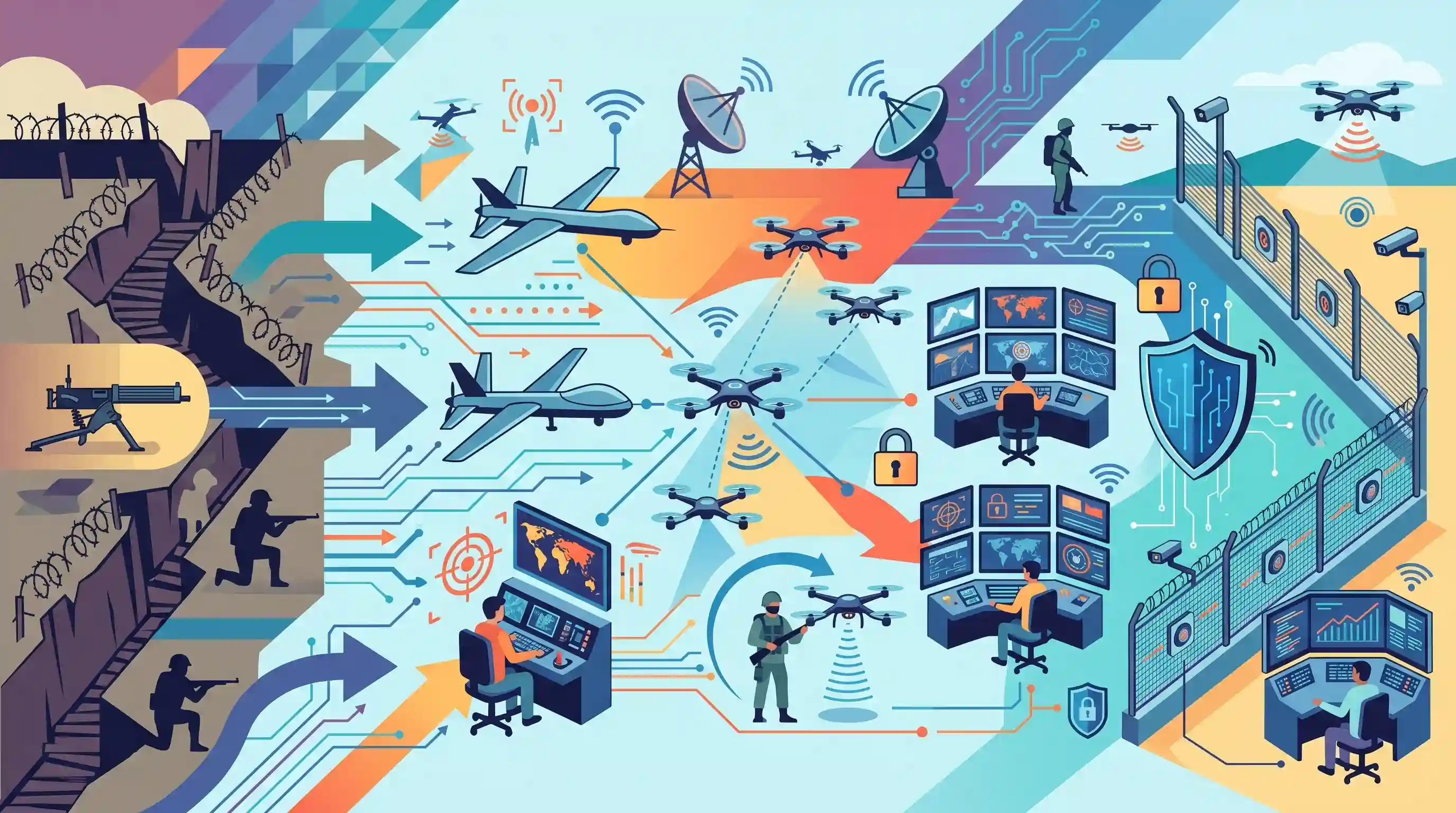
Evolution of Military Technology and Asymmetric Warfare Dynamics
Source:Indian Express ↗
Why It Matters
Highlights the critical shift in warfare from conventional military engagements to the use of autonomous and remote technologies (like drones), presenting new challenges for India's defense modernization and border management strategies against asymmetric threats.
Summary
The nature of warfare has continuously evolved with technological advancements, fundamentally transforming the "geometries of the battlefield." From the introduction of machine guns and trench warfare in World War I to the widespread deployment of Unmanned Aerial Vehicles (UAVs) and drones in contemporary conflicts like the Russia-Ukraine war, military strategy has dramatically shifted. Modern combat increasingly relies on asymmetric tactics, autonomous weapons, and remote-controlled technologies to gather intelligence, target adversaries, and minimize personnel casualties. This transition from conventional, static frontlines to dynamic, technology-driven warfare redefines global combat paradigms and introduces complex new challenges for national and border security architectures.
Key Points
- The evolution of military technology continuously redefines the spatial dynamics and strategies of warfare, often referred to as the 'geometries of the battlefield'.
- World War I marked a significant shift with the introduction of machine guns and trench warfare, leading to static, attritional combat.
- Contemporary conflicts, notably the Russia-Ukraine war, demonstrate a profound shift towards the use of Unmanned Aerial Vehicles (UAVs) and autonomous systems.
- Drones provide asymmetric advantages by enabling cost-effective reconnaissance, real-time intelligence, and precision strikes without risking human personnel.
- The proliferation of drone technology presents new security challenges for nations, necessitating updated strategies for border management, internal security, and air defense.
Prelims Trap
"All Unmanned Aerial Vehicles (UAVs) are inherently capable of vertical take-off, landing, and hovering."
Fixed-wing UAVs rely on aerodynamics similar to traditional airplanes. They require continuous forward motion to generate lift and cannot hover or land vertically.
Static Concepts Connected
What are the two main approaches of Counter-Unmanned Aircraft Systems (C-UAS)?
- Soft Kill: Disrupts the drone's control links and navigation through GPS spoofing, radio frequency (RF) jamming, or cyber interception without physical damage.
- Hard Kill: Involves the physical destruction of the rogue drone using kinetic projectiles, net-guns, or Directed Energy Weapons (DEWs) like DRDO's ADITYA laser.
How do drones create asymmetric threats to border management?
- Radar evasion: Small commercial quadcopters fly below conventional radar line-of-sight, evading standard border detection grids.
- Payload delivery: They facilitate low-risk, cross-border smuggling of narcotics, counterfeit currency, and small arms by non-state actors, notably in Punjab and J&K.
- Cost asymmetry: Cheap, highly accessible commercial drones force state security forces to deploy disproportionately expensive counter-measures.
Cross-Topic Patterns
Drones + Golden Crescent smuggling
The influx of drone-dropped narcotics in Punjab links modern C-UAS requirements directly to India's traditional internal security vulnerabilities along the Golden Crescent route.
Autonomous Weapons & AI Ethics
The transition from human-piloted drones to AI-driven Lethal Autonomous Weapon Systems (LAWS) triggers GS4 debates on AI ethics, accountability, and international humanitarian law.

Expect a 2026 Prelims tech question distinguishing 'Soft Kill' (RF jamming) vs 'Hard Kill' (Directed Energy Weapons) counter-drone systems.
Linked PYQs · 2
Linked PYQs · 2
- 2025PrelimsGS1
With reference to Unmanned Aerial Vehicles (UAVs), consider the following statements : I. All types of UAVs can do vertical landing. II. All types of UAVs can do automated hovering. III. All types of UAVs can use battery only as a source of power supply. How many of the statements given above are correct?
- 2023MainsGS3
The use of unmanned aerial vehicles (UAVs) by our adversaries across the borders to ferry arms/ammunitions, drugs, etc., is a serious threat to the internal security. Comment on the measures being taken to tackle this threat.
