Geopolitical Vulnerabilities in Strait of Hormuz
Source:The Hindu ↗
Why It Matters
The Strait of Hormuz is one of the world's most critical maritime choke points. Understanding India's energy dependency and strategic vulnerabilities in this region is essential for answering questions on India's foreign policy (GS2) and energy security/infrastructure (GS3).
Summary
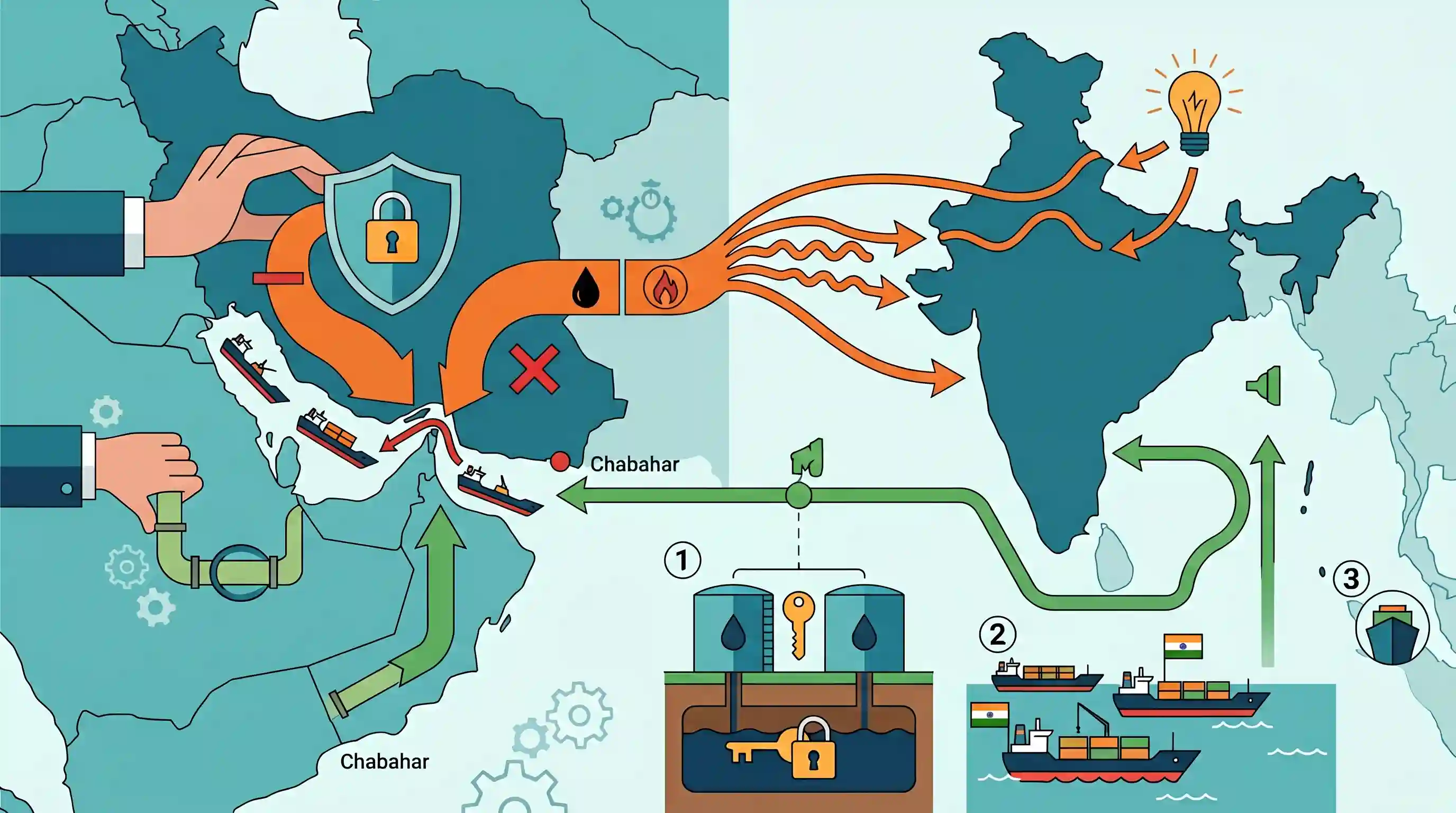
The editorial analyzes the changed geopolitical realities in the Middle East, particularly Iran's renewed leverage over the Strait of Hormuz through a newly established 'Persian Gulf Strait Authority'. It warns that India's heavy reliance on this maritime choke point for energy imports, especially LPG and crude oil, leaves it severely vulnerable to supply disruptions. Highlighting the lack of a credible contingency plan, the article urges India to develop strategic storage, expand its domestic merchant fleet, and invest in alternative trade routes like the Chabahar port, drawing inspiration from the UAE's 'zero Hormuz dependency' strategy.
Key Points
- Recent conflicts in the Middle East have underscored the vulnerability of global trade and energy flows through the Strait of Hormuz.
- Iran has asserted its control over the strait by establishing a formal 'Persian Gulf Strait Authority', compelling shipping companies to treat it as a decisive stakeholder.
- India relies heavily on the Strait of Hormuz for crude oil and LPG imports, yet lacks an adequate contingency plan, substantial cavern storage, or a large fleet of Indian-flagged vessels.
- In contrast, the UAE is proactively pursuing a 'zero Hormuz dependency' strategy by building alternative transport infrastructure.
- To safeguard its energy security, India must diversify its supply chains, develop strategic reserves, and invest in alternative land and maritime corridors such as the Chabahar port.
Important Terms
Persian Gulf Strait Authority (PGSA)

An Iranian government agency established in 2026 to regulate, coordinate, and authorize maritime transit through the Strait of Hormuz, institutionalizing Iranian control over the waterway.
UPSC context
GS Paper II: International Relations/Regional Security. Tests understanding of maritime sovereignty, regional hegemony, and impacts on global trade.
Strait of Hormuz
A narrow maritime passage between Iran and Oman connecting the Persian Gulf to the Gulf of Oman; a critical global energy conduit for oil and LNG.
UPSC context
GS Paper I/II: Geography/International Relations. Vital for mapping and analyzing India's energy dependency and West Asia diplomacy.
Maritime Choke Points
Narrow geographical passages like straits or canals where high volumes of global shipping are concentrated, making them vulnerable to military blockades and trade disruptions.
UPSC context
GS Paper III: Security/Economy. Tests knowledge of supply chain resilience and strategic bottlenecks in international maritime routes.
Chabahar Port
An Iranian deep-water port on the Gulf of Oman, bypassing the Strait of Hormuz, developed by India to access Afghanistan and Central Asia.
UPSC context
GS Paper II: Bilateral Relations. Crucial for India's 'Connect Central Asia' policy and strategic alternative to the Pakistan-China Gwadar link.
Zero Hormuz Dependency Strategy
The UAE’s infrastructure strategy to bypass the Strait of Hormuz for oil exports using alternative routes like the Habshan–Fujairah pipeline to the Indian Ocean.
UPSC context
GS Paper III: Energy Security/Infrastructure. Tests ability to compare regional mitigation strategies and energy infrastructure projects.
Merchant Fleet
The domestic shipping capacity owned or flagged by a country; India's relatively small fleet increases reliance on foreign vessels during geopolitical crises.
UPSC context
GS Paper III: Economy/Infrastructure. Relevant for 'Maritime India Vision 2030' and reducing foreign exchange outgo in shipping services.
Strategic Petroleum Reserves (SPR)
Large stockpiles of crude oil maintained by a nation to ensure energy supply during market disruptions or emergencies, typically managed by ISPRL in India.
UPSC context
GS Paper III: Energy Security. Tests knowledge of India's storage capacity (Phase I & II) versus IEA's 90-day benchmark.
Prelims Trap
"Coastal states like Iran have the right to suspend transit passage in the Strait of Hormuz for security reasons under UNCLOS."
UNCLOS guarantees "transit passage" through international straits, which cannot be suspended. Iran's new authority effectively challenges this international law, but it does not have UNCLOS backing to close the strait.
Static Concepts Connected
What are the key maritime chokepoints in the Middle East region?
- Strait of Hormuz: Connects the Persian Gulf to the Gulf of Oman and Arabian Sea. Bordered by Iran, Oman, and the UAE.
- Bab el-Mandeb: Connects the Red Sea to the Gulf of Aden. Bordered by Yemen on the Arabian Peninsula, and Djibouti and Eritrea in the Horn of Africa.
- Suez Canal: An artificial sea-level waterway in Egypt connecting the Mediterranean Sea to the Red Sea, separating the African continent from Asia.
Where are India's Strategic Petroleum Reserves (SPR) located and how are they managed?
- Phase I Locations: Phase I storage facilities are located in Visakhapatnam (AP), Mangaluru (Karnataka), and Padur (Karnataka), with a combined capacity of 5.33 MMT.
- Phase II Expansion: The government has given in-principle approval for two additional commercial-cum-strategic facilities at Chandikhol (Odisha) and Padur (Karnataka).
- Management Agency: Maintained by Indian Strategic Petroleum Reserves Limited (ISPRL), a special purpose vehicle under the Ministry of Petroleum and Natural Gas.
Cross-Topic Patterns
INSTC, IMEC and Hormuz bypass routes
Disruptions in Hormuz and the Red Sea amplify the strategic need for the INSTC (via Chabahar/Iran) and IMEC (via UAE/Saudi) as vital multi-modal supply chain alternatives.
IEA membership and 90-day SPR rule
India's push for full International Energy Agency (IEA) membership requires maintaining strategic reserves equivalent to 90 days of net imports, making the expansion of ISPRL facilities a pressing priority.

A map-based question pairing Middle East chokepoints with bordering states or UNCLOS 'transit passage' rights is highly likely in 2026.
Linked PYQs · 4
Linked PYQs · 4
- 2025MainsGS2
"Energy security constitutes the dominant kingpin of India's foreign policy, and is linked with India's overarching influence in Middle Eastern countries.” How would you integrate energy security with India's foreign policy trajectories in the coming years?
- 2017MainsGS2
The question of India's Energy Security constitutes the most important part of India's economic progress. Analyze India's energy policy cooperation with West Asian countries.
- 2025MainsGS3
Why is maritime security vital to protect India's sea trade? Discuss maritime and coastal security challenges and the way forward.
- 2022MainsGS3
What are the maritime security challenges in India ? Discuss the organisational, technical and procedural initiatives taken to improve the maritime security.
