Ayodhya Ram Temple Trust Introduces New Dress Code for Priests
Source:etvbharat ↗
Why It Matters
The standardization of ritual codes and the active revival of the Ramanandacharya sect's customs at a major national temple illustrates the contemporary relevance of historical Bhakti traditions and temple management, important themes in the UPPSC Prelims Art & Culture syllabus.
Summary
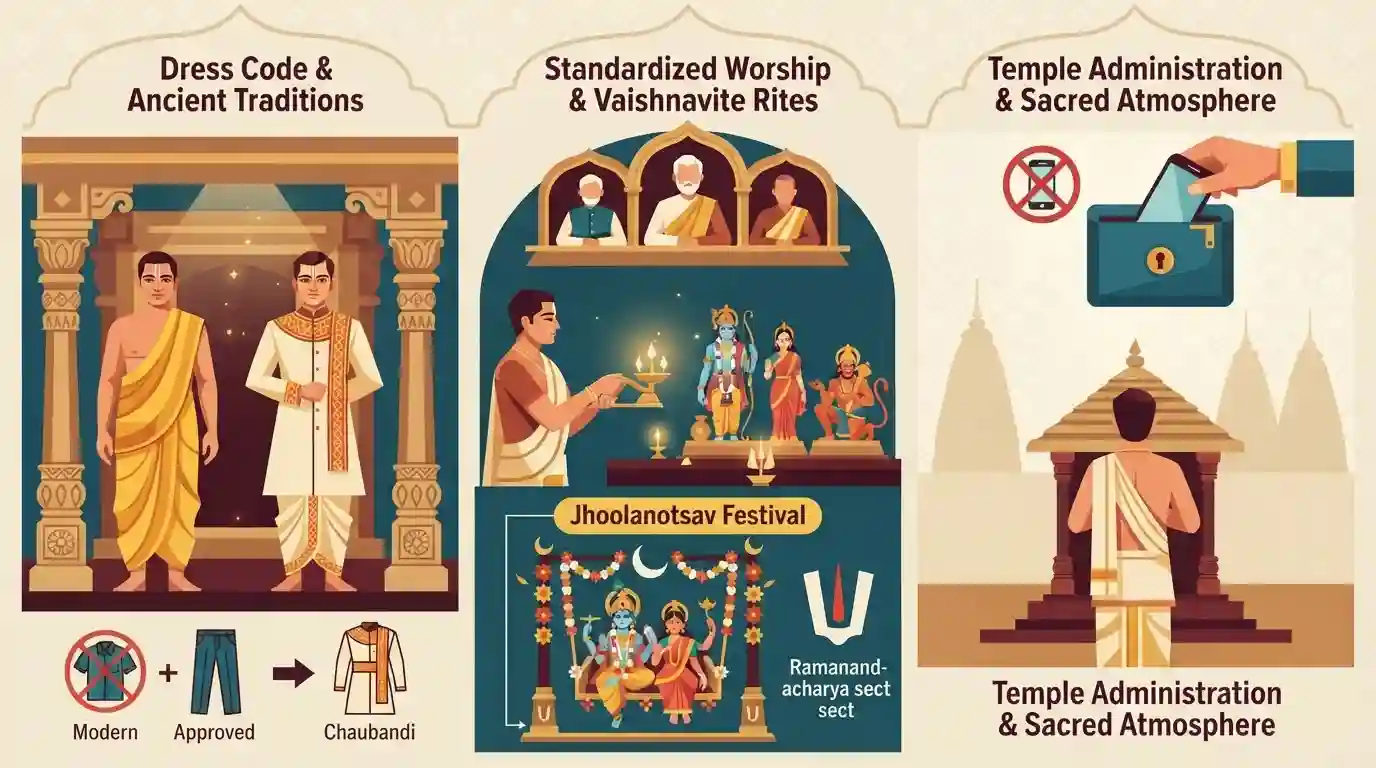
The Shri Ram Janmabhoomi Teerth Kshetra Trust has introduced a strict new dress code and ritual guidelines for priests at the Ayodhya Ram Temple. Aimed at reviving ancient traditions, priests will now wear traditional, unstitched garments like yellow dhotis and Chaubandis inside the sanctum sanctorum. The religious committee is standardizing worship systems based on the Vaishnavite traditions of the Ramanandacharya sect, which also influenced the observance of the traditional Jhoolanotsav festival. Additionally, the use of mobile phones by priests in the temple has been banned to preserve the sacred atmosphere.
Key Points
- The Shri Ram Janmabhoomi Teerth Kshetra Trust implemented a new dress code for the priests of the Ram Temple in Ayodhya.
- Priests entering the sanctum sanctorum must wear unstitched yellow dhotis, matching safas (turbans), and Chaubandis (four-tied wrap blouse), discarding modern stitched clothes.
- The religious committee standardized worship procedures strictly based on the ancient Vaishnavite traditions of the Ramanandacharya sect.
- The traditional Jhoolanotsav festival was observed with specific guidelines reflecting these revived ancient customs.
- The Trust banned the use of mobile phones by priests within the temple premises to maintain sanctity and focus on devotion.
Important Terms
Shri Ram Janmabhoomi Teerth Kshetra Trust

A central government-established trust formed in 2020 following the 2019 Supreme Court Ayodhya verdict. Composed of 15 trustees, it is uniquely mandated to oversee the construction, management, and administrative governance of the Ayodhya Ram Temple.
UPSC context
Relevant to GS Paper 2 (Governance & Trusts) and GS Paper 1 (Culture), testing knowledge of public-religious trusts.
Ramanandi Sampradaya (Ramanandacharya Sect)
The largest Vaishnava ascetic order in North India, founded by 14th-century Bhakti poet-saint Ramananda. Rejecting caste barriers, it emphasizes devotion to Lord Rama and integrates both traditional asceticism and inclusive spiritual equality.
UPSC context
Crucial for GS Paper 1 (Art and Culture - Bhakti Movement), testing the socio-religious impact of medieval saints.
Chaubandi
A traditional, kurta-like Indian wrap blouse secured with four ties or ropes instead of buttons. Mandated alongside yellow dhotis for Ayodhya priests, it represents the preservation of ancient, unstitched sartorial purity in Hindu temple rituals.
UPSC context
Relates to GS Paper 1 (Indian Heritage and Culture), specifically testing traditional Indian textiles, attire, and ritualistic customs.
Jhoolanotsav
A traditional Hindu swing festival celebrated during the monsoon month of Shravan. Deities, particularly Lord Rama and Krishna, are placed on decorated swings (phool banglas), reflecting the playful, devotional aesthetic of the Rasik sect.
UPSC context
Important for GS Paper 1 (Art and Culture), testing knowledge of regional Indian festivals and temple traditions.
Sanctum Sanctorum (Garbhagriha)
The innermost, sacred chamber of a Hindu temple where the primary deity's idol resides. In the Ayodhya Ram Temple, strict traditional norms, including unstitched attire and a ban on mobile phones, govern access to this space.
UPSC context
Relevant to GS Paper 1 (Temple Architecture) testing the structural and ritualistic components of Nagara-style temples.
Prelims Trap
"Saint Ramananda was a Nirguna Bhakti saint who composed his teachings exclusively in Sanskrit."
Ramananda was a Saguna Bhakti saint (worshipping Ram) who pioneered vernacular Hindi. Aspirants confuse his philosophy with his famous disciples (like Kabir) who preached Nirguna Bhakti.
Static Concepts Connected
What were Saint Ramananda's key contributions to the North Indian Bhakti Movement?
- Vernacular Medium: Pioneered preaching in vernacular Hindi rather than Sanskrit, democratizing religious texts and knowledge for the masses.
- Bridging Traditions: Acted as a vital philosophical link, bringing South Indian Vaishnavite traditions (influenced by Ramanuja) to North India.
- Social Inclusivity: Discarded caste restrictions in spiritual initiation, accepting marginalized disciples like Kabir (a weaver) and Ravidas (a cobbler).
What is the architectural significance of the Garbhagriha in Nagara temples?
- Sanctum Sanctorum: Literally meaning "womb-house," it is the innermost, highly sacred sanctum sanctorum designed to house the primary deity.
- Shikhara Alignment: In the Nagara style of North India, the Garbhagriha is invariably situated directly beneath the tallest temple spire (Shikhara).
- Ritual Purity: Kept austere and historically unlit to foster focus, requiring strict purity norms—like unstitched garments—for entering priests.
Cross-Topic Patterns
Temple Trusts & Judicial Mandates
The Teerth Kshetra Trust's statutory-like administration stems directly from the 2019 SC Ayodhya verdict, blending Art & Culture with Polity (Article 142 and state intervention in secular activities of religious places).
Saguna Roots, Nirguna Branches
The Ramanandacharya sect dictates Ayodhya’s orthodox Saguna rituals today, yet historically this exact lineage birthed radical Nirguna saints like Kabir and Ravidas, highlighting the complex evolution of the Bhakti movement.

Expect a 2026 Prelims pairing of North/South Bhakti saints (Ramanuja/Ramananda) focusing on sects and vernacular shifts.
Linked PYQs · 2
Linked PYQs · 2
- 1997UPPSC_PRELIMSGS1
The temples of Bhuvaneshwar and Puri were built in:
- 2015UPPSC_PRELIMSGS1
Famous medieval saint Shankardev belonged to
