Uttarakhand Congress Prepares for 2027 Polls with Yatra Campaign
Source:thehindu ↗
Why It Matters
The article highlights the political division of Uttarakhand's districts (10 hill vs 3 plains), the constitutional reservation of assembly seats (such as Chakrata for STs), and the role of historical regional parties like the UKD, which are frequently asked static and current-affairs areas in the UKPSC PCS Prelims.
Summary
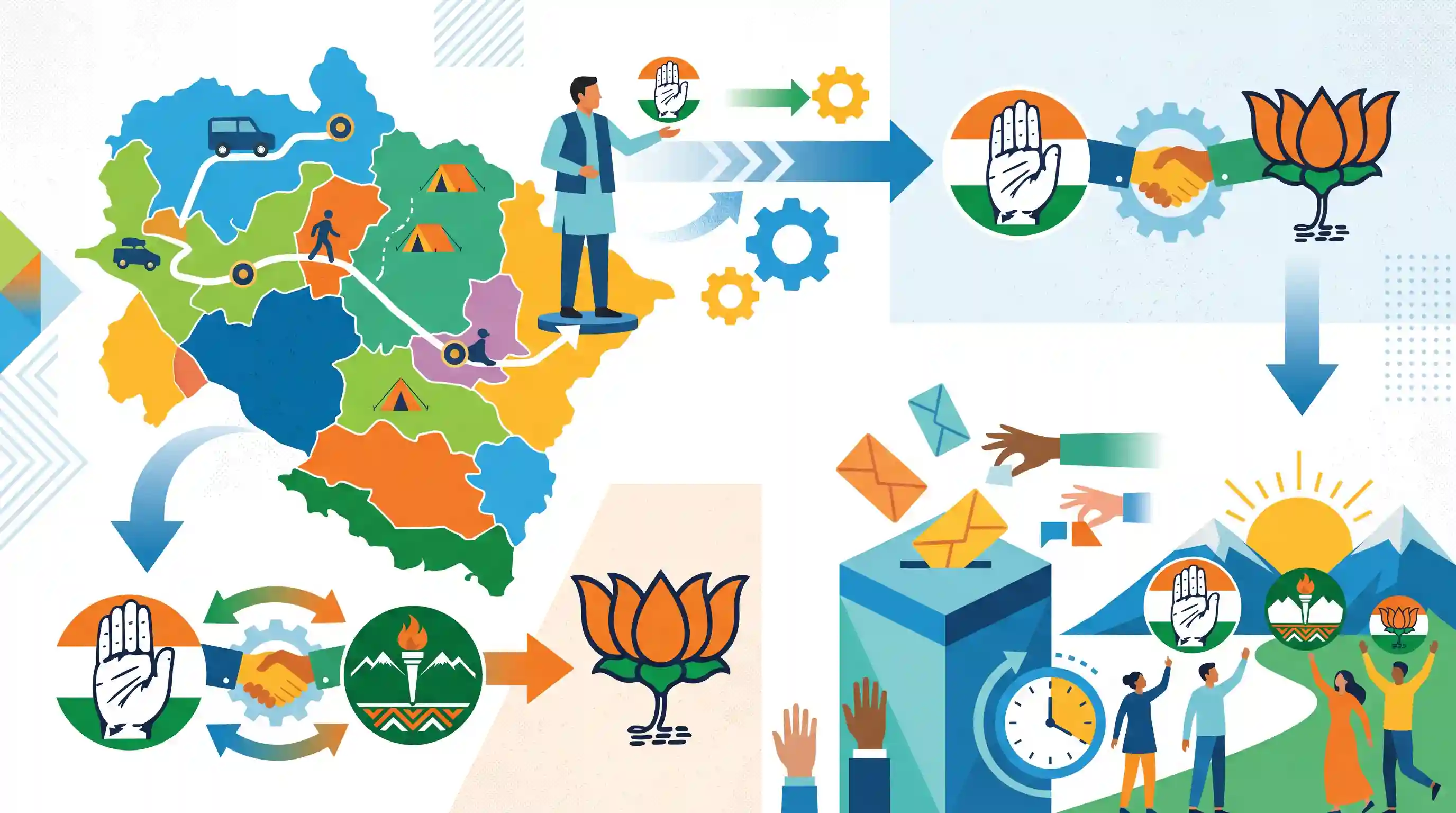
Uttarakhand Congress President Ganesh Godiyal announced that political change is certain in the state after the 2027 Assembly polls as the party concludes the first phase of its 'Parivartan Sankalp Yatra' across the 10 hill districts of the state. He indicated a strong pitch for opposition unity, raising the possibility of an alliance with the regional Uttarakhand Kranti Dal (UKD) to challenge the ruling BJP.
Key Points
- Uttarakhand Congress launched the 'Parivartan Sankalp Yatra' on June 29, 2026, targeting administrative and public issues like unemployment, inflation, and developmental concerns in the hill regions.
- The political campaign is strategically designed to cover Uttarakhand's 10 hill districts first, followed by a second phase covering the 3 plains districts: Dehradun, Haridwar, and Udham Singh Nagar.
- State Congress chief Ganesh Godiyal indicated openness to forming alliances with regional forces like the Uttarakhand Kranti Dal (UKD) and other opposition groups for the 2027 Uttarakhand Assembly elections.
- The UKD holds historical significance in Uttarakhand's polity as the oldest regional party, founded in July 1979 under Dr. D. D. Pant, which spearheaded the struggle for a separate hill state.
- Prominent leader Pritam Singh, who is leading the yatra's campaign committee, is the MLA of Chakrata. Chakrata and Nanakmatta are the only two assembly constituencies in the 70-member Uttarakhand Legislative Assembly reserved for Scheduled Tribes (ST).
Important Terms
104th Constitutional Amendment Act

A constitutional amendment that extended seat reservations for Scheduled Castes and Scheduled Tribes in the Lok Sabha and State Assemblies until 2030, while abolishing the reserved seats nominated for the Anglo-Indian community.
UPSC context
GS Paper II (Polity & Constitution); tests political reservations, minority representation, and constitutional amendment processes.
Uttarakhand Kranti Dal
A regional political party in Uttarakhand founded in 1979, which played a pioneering role in spearheading the statehood movement that led to the creation of Uttarakhand from Uttar Pradesh in 2000.
UPSC context
GS Paper II (Statehood Movements & Regional Parties); tests federalism dynamics and the creation of new states in India.
Parivartan Sankalp Yatra
A state-level public outreach and campaign march organized by the Congress party in Uttarakhand to mobilize voters and address issues like unemployment and inflation ahead of the assembly elections.
UPSC context
GS Paper II (Electoral Politics); tests public mobilization strategies, regional political dynamics, and party campaigns in state elections.
Cabinet Committee on Political Affairs
The most powerful cabinet committee in India, often called the "Super-Cabinet," chaired by the Prime Minister; it deals with domestic and foreign policy matters and Centre-State relations.
UPSC context
GS Paper II (Executive & Cabinet Committees); tests knowledge of executive decision-making organs and central governance structure.
Indian National Congress
India's oldest political party, founded in 1885, which served as the principal vehicle of the Indian independence movement and subsequently became a major centrist force in post-independence democratic politics.
UPSC context
GS Paper I (Modern History) & GS Paper II (Electoral Politics); tests the history of the freedom struggle and party system evolution.
Bharatiya Janata Party
A major right-wing political party in India, founded in 1980, whose political ideology is rooted in Hindutva (cultural nationalism); it currently serves as the primary ruling party at the national level.
UPSC context
GS Paper II (Political Parties & Ideologies); tests comprehension of national party systems, ideologies, and coalition politics.
Prelims Trap
Uttarakhand has parliamentary constituencies reserved for both Scheduled Castes (SC) and Scheduled Tribes (ST) under the current Delimitation Order.
While Uttarakhand reserves 2 assembly seats (Chakrata and Nanakmatta) for Scheduled Tribes, it has zero Lok Sabha seats reserved for STs (only Almora is reserved for SCs). Aspirants often assume assembly reservations mirror proportional parliamentary seat reservations in small states.
Static Concepts Connected
What are the constitutional provisions for reservation of seats for SCs and STs in State Assemblies?
- Article 332: Mandates that seats shall be reserved for the Scheduled Castes and the Scheduled Tribes in the Legislative Assembly of every State.
- Proportionality Rule: The number of reserved seats is determined based on the proportion of the SC/ST population to the total population of the state.
- Delimitation Commission: The actual boundaries and identification of these reserved constituencies are determined by the Delimitation Commission under Article 82.
How does the Constitution of India facilitate the creation of new states?
- Article 3 Power: Empowers Parliament to form new states, alter boundaries, or change names of existing states by passing a law with a simple majority.
- Presidential Referral: The President must refer the bill to the affected state legislature for views within a specified period, though Parliament is not bound by them.
- Article 4 Clarification: Any law made under Article 3 is not deemed to be an amendment of the Constitution for the purposes of Article 368.
Cross-Topic Patterns
Mountain Migration and Himalayan Carrying Capacity
The stark developmental divide between Uttarakhand's hill and plains districts drives out-migration, creating 'ghost villages' that weaken border security and overload the fragile carrying capacity of Himalayan foothills.
Regionalism and the Evolution of Small States
The rise of regional outfits like the UKD demonstrates how sub-regional identity struggles and perceived economic neglect drive the democratic demand for smaller states under Article 3 of the Constitution.

Delimitation patterns, specifically states with ST Assembly reservations but zero ST Lok Sabha seats, are highly likely for Prelims 2026.
Linked PYQs · 4
Linked PYQs · 4
- 2021UKPSC_PRELIMSGS1
The state of Uttarakhand came into existence on which of the following dates ?
- 2021UKPSC_PRELIMSGS1
How many Lok Sabha members are elected from Uttarakhand?
- 2016UKPSC_PRELIMSGS1
How many nominated members are there in the Legislative Assembly of Uttarakhand (2016)?
- 2024UKPSC_PRELIMSGS1
How many of the following women M.L.A.s were there in the first Legislative Assembly of Uttarakhand ?
