Chandrayaan four lunar mission roadmap and space station plans
Source:The Hindu ↗
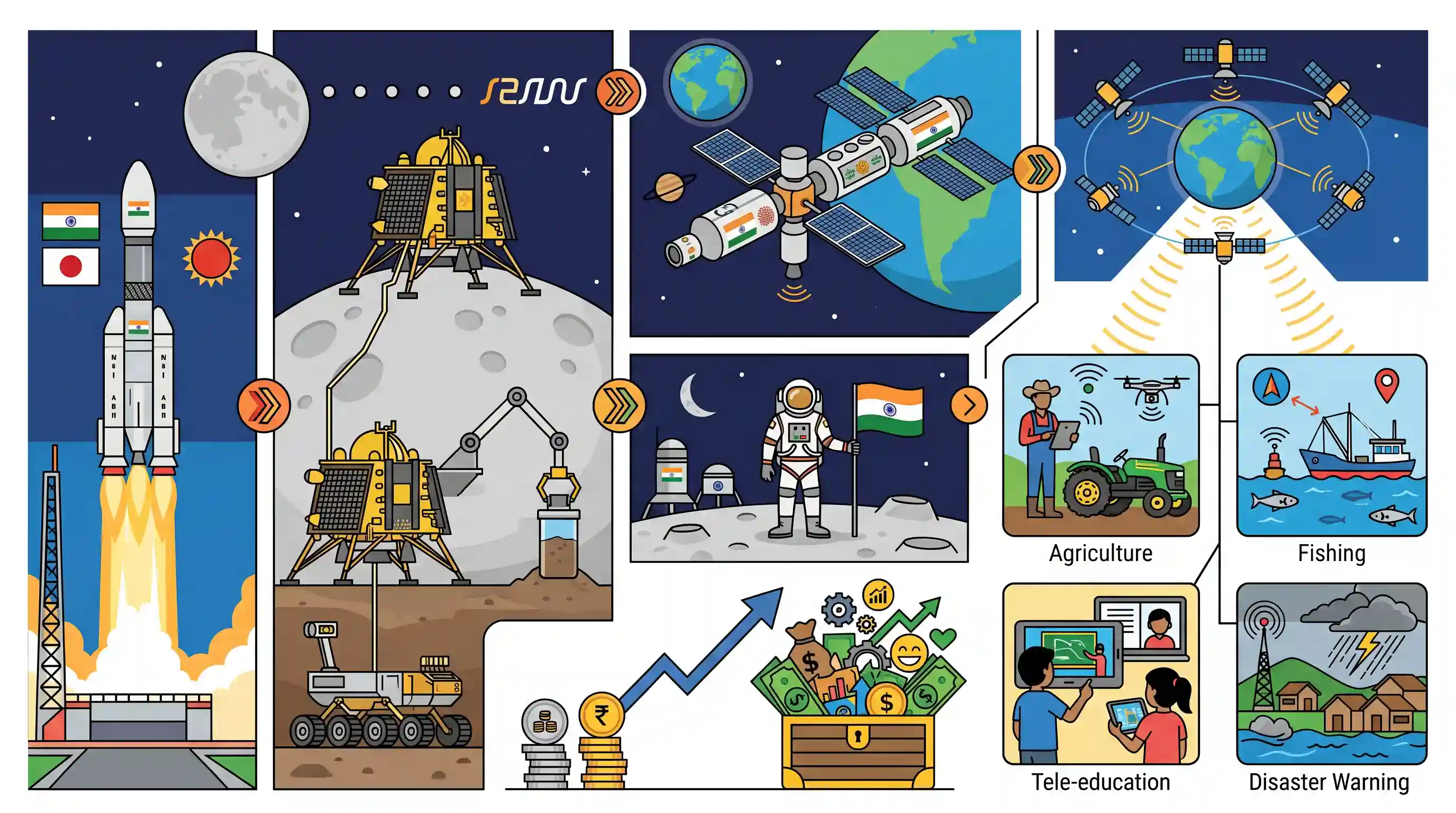
Why It Matters
It maps India\'s future space roadmap (Chandrayaan-4, space station, manned lunar mission) while heavily emphasizing the everyday socio-economic applications of space technology—a recurring and highly emphasized theme in both UPSC Prelims and Mains (e.g., benefits of satellite data for farmers, fishermen, and disaster management).
Summary
ISRO has announced that its upcoming Chandrayaan-4 lunar sample-return mission is slated for a 2028 launch in collaboration with Japan. The ambitious mission will feature a much heavier lander and rover compared to its predecessor. Beyond lunar exploration, ISRO is working towards establishing a 52-tonne indigenous space station by 2035 and aims for a manned moon mission by 2040. The agency also highlighted the tremendous socio-economic dividends of its 57 active satellites, whose applications in agriculture, fishing, tele-education, and disaster warning generate immense national economic value compared to the organization\'s relatively modest budget.
Key Points
- ISRO plans to launch the Chandrayaan-4 mission by 2028 in collaboration with Japan, designed to land on the Moon, collect samples, and return them to Earth.
- The mission represents a massive scale-up, featuring a 6,800 kg lander (compared to Chandrayaan-3\'s 1,600 kg) and a 350 kg rover.
- ISRO is concurrently developing a 52-tonne space station, expected to be operational by 2035, and aims to execute a manned lunar mission by 2040.
- India currently operates 57 satellites that provide crucial everyday socio-economic applications, ranging from disaster management and telemedicine to real-time railway tracking.
- Satellite services for ocean state forecasting identify potential fishing zones, aiding 9 lakh fishermen daily and generating huge economic returns that far exceed ISRO\'s annual budget.
Important Terms
Chandrayaan-4

ISRO’s planned lunar sample-return mission (targeted for 2028) that aims to collect moon rocks and return them to Earth, demonstrating advanced technologies like docking, sample containerization, and ascent from the lunar surface.
UPSC context
GS Paper 3 (Science & Tech); tests knowledge of indigenous technology milestones and planetary exploration objectives.
Bharatiya Antariksha Station (BAS)
An indigenous 52-tonne modular space station planned for Low Earth Orbit by 2035. It will serve as a platform for microgravity experiments and international scientific collaboration, following the successful execution of Gaganyaan.
UPSC context
GS Paper 3 (Space); tests awareness of India’s long-term space vision and strategic autonomy in low Earth orbit.
Gaganyaan Mission
India's first human spaceflight mission aiming to send a crew to a 400 km orbit. It is the fundamental technical step toward establishing the Bharatiya Antariksha Station and eventual crewed lunar landings.
UPSC context
GS Paper 3 (Science & Tech); highlights human-rated space systems and the evolution of the Indian human spaceflight program.
Socio-economic Dividends of Space
The large-scale economic and social benefits (like disaster warnings, agricultural monitoring, and resource mapping) provided by satellite data, which generated an estimated return of 2.5 times the initial investment cost for India.
UPSC context
GS Paper 3 (Economic Development/S&T); evaluates the practical utility and return on investment (ROI) of public science expenditure.
LUPEX (Lunar Polar Exploration)
A joint ISRO-JAXA mission targeting the lunar south pole to investigate water-ice presence. It combines Indian landing capabilities with Japanese rover technology to assess resources for future human habitation.
UPSC context
GS Paper 3 (Science & Tech); focuses on international space diplomacy and joint technological ventures for resource exploration.
LVM3 (Launch Vehicle Mark 3)
India's heaviest-lift launch vehicle, capable of carrying 4 tonnes to Geosynchronous Transfer Orbit. It is the primary workhorse for the Gaganyaan, Chandrayaan-4, and the initial modules of the space station.
UPSC context
GS Paper 3 (Science & Tech); tests awareness of heavy-lift capabilities and launch infrastructure critical for advanced missions.
Prelims Trap
"Chandrayaan-4 will be launched in a single flight of India's heaviest launch vehicle, LVM3."
Unlike its predecessor, Chandrayaan-4's heavy five-module payload necessitates TWO separate LVM3 launches and subsequent in-orbit docking to complete the mission.
Static Concepts Connected
How are Potential Fishing Zones (PFZ) identified using satellites?
- Key Indicators: PFZs are located by mapping Sea Surface Temperature (SST) and phytoplankton (chlorophyll) concentrations in the ocean.
- Satellite Used: ISRO's Oceansat series provides the essential optical and thermal data required for this mapping.
- Dissemination: INCOIS (under the Ministry of Earth Sciences) generates and disseminates these advisories to fishermen.
What is the Space Docking Experiment (SPADEX)?
- Objective: It is a technology demonstration for the autonomous rendezvous and physical docking of two independent spacecraft in orbit.
- Application: It is a prerequisite for Chandrayaan-4's multi-module orbital assembly and the future Bharatiya Antariksha Station (BAS).
- Technological Challenge: It requires ultra-precise navigation, alignment, and velocity matching while traveling at high orbital speeds.
Cross-Topic Patterns
Space Technology + Blue Economy
ISRO's ocean state forecasting (via Oceansat) directly boosts the Blue Economy by providing Potential Fishing Zone advisories, lowering fuel costs, and securing livelihoods for marine communities.
Space Diplomacy + Indo-Pacific geopolitics
ISRO-JAXA lunar collaborations highlight a strategic shift where high-end space technology acts as an extension of Indo-Pacific geopolitical ties and Quad partnerships.

Chandrayaan-4's dual-launch docking (SPADEX) and PFZ satellite mapping are highly probable multi-statement targets for the 2026 Prelims.
Linked PYQs · 4
Linked PYQs · 4
- 2023MainsGS3
What is the main task of India's third moon mission which could not be achieved in its earlier mission? List the countries that have achieved this task. Introduce the subsystems in the spacecraft launched and explain the role of the Virtual Launch Control Centre' at the Vikram Sarabhai Space Centre which contributed to the successful launch from Sriharikota.
- 2017MainsGS3
India has achieved remarkable successes in unmanned space missions including the Chandrayaan and Mars Orbitter Mission, but has not ventured into manned space missions. What are the main obstacles to launching a manned space mission, both in terms of technology and logistics? Examine critically.
- 2020MainsGS3
How is science interwoven deeply with our lives? What are the striking changes in agriculture triggered off by the science-based technologies?
- 2015PrelimsGS1
In which of the following activities are Indian Remote Sensing (IRS) satellites used? 1. Assessment of crop productivity 2. Locating groundwater resources 3. Mineral exploration 4. Telecommunications 5. Traffic studies Select the correct answer using the code given below.
