Chandrayaan-2 Observes Solar Coronal Mass Ejection Impact on Moon
Source:The Hindu ↗
Why It Matters
Showcases India's ongoing scientific contributions through legacy missions like Chandrayaan-2. Relevant for GS3 (Space Technology, ISRO achievements) and Prelims (impacts of solar flares/CMEs, details of space launch vehicles and payloads).
Summary
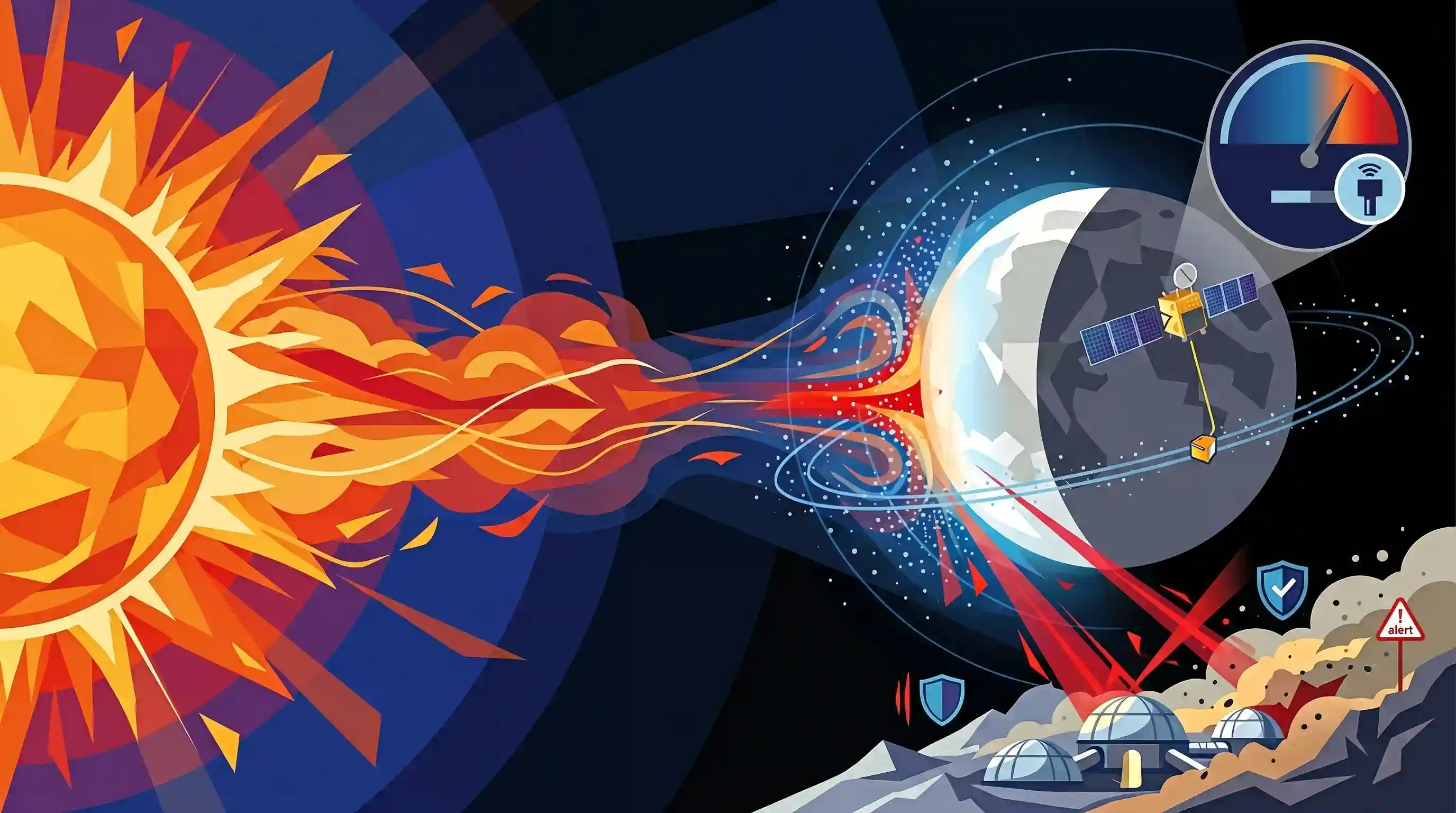
ISRO's Chandrayaan-2 orbiter has achieved a significant milestone by making the first-ever observation of a Coronal Mass Ejection (CME) impacting the Moon. Utilizing its CHACE-2 payload, the orbiter recorded a surge in the total pressure of the dayside lunar exosphere when struck by solar storms in May 2024. This data provides crucial insights into how space weather disrupts the lunar atmosphere, emphasizing the radiation and environmental hurdles that must be overcome before establishing permanent scientific bases or habitats on the Moon.
Key Points
- ISRO's Chandrayaan-2 orbiter made the first-ever observation of the impact of the Sun's Coronal Mass Ejection (CME) on the Moon.
- The CHACE-2 (Chandra's Atmospheric Composition Explorer-2) payload detected a significant increase in the total pressure of the dayside lunar exosphere during a CME event in May 2024.
- The event highlights how extreme space weather and solar flares alter the tenuous lunar atmosphere.
- These observations demonstrate the severe radiation and environmental challenges future lunar habitats and scientific bases will face.
Important Terms
CHACE-2

A neutral gas mass spectrometer on the Chandrayaan-2 orbiter. It measures the composition and density of the lunar neutral exosphere to understand surface-atmosphere interactions.
UPSC context
GS III: Space Technology. Tests knowledge of indigenous scientific payloads and their specific roles in planetary exploration missions.
Coronal Mass Ejection (CME)
Massive bursts of magnetized plasma and magnetic fields expelled from the Sun's corona. They are major drivers of space weather and can disrupt terrestrial and orbital technology.
UPSC context
GS III: Science & Tech (Solar Phenomena). Important for understanding space weather, satellite safety, and Sun-Earth-Moon interactions.
Lunar Exosphere
The extremely thin, non-collisional atmosphere surrounding the Moon. It acts as a surface boundary exosphere, primarily composed of helium, argon, and neon, influenced by solar activity.
UPSC context
GS III: Science & Tech. Relevant for studying planetary environments and planning future lunar habitats or permanent scientific bases.
Chandrayaan-2
India's second lunar exploration mission (2019), consisting of an orbiter, lander (Vikram), and rover (Pragyan). The orbiter continues to provide data on lunar composition and space weather.
UPSC context
GS III: Space Technology. A key milestone in ISRO's planetary missions, demonstrating long-term orbital operations and advanced remote sensing.
GSLV-MkIII-M1
The heavy-lift launch vehicle (now LVM3) used for Chandrayaan-2. It is a three-stage rocket featuring two solid strap-ons, a liquid core, and a cryogenic upper stage.
UPSC context
GS III: Space Technology. Represents India's self-reliance in heavy-lift capabilities and the strategic development of cryogenic engine technology.
ISRO
India's national space agency responsible for the development of space technology and exploration. It manages missions like Chandrayaan, Mangalyaan, and Gaganyaan.
UPSC context
GS III: Science & Tech. The primary institutional body for Indian space programs; a frequent subject in Mains and Prelims.
Prelims Trap
Chandrayaan-2 is an inactive mission following the failure of its lander module.
While the Vikram lander crashed in 2019, the Chandrayaan-2 Orbiter remains fully operational. It continues to orbit the Moon and provide critical scientific data.
Static Concepts Connected
What is the difference between Solar Flares and Coronal Mass Ejections (CMEs)?
- Solar Flares: Intense bursts of electromagnetic radiation (light) that travel at the speed of light, reaching Earth/Moon in about 8 minutes.
- CMEs: Massive clouds of superheated plasma and magnetic fields ejected from the Sun's corona, taking 1 to 3 days to travel through space.
- Differential Impacts: Flares primarily disrupt high-frequency radio communications, while CMEs cause severe geomagnetic storms, satellite damage, and physical impacts on tenuous atmospheres.
Why does the Moon have an 'exosphere' rather than a standard atmosphere?
- Low Gravity: The Moon's weak gravity is insufficient to hold dense gases, causing them to easily escape into interplanetary space.
- No Magnetic Field: The lack of a global dipole magnetic field allows charged particles from the solar wind to constantly strip away accumulating gases.
- Collisionless State: In this ultra-thin exosphere, gas molecules are so sparse that they rarely, if ever, collide with one another.
Cross-Topic Patterns
Multi-mission solar and space weather network
ISRO can correlate Aditya-L1's real-time solar emission data with Chandrayaan-2's downstream lunar impact data, creating a comprehensive space weather monitoring network from Earth to the Moon.
Artemis Accords and lunar habitat shielding
India's CHACE-2 data directly feeds into global planning under the Artemis Accords, helping define critical radiation shielding requirements for future permanent human habitats on the lunar surface.

Expect a multi-statement prelims question contrasting Chandrayaan-2 orbiter payloads (CHACE-2) with Aditya-L1 payloads tracking CMEs.
Linked PYQs · 5
Linked PYQs · 5
- 2023MainsGS3
What is the main task of India's third moon mission which could not be achieved in its earlier mission? List the countries that have achieved this task. Introduce the subsystems in the spacecraft launched and explain the role of the Virtual Launch Control Centre' at the Vikram Sarabhai Space Centre which contributed to the successful launch from Sriharikota.
- 2017MainsGS3
India has achieved remarkable successes in unmanned space missions including the Chandrayaan and Mars Orbitter Mission, but has not ventured into manned space missions. What are the main obstacles to launching a manned space mission, both in terms of technology and logistics? Examine critically.
- 2025PrelimsGS1
Consider the following statements : Statement I: Scientific studies suggest that a shift is taking place in the Earth's rotation and axis. Statement II: Solar flares and associated coronal mass ejections bombarded the Earth's outermost atmosphere with tremendous amount of energy. Statement III : As the Earth's polar ice melts, the water tends to move towards the equator. Which one of the following is correct in respect of the above statements?
- 2022PrelimsGS1
If a major solar storm (solar flare) reaches the Earth, which of the following are the possible effects on the Earth? 1. GPS and navigation systems could fail. 2. Tsunamis could occur at equatorial regions. 3. Power grids could be damaged. 4. Intense auroras could occur over much of the Earth. 5. Forest fires could take place over much of the planet. 6. Orbits of the satellites could be disturbed. 7. Shortwave radio communication of the aircraft flying over polar regions could be interrupted. Select the correct answer using the code given below:
- 2018PrelimsGS1
With reference to India's satellite launch vehicles, consider the following statements: 1. PSLVs launch the satellites useful for Earth resources monitoring whereas GSLVs are designed mainly to launch communication satellites. 2. Satellites launched by PSLV appear to remain permanently fixed in the same position in the sky, as viewed from a particular location on Earth. 3. GSLV Mk III is a four-staged launch vehicle with the first and third stages using solid rocket motors; and the second and fourth stages using liquid rocket engines. Which of the statements given above is/are correct?
