Chandrayaan-2 Detects Subsurface Ice Near Lunar South Pole
Source:The Hindu ↗
Why It Matters
Demonstrates the continued scientific value of the Chandrayaan-2 orbiter and highlights India's vital contribution to global lunar exploration. Discoveries regarding lunar water ice are foundational for planning future manned missions, lunar bases, and deep-space travel.
Summary
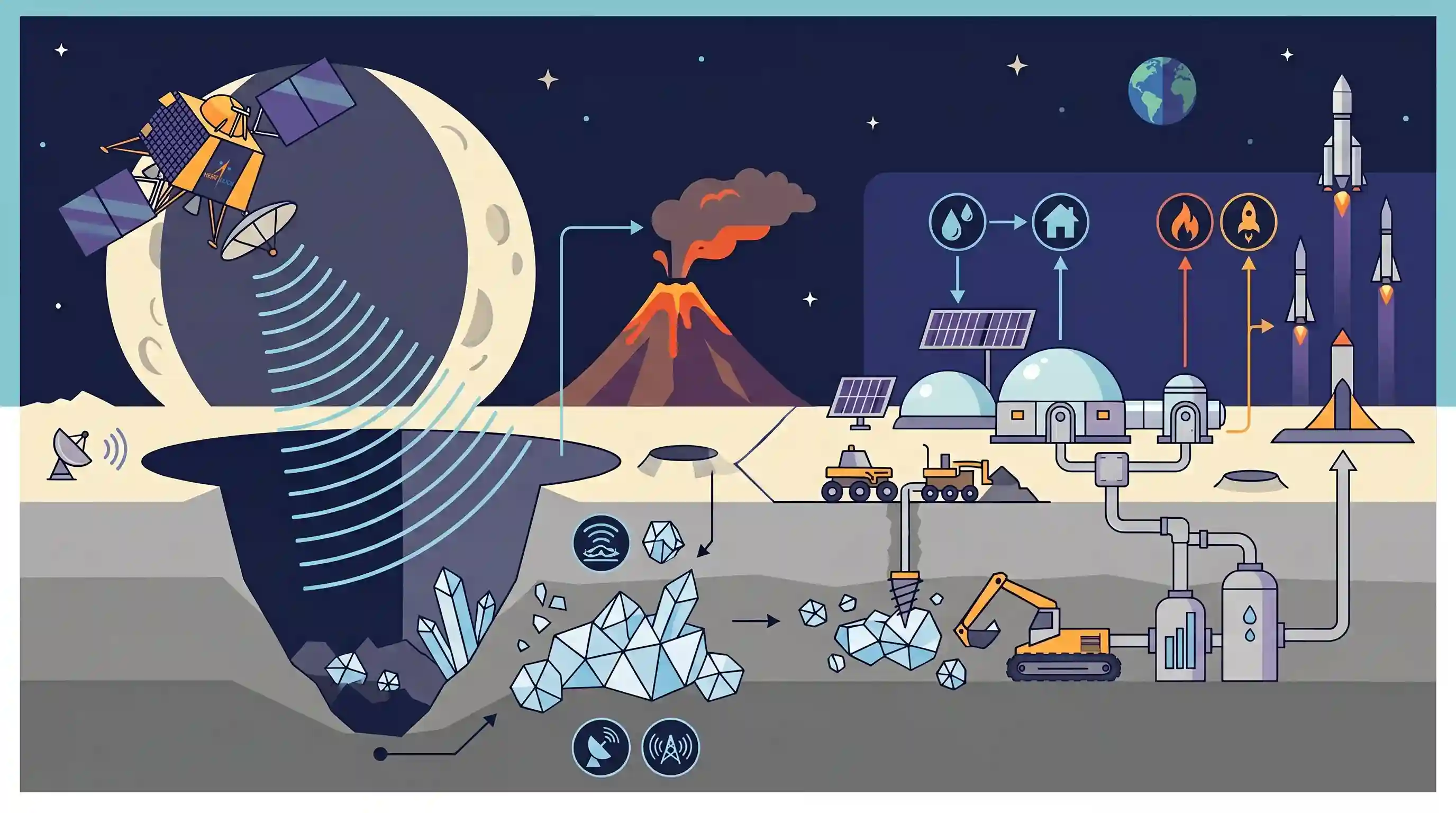
Researchers utilizing data from the Chandrayaan-2 mission's Dual Frequency Synthetic Aperture Radar (DFSAR) have detected the possible presence of subsurface ice in the lunar south polar region. The findings indicate that water ice may exist within the first couple of meters below the surface, specifically in permanently shadowed regions (PSRs). The ice is thought to have originated from outgassing during ancient lunar volcanism. This discovery is significant for future lunar exploration, as tapping into subsurface ice for In-Situ Resource Utilization (ISRU) could support long-term lunar habitats and further deep-space missions.
Key Points
- Data from Chandrayaan-2's Dual Frequency Synthetic Aperture Radar (DFSAR) indicates the possible presence of subsurface ice near the moon's south pole.
- The subsurface ice is believed to be concentrated in the upper few meters of soil within doubly shadowed craters located in Permanently Shadowed Regions (PSRs).
- The ice likely originated from outgassing during historic lunar volcanic activity.
- This discovery enhances prospects for In-Situ Resource Utilization (ISRU), which is critical for future human habitats on the moon and deep-space missions.
- DFSAR's full-polarimetric capabilities enabled it to penetrate the lunar surface deeper than past instruments and effectively distinguish between water-ice and surface roughness.
Important Terms
Chandrayaan-2

India's second lunar mission (2019) comprising an orbiter, lander, and rover. While the landing failed, the orbiter continues to provide high-resolution data on lunar mineralogy and topography.
UPSC context
GS III: Science and Technology. Essential for understanding India’s lunar exploration roadmap and planetary science achievements.
Dual Frequency Synthetic Aperture Radar (DFSAR)
A microwave imaging sensor on Chandrayaan-2 that uses L and S bands to map the lunar surface. It is the first fully-polarimetric SAR to probe the Moon's subsurface.
UPSC context
GS III: Science and Technology. Tests awareness of specific technological payloads and their role in remote sensing.
In-Situ Resource Utilization (ISRU)
The collection and processing of local materials (like water or regolith) on extraterrestrial bodies to support missions. This minimizes the need to transport heavy supplies from Earth.
UPSC context
GS III: Space Technology. Key for topics on sustainable space exploration and future human settlements beyond Earth.
Permanently Shadowed Regions (PSRs)
Lunar polar craters that never receive sunlight due to the Moon's axial tilt. These ultra-cold areas act as "cold traps" for water ice and other volatiles.
UPSC context
GS I: Geography & GS III: Space. Tests understanding of lunar geography and the strategic importance of polar regions.
Space Applications Centre (SAC)
A major ISRO center in Ahmedabad responsible for designing and developing space-borne payloads for communication, navigation, and planetary observation missions.
UPSC context
GS III: Science and Technology. Focuses on the institutional framework and R&D landscape of the Indian space program.
ISRO (Indian Space Research Organisation)
India's premier space agency established in 1969. It manages the national space program, including satellite launches, Earth observation, and interplanetary exploration missions.
UPSC context
GS III: Science and Technology. The foundational organization for all space-related current affairs in the UPSC syllabus.
Prelims Trap
Subsurface ice at the lunar south pole was detected by Chandrayaan-3's Pragyan rover.
Aspirants often attribute all recent lunar south pole discoveries to Chandrayaan-3. However, this subsurface ice data actually comes from the Chandrayaan-2 orbiter, which remains highly active.
Static Concepts Connected
Why do the Moon's Permanently Shadowed Regions (PSRs) retain ancient ice?
- Negligible axial tilt: The Moon's axis is tilted only ~1.5° (unlike Earth's 23.5°), meaning sunlight never reaches the bottoms of deep polar craters.
- Cold traps: These permanently dark areas maintain extreme cryogenic temperatures (around -248°C), acting as 'cold traps' that prevent ancient trapped volatiles from sublimating into space.
What makes Synthetic Aperture Radar (SAR) effective for subsurface space exploration?
- Active sensing: SAR instruments generate their own microwave signals rather than relying on reflected sunlight, allowing them to map topography and map surfaces even in permanently dark regions.
- Deep penetration: Lower frequency microwaves (like DFSAR's L-band) can penetrate the upper layers of the lunar regolith to detect subsurface features and distinguish water-ice from rocky roughness.
Cross-Topic Patterns
Artemis Accords & Global Space Law
In-Situ Resource Utilization (ISRU) triggers debates under the Outer Space Treaty. India's signing of the Artemis Accords aligns it with US-led frameworks for extracting and utilizing lunar water.
ISRO-JAXA LUPEX Collaboration
Chandrayaan-2's subsurface ice mapping directly informs the landing site selection for the upcoming Lunar Polar Exploration (LUPEX), a joint rover mission between ISRO and Japan's JAXA.

Expect a 2026 Prelims question mixing Chandrayaan-2's active orbiter payloads (DFSAR) with Chandrayaan-3's rover achievements.
Linked PYQs · 2
Linked PYQs · 2
- 2023MainsGS3
What is the main task of India's third moon mission which could not be achieved in its earlier mission? List the countries that have achieved this task. Introduce the subsystems in the spacecraft launched and explain the role of the Virtual Launch Control Centre' at the Vikram Sarabhai Space Centre which contributed to the successful launch from Sriharikota.
- 2017MainsGS3
India has achieved remarkable successes in unmanned space missions including the Chandrayaan and Mars Orbitter Mission, but has not ventured into manned space missions. What are the main obstacles to launching a manned space mission, both in terms of technology and logistics? Examine critically.
