Telugu Desam Party President Re-elected for New Term
Source:economic-times ↗
ఇది ఎందుకు ముఖ్యం
The organizational functioning and internal democracy of political parties (both national and regional) are critical components of the Indian electoral system, falling under the purview of the Election Commission and relevant statutory laws. This remains a direct focus area in APPSC and UPSC Polity sections.
సారాంశం
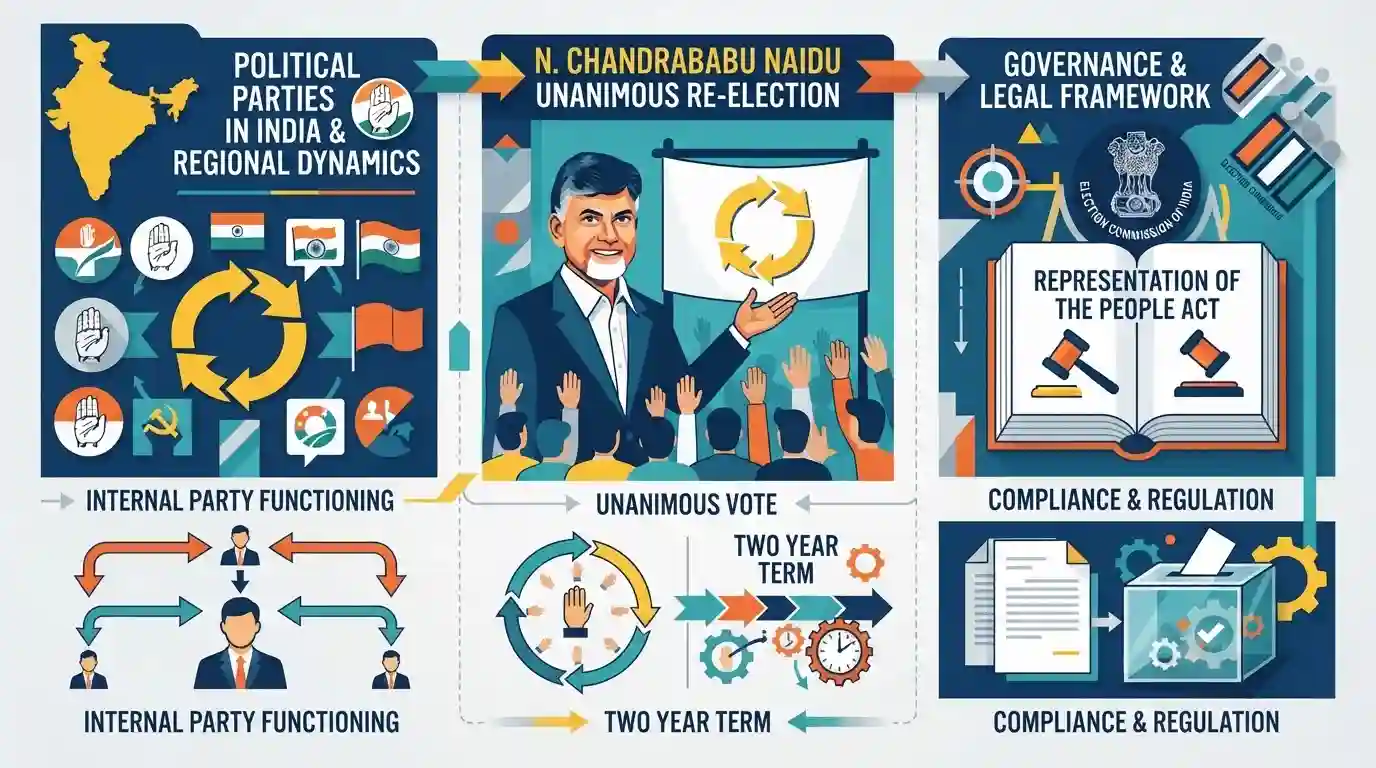
N. Chandrababu Naidu has been unanimously re-elected as the president of the Telugu Desam Party (TDP) for the next two years. This development sheds light on the internal functioning and organizational structure of regional political parties in India, a process governed by the guidelines of the Election Commission of India under the Representation of the People Act.
ముఖ్య అంశాలు
- N. Chandrababu Naidu was unanimously re-elected as the president of the Telugu Desam Party (TDP) for a term of two years.
- Internal party elections highlight the organizational structure and democratic functioning of political parties in India.
- The functioning, registration, and internal democracy of political parties are guided by regulations set by the Election Commission of India and the Representation of the People Act, 1951.
ముఖ్యమైన పదాలు
Representation of the People Act, 1951

An Act passed by the Indian Parliament to provide for the conduct of elections to Parliament and State Legislatures, including the registration of political parties under Section 29A.
UPSC context
Key for GS Paper 2 (Elections, Polity). Evaluates understanding of electoral laws, party registration, and electoral reforms.
Telugu Desam Party (TDP)
A prominent regional political party in India, currently led by N. Chandrababu Naidu, primarily active in the state of Andhra Pradesh.
UPSC context
Relevant to GS Paper 2 (Indian Polity). Serves as an example when discussing regional parties, coalition politics, and internal party structures.
Election Commission of India (ECI)
An independent constitutional authority established under Article 324 of the Constitution, responsible for administering all elections to public offices in India.
UPSC context
Core topic in GS Paper 2 (Constitutional Bodies). Tested on its composition, independence, powers (Article 324), and role in free and fair elections.
Internal Party Democracy
The level and methods of including party members in decision-making, deliberation, and leadership selection within a political party's structure.
UPSC context
Crucial for GS Paper 2 (Governance & Polity). Discussed in the context of political reforms, anti-defection, dynastic politics, and party accountability.
ప్రిలిమ్స్ ఉచ్చు
The ECI has the statutory authority to de-register a political party for failing to hold regular internal organizational elections as per its constitution.
In the 2002 Indian National Congress (I) case, the SC held that ECI lacks statutory or inherent power to de-register parties except in extreme circumstances like fraud or unlawful status.
అనుసంధానమైన స్థిర భావనలు
What are ECI's powers regarding registration and de-registration of political parties?
- Section 29A RPA: Section 29A of the RPA 1951 governs party registration, requiring associations to submit applications and pledge allegiance to the Constitution, secularism, and democracy.
- De-registration limit: The Supreme Court (2002) ruled that ECI cannot de-register parties, preserving multi-party competitive democracy from administrative overreach.
- Rare exceptions: De-registration is permitted only if registration was obtained by fraud, or the party is declared an unlawful association by the government.
How do political and legislature parties differ under the Tenth Schedule?
- Organizational vs Legislative: The 'political party' refers to the parent organizational wing, while 'legislature party' represents only the elected lawmakers in the House.
- Whip appointment: In the Subhash Desai (2023) case, the Supreme Court ruled that the parent political party, not the legislative wing, appoints the Chief Whip.
- Anti-defection impact: Prevents a rebel faction of legislators from usurping the party's legal identity or bypassing the official party whip.
అంతర-అంశ నమూనాలు
Inner-party democracy and Tenth Schedule
A lack of legal frameworks for inner-party democracy often triggers factional splits, leading to symbol disputes under Paragraph 15 and complex Anti-Defection proceedings.
Electoral reforms and Law Commission
The 170th Law Commission report proposed legal regulation of internal party organs, linking executive reforms to constitutional stability and representation.

Distinction between political and legislative party under Tenth Schedule alongside ECI's de-registration powers will be tested in 2026.
అనుసంధాన PYQలు · 2
అనుసంధాన PYQలు · 2
- 2024APPSC_PRELIMSGS1
Consider the following statements with reference to the Election Commission of India : I. The Constitution of India has debarred the retiring Election Commissioners from any further appointment by the government. II. In 'Anoop Baranwal Case' (2023), the Supreme Court has directed the Government to treat the Regional Commissioners on par with the Election Commissioners (other than the Chief Election Commissioner), as far as removal from office is concerned. III. Since its inception, the Election Commission had functioned as a multi-member body. IV. The power of superintendence, direction and control of elections to the office of Vice-President of India is vested in the Election Commission. Which of the above statement/statements is/are valid ?
- 2023APPSC_PRELIMSGS1
The powers of the Election Commission include which of the following? I. The Election Commission takes decisions on every aspect of conduct and control of elections from the announcement of elections to the declaration of results. II. During the election period, the Election Commission can order the Government to dismiss some government officials. III. When on election duty, Government officers work under the control of the Election Commission. Choose the correct answer using the codes given below:
