River interlinking roadmap proposed for Andhra Pradesh irrigation
Source:telangana-today ↗
ఇది ఎందుకు ముఖ్యం
River interlinking and multipurpose irrigation projects are critical topics in APPSC Prelims Geography and State-Specific sections. Candidates must be familiar with key projects like Polavaram, Pattiseema, and historical infrastructure contributors like Dr. K.L. Rao.
సారాంశం
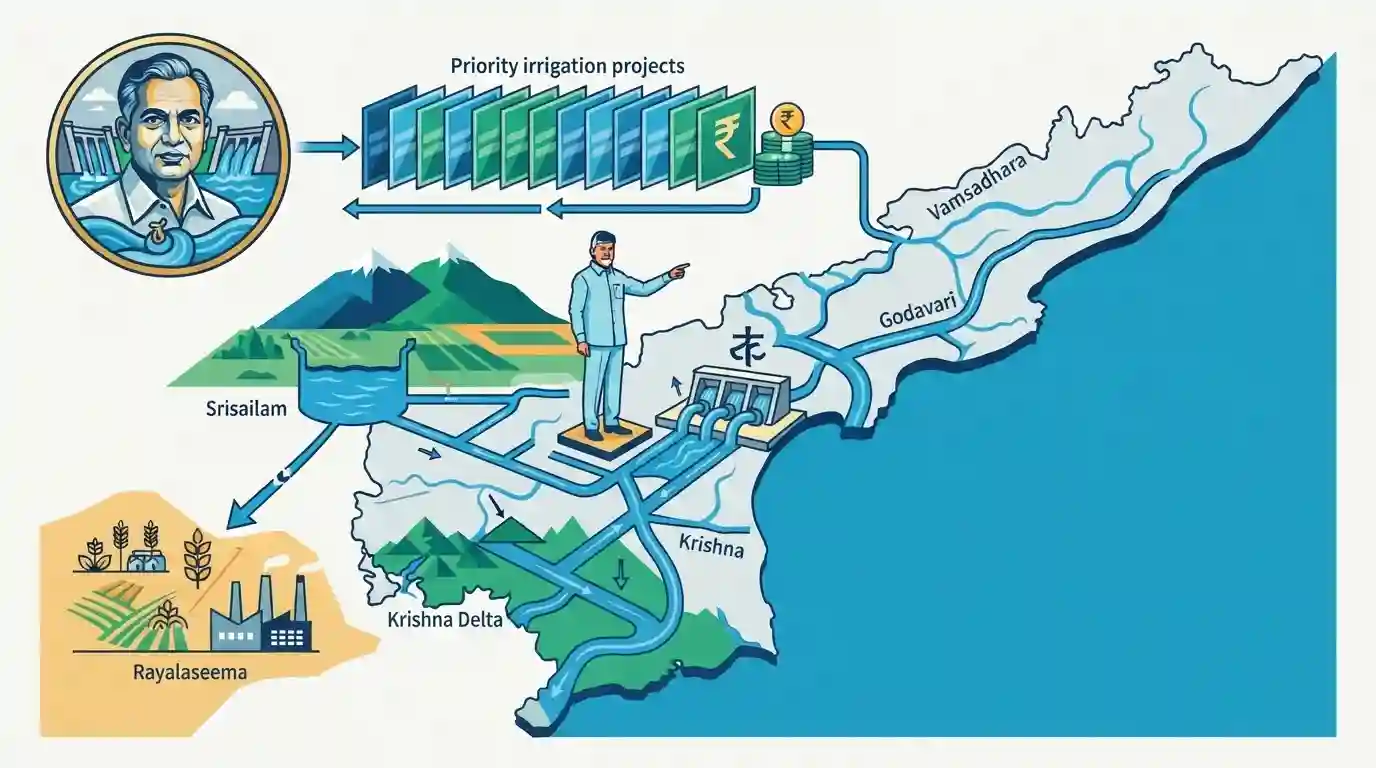
Andhra Pradesh Chief Minister N. Chandrababu Naidu has pitched an ambitious vision to interlink rivers across the state from Vamsadhara to Penna, asserting that such projects generate enormous agricultural and industrial wealth. Speaking at the confluence of the Godavari and Krishna rivers, Naidu highlighted the success of the Pattiseema Lift Irrigation Project, which stabilized the Krishna Delta by diverting Godavari waters and conserved Krishna waters in the Srisailam reservoir for Rayalaseema's needs. The government plans to complete 36 priority irrigation projects with an investment of ₹35,000 crore in the coming years. Naidu also paid homage to legendary engineer Dr. K.L. Rao for his monumental contributions to major Indian dam projects.
ముఖ్య అంశాలు
- Andhra Pradesh CM N. Chandrababu Naidu announced plans to complete 36 priority irrigation projects over the next three years with a ₹35,000 crore investment.
- His long-term vision includes an extensive river interlinking network across the state from the Vamsadhara River to the Penna River.
- The Pattiseema Lift Irrigation Project has successfully diverted 450 TMC of Godavari water to the Krishna River since 2015, stabilizing the Krishna Delta and helping divert conserved Krishna waters from the Srisailam reservoir to Rayalaseema.
- Tributes were paid to eminent engineer Dr. K.L. Rao on his 124th birth anniversary; he was instrumental in constructing major dams like Srisailam, Nagarjuna Sagar, Hirakud, and Kosi, and worked as a UN water expert.
ముఖ్యమైన పదాలు
Pattiseema Lift Irrigation Project

A landmark lift irrigation scheme in Andhra Pradesh that diverts surplus water from the Godavari River to the Krishna River, stabilizing the Krishna Delta and representing India's first successful major river-interlinking project.
UPSC context
GS Paper I (Geography) & GS Paper III (Water Resources); tests knowledge of river-linking initiatives and irrigation technology.
Polavaram Project
A major under-construction multipurpose national irrigation project on the Godavari River in Andhra Pradesh, designed to provide irrigation, hydropower, drinking water, and facilitate inter-basin water transfers.
UPSC context
GS Paper I (Geography) & GS Paper III (Water Resources); tests major infrastructure, environmental clearances, and interstate water disputes.
Penna River
An east-flowing peninsular river that originates in Karnataka's Nandi Hills, flows through Andhra Pradesh into the Bay of Bengal, and serves as a vital water source for the drought-prone Rayalaseema region.
UPSC context
GS Paper I (Indian Geography); tests peninsular drainage systems, seasonal river characteristics, and regional water resource management.
Vamsadhara River
An east-flowing interstate peninsular river originating in the Eastern Ghats of Odisha and emptying into the Bay of Bengal in Andhra Pradesh, central to local irrigation and regional water sharing disputes.
UPSC context
GS Paper I (Physical Geography) & GS Paper II (Interstate Relations); tests river basins, drainage networks, and federal water disputes.
Telugu Desam Party
A prominent regional political party in Andhra Pradesh and Telangana, founded in 1982 by N.T. Rama Rao, advocating for regional identity, self-respect, and federalism within India's political system.
UPSC context
GS Paper II (Polity & Governance); tests the dynamics of regional political parties, coalition politics, and federal structure.
ప్రిలిమ్స్ ఉచ్చు
The Ken-Betwa Link Project is India's first operational river-interlinking project.
While Ken-Betwa is the first major project under the Central National Perspective Plan, Andhra Pradesh's Pattiseema project (Godavari-Krishna) was completed and made operational first in 2015.
అనుసంధానమైన స్థిర భావనలు
What is the constitutional and statutory framework for inter-state river water disputes?
- Article 262: Empowers Parliament to adjudicate disputes regarding inter-state rivers and explicitly bars Supreme Court jurisdiction under this specific provision.
- Statutory Framework: The Inter-State River Water Disputes Act, 1956 allows the Centre to set up tribunals whose decisions hold the force of a Supreme Court decree.
- Apex Council: Established under the AP Reorganisation Act, 2014, to supervise Krishna and Godavari River Management Boards and resolve bilateral water disputes.
What is the National Perspective Plan (NPP) for water resources development?
- Two Components: Managed by NWDA, it comprises the Himalayan Component (14 river links) and the Peninsular Component (16 river links) to transfer surplus water.
- Historical Pioneer: Dr. K.L. Rao in 1972 proposed a 2,640 km 'Ganga-Cauvery Link Canal', laying the conceptual foundation for today's National Water Grid.
అంతర-అంశ నమూనాలు
Cooperative Federalism & Water Sharing
Inter-state links challenge federal dynamics under Article 262, requiring consensus among riparian states like Andhra Pradesh, Telangana, and Odisha over surplus water allocations.
Eco-hydrology vs. Mega-Engineering
Large-scale water diversions disrupt estuarine ecology, reduce nutrient-rich sediment discharge to crucial agricultural deltas, and risk violating minimum environmental flow (E-flow) standards.

2026 prelims may contrast state-led links like Pattiseema with Ken-Betwa, testing Article 262 and river basin eco-hydrology.
అనుసంధాన PYQలు · 3
అనుసంధాన PYQలు · 3
- 2023APPSC_PRELIMSGS1
Polavaram Project is a
- 2023APPSC_PRELIMSGS1
Apex Council of Godavari and Krishna river water resources and their management consists of
- 2008APPSC_PRELIMSGS1
Nagarjuna Dam was constructed in the year:
