Decade of Governance Economic Growth and Digital Infrastructure
Source:Indian Express ↗
Why It Matters
Provides a significant political and administrative perspective from a key regional ally on the evolution of cooperative federalism, digitalization, and welfare delivery mechanisms over the past decade, which are core themes in GS Paper 2 and GS Paper 3.
Summary
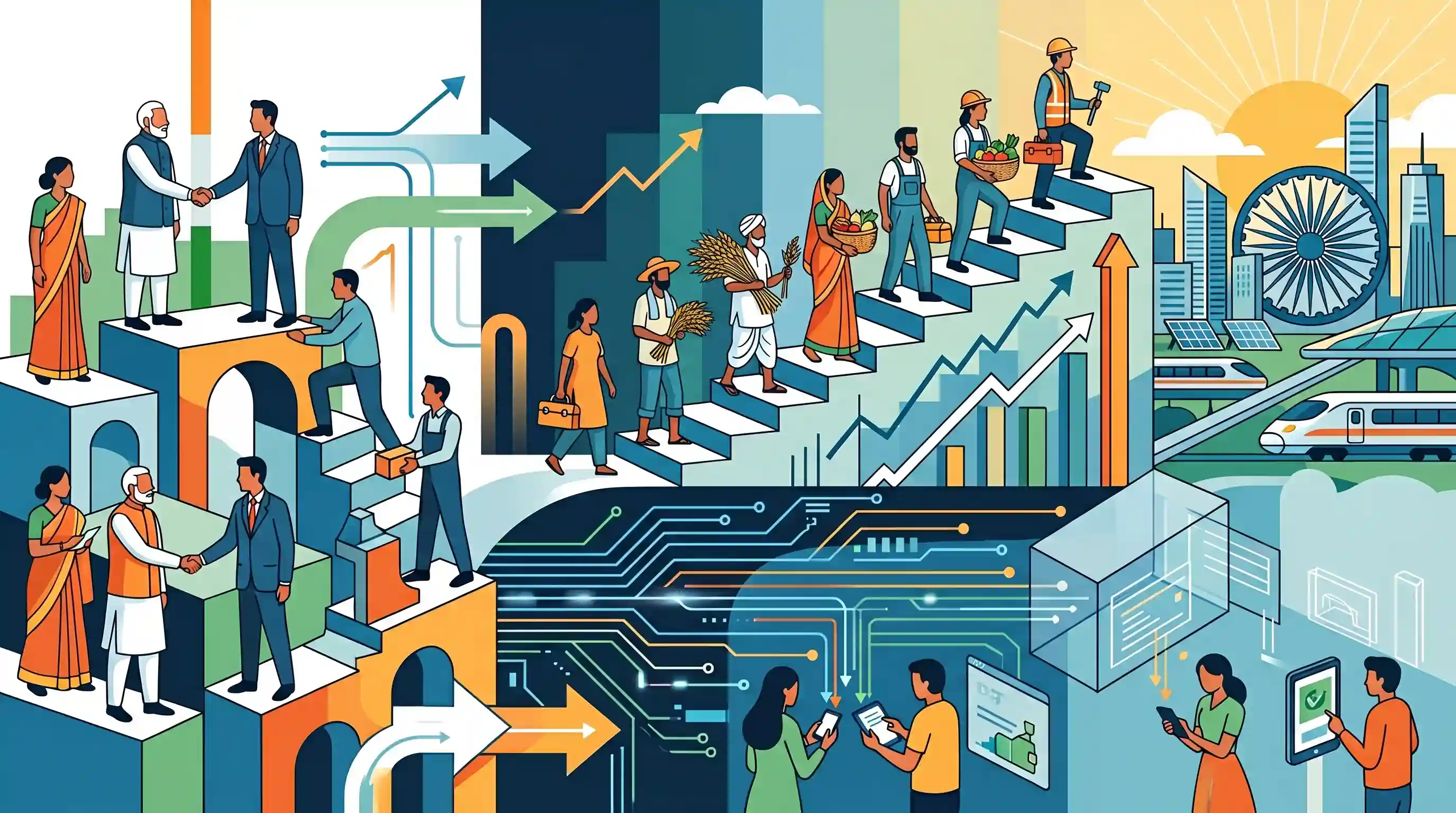
In an opinion piece reflecting on 12 years of Prime Minister Narendra Modi's tenure, N. Chandrababu Naidu highlights India's journey toward becoming a confident and resilient nation. The article underscores key achievements including the scale-up of Digital Public Infrastructure (DPI), targeted welfare through Direct Benefit Transfers (DBT), multi-dimensional poverty reduction, and macroeconomic growth. Naidu also emphasizes the critical role of competitive and cooperative federalism, where the Union and states collaborate to realize the vision of Viksit Bharat by 2047.
Key Points
- Governance over the last 12 years has been anchored in the 'Nation First' principle, blending civilisational pride with modern policy execution.
- India has made transformative strides in Digital Public Infrastructure (DPI) through the JAM trinity (Jan Dhan, Aadhaar, Mobile) and UPI, facilitating transparent Direct Benefit Transfers (DBT).
- A paradigm shift in welfare from mere survival to empowerment, focusing on multi-dimensional poverty eradication through targeted housing, healthcare, and sanitation schemes.
- Economic resilience has propelled India from the 11th to the 4th largest global economy, backed by sustained investments in next-generation infrastructure.
- The Union and States are actively partnering through a framework of competitive and cooperative federalism to achieve the vision of a developed India (Viksit Bharat) by 2047.
Important Terms
Viksit Bharat 2047

The central vision to transform India into a developed nation by 2047, targeting a $30-trillion economy with high per-capita income, quality infrastructure, and social equity.
UPSC context
Relevant for GS Paper III (Economy/Planning) and GS Paper II (Governance) regarding long-term national growth strategies.
Cooperative Federalism
A governance concept where the Union and States work as partners to solve national problems and achieve growth, often facilitated by institutions like NITI Aayog.
UPSC context
Core topic for GS Paper II (Polity), testing understanding of Centre-State relations and administrative collaboration.
Digital Public Infrastructure (DPI)
Open, interoperable digital platforms (like Aadhaar, UPI, and DigiLocker) that enable the delivery of public and private services at a societal scale.
UPSC context
Crucial for GS Paper III (Science & Technology/Economy) and GS Paper II (E-governance) regarding digital transformation.
Direct Benefit Transfer (DBT)
A welfare reform mechanism that transfers subsidies and benefits directly into the bank accounts of beneficiaries to eliminate leakages, intermediaries, and corruption.
UPSC context
Key topic for GS Paper II (Governance/Welfare Schemes) and GS Paper III (Inclusive Growth/Economics).
JAM Trinity
The integration of Jan Dhan (bank accounts), Aadhaar (biometric ID), and Mobile (connectivity) to create a seamless delivery pipeline for financial inclusion and welfare.
UPSC context
Standard UPSC term for GS Paper III (Financial Inclusion) and GS Paper II (Social Justice/Governance).
Unified Payments Interface (UPI)
An indigenous, real-time payment system developed by NPCI that allows instant inter-bank transactions via mobile devices using a Virtual Payment Address (VPA).
UPSC context
Essential for GS Paper III (Economy/Technology) as a model of India's fintech leadership and DPI success.
Prelims Trap
NITI Aayog's National Multidimensional Poverty Index uses the exact same indicators and weights as the Global MPI.
While heavily aligned, NITI Aayog's National MPI adds two specific indicators—maternal health and bank accounts—diverging slightly from the 10 standard indicators of the Global MPI.
Static Concepts Connected
What distinguishes cooperative federalism from competitive federalism in India?
- Cooperative Federalism: The Center and States collaborate horizontally to resolve national issues and formulate broad policies (e.g., the GST Council or Inter-State Council).
- Competitive Federalism: States actively compete against each other to attract investment and rank higher on national governance metrics (e.g., NITI Aayog's SDG India Index or Export Preparedness Index).
How does the JAM trinity structurally enable targeted Direct Benefit Transfers?
- Jan Dhan: Provides universal, zero-balance access to formal banking, ensuring state funds have a direct route to the unbanked poor.
- Aadhaar: Acts as a biometric deduplication tool, eliminating ghost beneficiaries and plugging systemic leakages in welfare delivery.
- Mobile: Enables digital connectivity for transaction alerts, remote authentication, and seamless UPI integration.
Cross-Topic Patterns
DPI as Diplomatic Soft Power
India's domestic success with the JAM trinity is increasingly leveraged as a core foreign policy tool, offering 'India Stack' frameworks to Global South nations via multilateral forums like the G20.
Targeted Welfare vs. Fiscal Consolidation
The shift from broad physical subsidies to targeted DBT allows the Union to rationalize revenue expenditure, creating fiscal space for the massive infrastructure capital expenditure driving macroeconomic resilience.

DPI's evolution from domestic welfare (DBT) to a foreign policy tool (Global South outreach) is highly probable as a 2026 GS-2 question.
Linked PYQs · 5
Linked PYQs · 5
- 2023MainsGS3
What is the status of digitalization in the Indian economy? Examine the problems faced in this regard and suggest improvements.
- 2024MainsGS2
What changes has the Union Government recently introduced in the domain of Centre-State relations ? Suggest measures to be adopted to build the trust between the Centre and the States and for strengthening federalism.
- 2020MainsGS2
How far do you think cooperation, competition and confrontation have shaped the nature of federation in India? Cite some recent examples to validate your answer.
- 2022MainsGS2
Besides the welfare schemes, India needs deft management of inflation and unemployment to serve the poor and the underprivileged sections of the society. Discuss.
- 2022MainsGS3
Is inclusive growth possible under market economy ? State the significance of financial inclusion in achieving economic growth in India.
