Chandipura Virus Outbreak and Public Health Concerns
Source:Indian Express ↗
Why It Matters
It highlights the vulnerabilities of rural and pediatric populations to lesser-known vector-borne diseases and emphasizes the urgent need for better disease surveillance, vector control, and robust primary healthcare infrastructure.
Summary
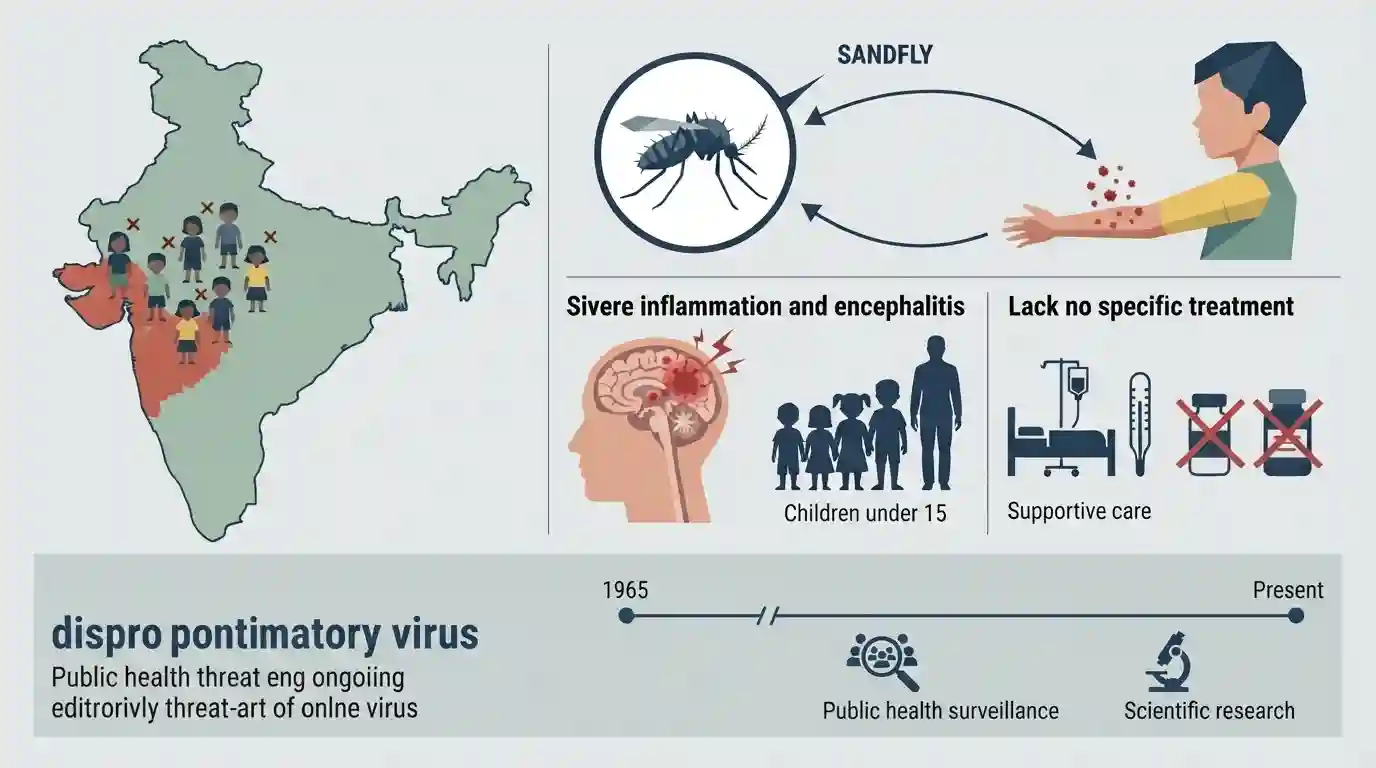
Six children have recently died in Gujarat from suspected Chandipura virus (CHPV) infection. CHPV is a vector-borne viral disease transmitted primarily by sandflies, which causes severe encephalitis and disproportionately affects children under 15. Due to the lack of specific antiviral therapies or vaccines, the disease relies entirely on symptomatic treatment and supportive care. First identified in Maharashtra in 1965, the virus has caused sporadic outbreaks in western and southern India, underscoring the ongoing public health threat posed by neglected vector-borne diseases.
Key Points
- The Chandipura virus (CHPV) causes rapid-onset encephalitis (brain inflammation), typically affecting children under the age of 15.
- CHPV is a vector-borne pathogen primarily transmitted by Phlebotomine sandflies, though certain mosquitoes and ticks can also carry the virus.
- Symptoms include sudden high fever, vomiting, convulsions, altered sensorium, and can quickly progress to a coma or death.
- There is currently no specific vaccine or antiviral drug available to treat the infection; medical response is limited to symptomatic management and supportive care.
- The virus was first identified in 1965 in Chandipura, Maharashtra, with recurrent localized outbreaks recorded in Gujarat, Andhra Pradesh, and Maharashtra.
Important Terms
Chandipura virus (CHPV)

A deadly virus of the Rhabdoviridae family, transmitted primarily by sandflies. It causes acute encephalitis syndrome (AES), predominantly affecting children under 15, and has a rapid progression with no specific vaccine or antiviral treatment available.
UPSC context
GS Paper 2 & 3 (Health/Science). Tests awareness of endemic vector-borne diseases, public health preparedness, and emerging viral threats.
Sandflies
Small blood-sucking insects that act as vectors for various diseases. In India, they are the primary transmitters of the Chandipura virus and Kala-azar (Visceral Leishmaniasis), breeding in warm, moist environments like mud and cracks.
UPSC context
GS Paper 3 (Science). Relevant for questions on disease vectors, zoonotic transmissions, and environmental factors influencing vector breeding.
Acute Encephalitis Syndrome (AES)
A group of neurological conditions characterized by acute-onset fever and clinical neurological manifestations like mental confusion, disorientation, or coma. It is caused by various pathogens, including the Chandipura and Japanese encephalitis viruses.
UPSC context
GS Paper 2 (Health). Important for evaluating public health burdens, pediatric mortality, and regional disease monitoring in India.
National Institute of Virology (NIV)
An apex virology research institute located in Pune, operating under the Indian Council of Medical Research (ICMR). It serves as a WHO collaborating center and leads India's diagnostic and surveillance efforts for viral outbreaks.
UPSC context
GS Paper 3 (Science & Tech). Tests knowledge of key national institutions driving biomedical research, viral surveillance, and pandemic response.
Indian Council of Medical Research (ICMR)
India's apex body for the formulation, coordination, and promotion of biomedical research. Funded by the Ministry of Health and Family Welfare, it addresses national health priorities including communicable diseases, non-communicable diseases, and viral outbreaks.
UPSC context
GS Paper 2 (Governance/Health). Crucial for questions on national health policies, research infrastructure, and governmental response to disease outbreaks.
Prelims Trap
"Chandipura virus is a mosquito-borne disease causing encephalitis that can be prevented by a specific vaccine."
Aspirants often conflate encephalitis outbreaks with Japanese Encephalitis (mosquito-borne, vaccine-preventable). CHPV is primarily transmitted by sandflies and currently lacks a vaccine.
Static Concepts Connected
What are the common pathogens causing Acute Encephalitis Syndrome (AES) in India?
- Viral pathogens: Japanese Encephalitis (JEV), Chandipura virus (CHPV), Nipah virus, and various enteroviruses.
- Non-viral causes: Scrub typhus (bacterial) and toxoplasmosis (parasitic) can also present as AES.
- Primary vectors: Culex mosquitoes for JEV, Phlebotomine sandflies for CHPV, and Trombiculid mites for Scrub Typhus.
Which major diseases are transmitted by the Phlebotomine sandfly in India?
- Kala-azar: Visceral leishmaniasis, a parasitic disease endemic to eastern India, targeted for elimination through vector control.
- Chandipura virus: An RNA virus of the Rhabdoviridae family causing rapid-onset encephalitis and high mortality in children.
Cross-Topic Patterns
Sandflies + Kala-azar elimination
The common sandfly vector links CHPV outbreaks to India's ongoing public health efforts to eliminate Kala-azar via integrated vector management.
AES + Rhabdoviridae family
UPSC often tests viral families. CHPV shares the Rhabdoviridae family with Rabies, distinguishing it from Flaviviruses like Dengue, Zika, and Japanese Encephalitis.

Expect a matching question in 2026 pairing vectors to AES viruses (Sandfly/CHPV, Culex/JEV) or viral families (Rhabdoviridae/Flavivirus).
Linked PYQs · 5
Linked PYQs · 5
- 2023PrelimsGS1
'Wolbachia method' is sometimes talked about with reference to which one of the following?
- 2017PrelimsGS1
Consider the following statements: 1. In tropical regions, Zika virus disease is transmitted by the same mosquito that transmits dengue. 2. Sexual transmission of Zika virus disease is possible. Which of the statements given above is/are correct?
- 2013PrelimsGS1
Which of the following statements is/are correct?
- 2021MainsGS2
“Besides being a moral imperative of a Welfare State, primary health structure is a necessary precondition for sustainable development.” Analyze.
- 2024MainsGS2
In a crucial domain like the public healthcare system the Indian State should play a vital role to contain the adverse impact of marketisation of the system. Suggest some measures through which the State can enhance the reach of public healthcare at the grassroots level.
