Chandipura Virus Outbreak Prompts Health Alert In Gujarat
Source:etvbharat ↗
Why It Matters
Managing disease outbreaks like the Chandipura virus highlights the critical need for resilient regional healthcare infrastructure and rapid administrative response, essential themes for civil service exams focusing on governance, social justice, and public health.
Summary
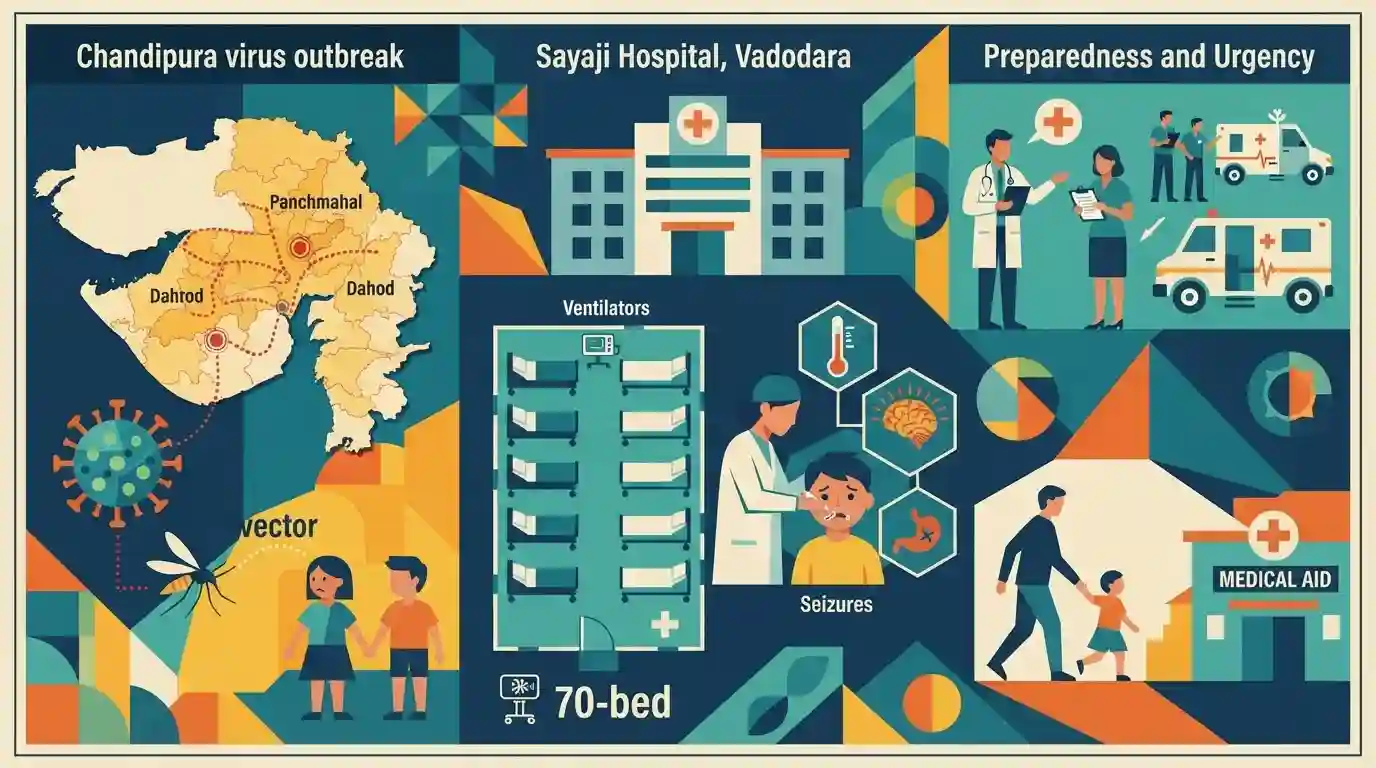
An outbreak of the Chandipura virus has put healthcare authorities in Gujarat on high alert, with Sayaji Hospital in Vadodara dedicating a 70-bed ventilator-equipped facility for pediatric patients. The virus, primarily affecting children, presents with severe symptoms such as fever, vomiting, and seizures, and has resulted in several suspected fatalities in districts like Panchmahal and Dahod. Central Gujarat health networks are intensifying their preparedness and urging immediate medical intervention for symptomatic children to prevent further casualties.
Key Points
- Sayaji Hospital in Vadodara has prepared a 70-bed facility equipped with ventilators in response to a surge in suspected Chandipura virus cases.
- The virus primarily targets young children, causing severe symptoms such as high fever, vomiting, convulsions, and unconsciousness, which require immediate medical care.
- Recent suspected cases and tragic fatalities of children in the Panchmahal and Vadodara districts have intensified the public health alert across central Gujarat.
- Local health authorities and doctors are advising parents to seek prompt medical attention if children exhibit any warning signs, as timely treatment is crucial.
Important Terms
Chandipura Virus

An RNA virus of the Rhabdoviridae family, primarily transmitted by sandflies. It causes severe acute encephalitis syndrome (AES), predominantly affecting children under 15, characterized by rapid onset of fever, seizures, and brain inflammation.
UPSC context
Relevant for GS Paper 3 (Science & Tech) and GS 2 (Health). Tests knowledge of viral outbreaks, epidemiology, and vectors.
Vector-borne Diseases
Illnesses caused by pathogens transmitted to humans by vectors like mosquitoes, sandflies, and ticks. Common examples in India include Malaria, Dengue, Chikungunya, Japanese Encephalitis, and Chandipura virus infection.
UPSC context
Crucial for GS Paper 2 (Health) and GS Paper 3. Highlights the National Vector Borne Disease Control Programme (NVBDCP).
Acute Encephalitis Syndrome (AES)
A clinical syndrome characterized by sudden-onset fever and neurological manifestations like mental confusion, delirium, or seizures. It is caused by various agents, including the Chandipura and Japanese Encephalitis viruses.
UPSC context
Important for GS Paper 2 (Health) and GS 3 (Science). Tests awareness of recurring pediatric neurological disease outbreaks in India.
Sandflies (Phlebotomus)
Small flying insects acting as primary vectors for several diseases, including Kala-azar and the Chandipura virus. They breed in moist organic matter, with populations peaking during the Indian monsoon season.
UPSC context
Significant for GS Paper 3 (Science - Disease vectors). Tests understanding of disease transmission cycles and environmental vector control strategies.
Prelims Trap
"Chandipura virus is primarily transmitted by mosquitoes, and a vaccine is administered under the Universal Immunisation Programme."
Aspirants often confuse CHPV with Japanese Encephalitis (JE). JE is transmitted by Culex mosquitoes and has a vaccine; CHPV is sandfly-borne with NO vaccine.
Static Concepts Connected
What are the key biological characteristics of the Chandipura Virus (CHPV)?
- Pathogen classification: It is an enveloped, single-stranded RNA virus belonging to the Rhabdoviridae family (the same family as the Rabies virus).
- Primary vector: It is an arbovirus primarily transmitted to humans by the bite of the female Phlebotomine sandfly.
- Treatment protocols: There is currently no specific antiviral drug or approved vaccine; treatment relies entirely on intensive supportive care and symptom management.
What constitutes Acute Encephalitis Syndrome (AES) in the Indian public health context?
- Syndromic definition: AES is a group of clinical neurologic manifestations (fever, altered mental status) rather than a single disease; it acts as a syndromic umbrella.
- Multiple pathogens: It can be caused by various agents, including viruses (JEV, CHPV, Nipah), bacteria, fungi, and parasites like Scrub Typhus.
- Dominant vs emerging causes: Japanese Encephalitis Virus (JEV) is historically the major cause in India, but emerging viruses like CHPV heavily impact specific regions.
Cross-Topic Patterns
Climate shifts and vector ecology
Altered monsoon patterns and warmer temperatures expand the geographical range of sandflies and mosquitoes, linking climate change directly to recurrent Acute Encephalitis Syndrome (AES) outbreaks in new districts.
One Health and disease surveillance
Repeated arboviral and zoonotic outbreaks (CHPV, Nipah) validate the necessity of the One Health approach within India's National Center for Disease Control (NCDC) framework to predict pathogen spillover.

Expect a multi-statement Prelims question comparing Chandipura (sandfly/RNA/no vaccine) with Japanese Encephalitis (mosquito/flavivirus).
Linked PYQs · 2
Linked PYQs · 2
- 2025GPSC_PRELIMSGS1
Which of the following countries was recently in the news regarding an outbreak of human metapneumovirus (HMPV)?
- 2025GPSC_PRELIMSGS1
______ initiated its withdrawal from the World Health Organization (WHO) on January 20, 2025 citing mishandling of the COVID-19 pandemic financial disparities and political influence concerns.
