PM Surya Ghar Scheme Rooftop Solar Awareness Campaign in Chandigarh
Source:Indian Express ↗
Why It Matters
Rooftop solar is a critical component of India's decentralized renewable energy strategy. The PM Surya Ghar scheme directly addresses barriers to residential adoption through financial incentives (subsidies and low-interest loans) and administrative ease (single-window clearance and DBT). This aligns with India's climate commitments and targets for renewable energy capacity.
Summary
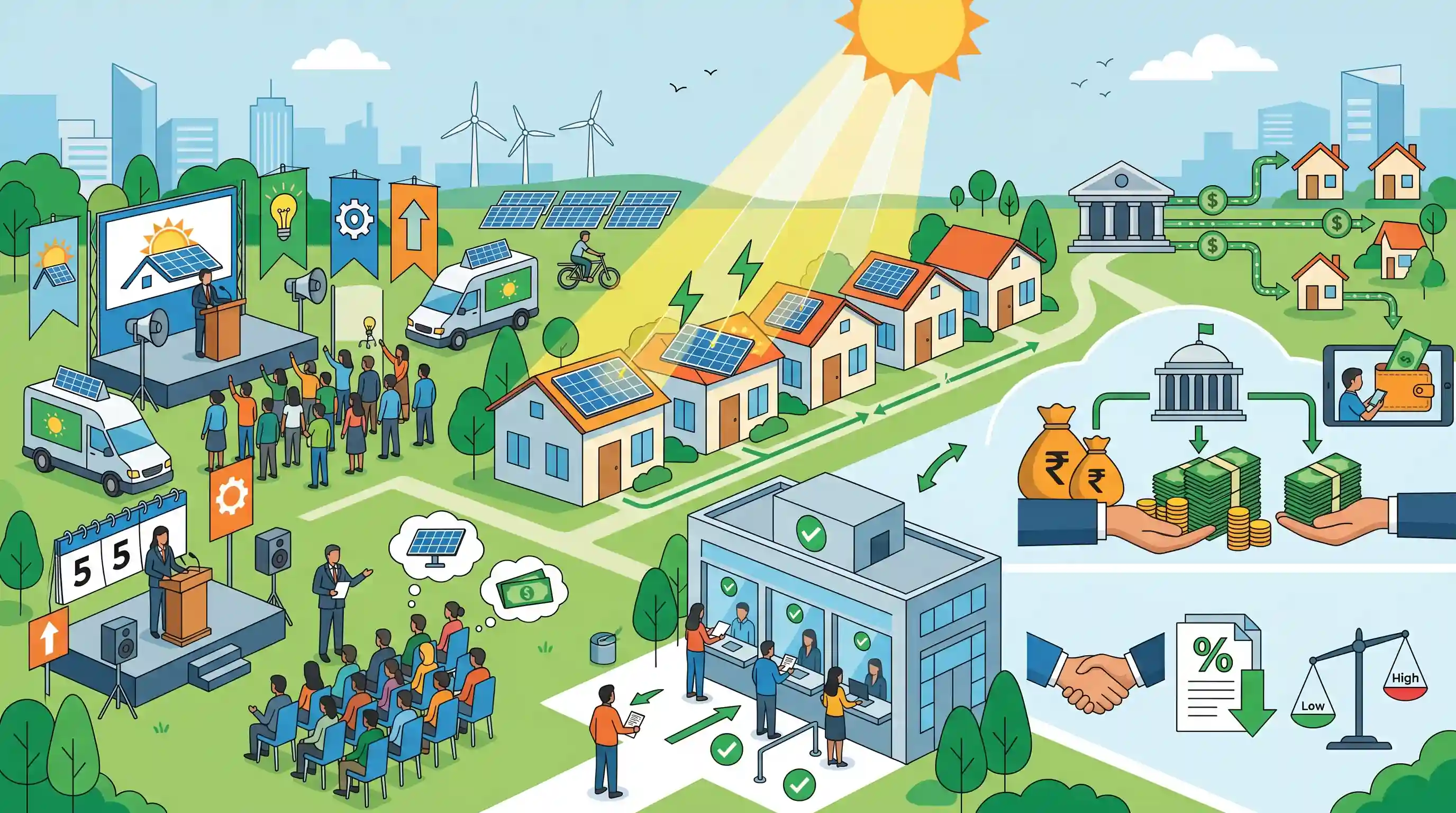
The Chandigarh Renewable Energy, Science and Technology Promotion Society (CREST) has launched a five-day awareness campaign to encourage residents to adopt rooftop solar panels under the PM Surya Ghar: Muft Bijli Yojana. The scheme incentivizes residential solar adoption by offering subsidies up to Rs 78,000 and affordable loans with interest rates capped at 6%. To ensure a seamless experience, the government has established a single-window facilitation system through CREST and employs Direct Benefit Transfer (DBT) to disburse subsidies directly to households, supporting India's broader renewable energy targets.
Key Points
- Five-day solar awareness camps are being organized in Chandigarh by CREST to promote the PM Surya Ghar: Muft Bijli Yojana.
- The scheme offers Central Financial Assistance (subsidy) up to Rs 78,000 for residential rooftop solar installations.
- Beneficiaries can access low-interest bank loans (up to 6%) to fund their rooftop solar projects.
- The initiative utilizes Direct Benefit Transfer (DBT) to credit the subsidy directly into the beneficiary's bank account, supported by a single-window facilitation system managed by CREST.
Important Terms
PM Surya Ghar: Muft Bijli Yojana

A central scheme providing subsidies (up to ₹78,000) for residential rooftop solar to provide 300 units of free monthly electricity to one crore households.
UPSC context
GS II (Govt Schemes) & GS III (Energy); crucial for energy security and sustainability topics.
Direct Benefit Transfer (DBT)
A mechanism transferring government subsidies directly to beneficiaries' bank accounts via Aadhaar, aimed at improving transparency and reducing leakages in welfare delivery.
UPSC context
GS II (Governance); tests understanding of efficient service delivery and financial inclusion.
Rooftop Solar (RTS)
Solar photovoltaic systems installed on building rooftops to generate electricity for local consumption, often feeding surplus power back into the utility grid.
UPSC context
GS III (Environment/Infrastructure); central to India's decentralized energy and climate change mitigation strategies.
Net Metering
A billing mechanism that credits solar energy system owners for electricity they add to the grid, offsetting their total power consumption costs.
UPSC context
GS III (Energy Policy); a technical pillar for residential and commercial solar adoption.
CREST (Chandigarh context)
The nodal agency for renewable energy in Chandigarh, tasked with developing the city into a 'Model Solar City' through awareness and infrastructure projects.
UPSC context
GS III (Infrastructure); illustrates regional institutional frameworks executing national energy transitions.
RESCO Model
A financing model where a private developer (RESCO) installs, owns, and maintains the solar system, selling the power to the consumer at fixed rates.
UPSC context
GS III (Energy/Economy); relevant for public-private partnership (PPP) and zero-upfront-cost infrastructure models.
Panchamrit Targets
India's five climate commitments made at COP26, including reaching 500 GW non-fossil fuel capacity and 50% renewable energy share by 2030.
UPSC context
GS III (Environment); the overarching strategic framework for all national clean energy initiatives.
Prelims Trap
The PM Surya Ghar scheme provides 100% free rooftop solar panel installation for households.
It offers a fixed subsidy (up to ₹78,000) and low-interest loans, not free installation. The "Muft Bijli" refers to the 300 free units of electricity generated post-installation.
Static Concepts Connected
What is 'Net Metering' in the context of renewable energy?
- Bi-directional tracking: A bi-directional billing mechanism that credits solar energy system owners for the surplus electricity they add to the public grid.
- Financial benefit: Consumers only pay for the 'net' energy used (import minus export), allowing them to become 'prosumers' and significantly lower monthly bills.
How do Central Sector Schemes differ from Centrally Sponsored Schemes?
- Complete Union Funding: Central Sector Schemes (like PM Surya Ghar) are 100% funded by the Union Government, with no financial burden on states.
- Implementation: They are primarily formulated on subjects in the Union List and implemented directly by Central Government agencies or dedicated nodal bodies.
Cross-Topic Patterns
Decentralization meets Climate Action
By incentivizing Panchayats and ULBs to promote rooftop solar, the scheme operationalizes local governance institutions (Schedules 11 & 12) for achieving India's national renewable energy targets.
Green Energy & Retail Credit Intersections
Collateral-free, low-interest loans for solar panels intersect with Priority Sector Lending (PSL) norms, linking climate finance to retail banking and Direct Benefit Transfer (DBT) digital infrastructure.

Expect a multi-statement Prelims question on PM Surya Ghar linking net metering, its Central Sector status, and incentives for PRIs.
Linked PYQs · 3
Linked PYQs · 3
- 2025PrelimsGS1
Consider the following statements about 'PM Surya Ghar Muft Bijli Yojana': I. It targets installation of one crore solar rooftop panels in the residential sector. II. The Ministry of New and Renewable Energy aims to impart training on installation, operation, maintenance and repairs of solar rooftop systems at grassroot levels. III. It aims to create more than three lakhs skilled manpower through fresh skilling, and up-skilling, under scheme component of capacity building. Which of the statements given above are correct?
- 2022MainsGS3
Do you think India will meet 50 percent of its energy needs from renewable energy by 2030 ? Justify your answer. How will the shift of subsidies from fossil fuels to renewables help achieve the above objective ? Explain.
- 2018MainsGS3
“Access to affordable, reliable, sustainable and modern energy is the sine qua non to achieve Sustainable Development Goals (SDGs).” Comment on the progress made in India in this regard.
