Chronic Disease Mortality Rises in India with Disproportionate Impact
Source:The Hindu ↗
Why It Matters
The burden of Non-Communicable Diseases (NCDs) is a critical public health issue in India, directly tying into UPSC syllabus topics on health policy, social justice, and human resource development. This study provides crucial data for evaluating India's progress toward global health commitments like the SDGs.
Summary
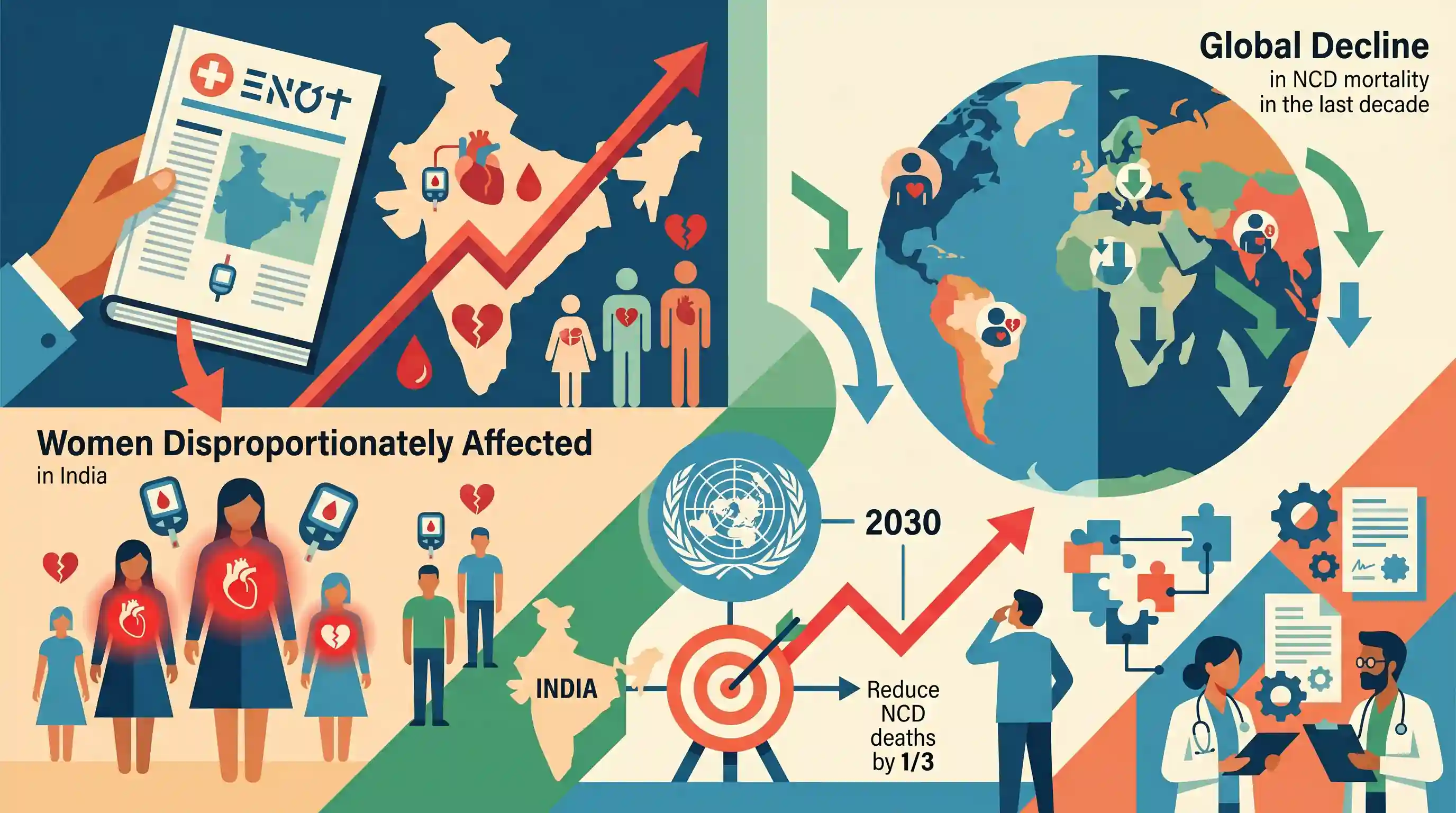
According to a recent Lancet study, India is experiencing an increased risk of premature mortality from chronic non-communicable diseases (NCDs) such as heart disease and diabetes, with women being disproportionately affected. This trend contrasts with the global decline in NCD mortality observed in a majority of countries over the last decade. The findings underscore significant public health challenges in India and highlight the pressing need for targeted healthcare policies to meet the UN Sustainable Development Goal of reducing premature NCD deaths by one-third by 2030.
Key Points
- A new Lancet study reveals that the risk of dying prematurely from chronic non-communicable diseases (NCDs) like heart disease and diabetes has increased in India.
- This rising risk of NCD mortality in India disproportionately affects women more than men, contrasting with a broader global trend of declining NCD deaths.
- Globally, deaths from cardiovascular disease and cancer have declined in most countries, but increases in deaths from dementia, alcohol use disorders, and certain cancers are counteracting these gains.
- The findings highlight the urgent need for targeted healthcare interventions to meet the UN Sustainable Development Goal (SDG) of reducing premature NCD mortality by one-third by 2030.
Important Terms
Non-Communicable Diseases (NCDs)

Chronic medical conditions (e.g., heart disease, cancer, diabetes) not transmitted person-to-person, caused by genetic, physiological, environmental, and behavioral factors.
UPSC context
GS Paper II: Health. Core topic for social sector development, demographic dividend, and public health policy challenges.
Sustainable Development Goals (SDG)
A collection of 17 interlinked global goals adopted by the UN in 2015; Goal 3.4 specifically targets a one-third reduction in premature NCD mortality by 2030.
UPSC context
GS Paper II & III: International institutions and development. Tests knowledge of global commitments and India's progress toward health targets.
World Health Organization (WHO)
A specialized agency of the United Nations responsible for international public health, setting global standards, and monitoring health trends like NCD mortality.
UPSC context
GS Paper II: Important International institutions. Focuses on their role in global governance and health security.
The Lancet
One of the world's oldest and most prestigious peer-reviewed medical journals, frequently cited for authoritative data on global health burdens and disease trends.
UPSC context
GS Paper II: Used as a credible source for evidence-based policy making and health data analysis in India.
National Programme for Prevention and Control of NCDs (NP-NCD)
India's flagship health initiative (formerly NPCDCS) aimed at infrastructure strengthening, human resource development, health promotion, early diagnosis, and management of chronic diseases.
UPSC context
GS Paper II: Government schemes and interventions for social sector development. Essential for discussing India's specific healthcare response.
Prelims Trap
Premature mortality from NCDs is declining in India in line with global trends, with men being the most vulnerable demographic.
Aspirants often assume India mirrors global health improvements and that cardiovascular/lifestyle diseases primarily affect men. This specific study proves the exact opposite for India.
Static Concepts Connected
What is the 'Epidemiological Transition' and India's 'Double Burden'?
- Epidemiological Transition: The demographic shift from infectious and communicable diseases to chronic, non-communicable diseases (NCDs) as populations age and lifestyles change.
- Double Burden: The unique challenge for developing nations like India of simultaneously battling persistent communicable diseases (TB, Malaria) alongside rapidly rising NCDs (Diabetes, Heart Disease).
What are the key UN Sustainable Development Goal (SDG) targets for NCDs?
- Target 3.4: SDG Target 3.4 explicitly mandates reducing premature mortality from non-communicable diseases by one-third by 2030 through prevention and treatment.
- Universal Coverage: SDG Target 3.8 focuses on achieving Universal Health Coverage, which is critical for providing equitable access to essential NCD medicines and diagnostics.
Cross-Topic Patterns
NCDs + Female Labour Force Participation
The rising NCD burden among women directly impacts their economic productivity, creating a hidden health barrier that further suppresses India's already low Female Labour Force Participation Rate (FLFPR).
Urbanization + The Nutrition Transition
Unplanned urbanization, sedentary jobs, and shifting dietary patterns (the nutrition transition) are the core geographical and societal drivers behind India's localized NCD spike despite global declines.

Expect a multi-statement question contrasting India's rising female NCD mortality with global declines and SDG 3.4 targets in Prelims 2026.
Linked PYQs · 3
Linked PYQs · 3
- 2024MainsGS2
In a crucial domain like the public healthcare system the Indian State should play a vital role to contain the adverse impact of marketisation of the system. Suggest some measures through which the State can enhance the reach of public healthcare at the grassroots level.
- 2020MainsGS2
In order to enhance the prospects of social development, sound and adequate health care policies are needed particularly in the fields of geriatric and maternal health care. Discuss.
- 2021MainsGS2
“Besides being a moral imperative of a Welfare State, primary health structure is a necessary precondition for sustainable development.” Analyze.
