Socioeconomic Barriers to Tribal Children Education in India
Source:The Hindu ↗
Why It Matters
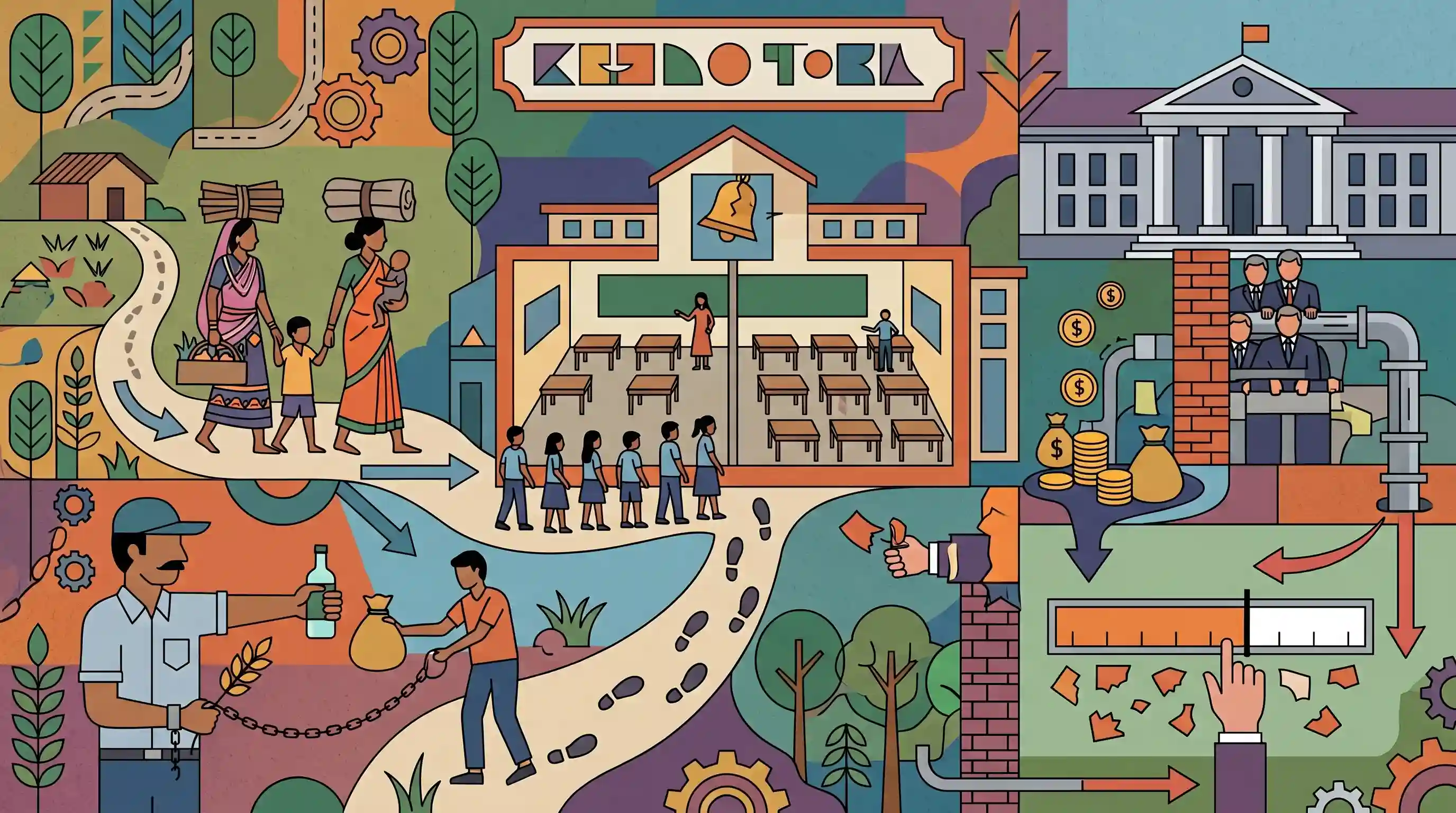
The article highlights systemic and socio-economic barriers to tribal education, such as seasonal migration, teacher shortages, and fund underutilization. It is crucial for understanding the ground realities of human resource development and evaluating the performance of welfare schemes for vulnerable sections, which are key themes in GS Paper II (Social Justice) and GS Paper I (Indian Society).
Summary
Seasonal migration, exploitation of tribal laborers, and structural deficits in schools significantly hinder the education of tribal children in Karnataka. High dropout rates are largely driven by families frequently moving for work, while exploitative practices by employers—such as offering alcohol as an incentive—exacerbate social vulnerabilities. Furthermore, schools for tribal students suffer from a severe shortage of teachers, and government funds earmarked for tribal welfare remain underutilized due to a lack of administrative will. Officials note that only 58% of tribals are making academic progress, underscoring the need for better policy implementation, structural reforms in tribal schools, and stronger measures to prevent the exploitation of vulnerable laborers.
Key Points
- Seasonal migration by tribal communities in search of work leads to a high dropout rate among tribal children and disrupts their education.
- Exploitative practices by employers, such as providing alcohol to keep tribal laborers engaged, destabilize families and affect children's welfare.
- Government funds allocated for tribal welfare are often unutilized or ineffectively spent due to a lack of administrative will among officials.
- Schools catering to tribal children face structural issues, including a significant shortage of teachers.
- Only around 58% of tribals are progressing academically, necessitating urgent targeted educational and social interventions.
Important Terms
Karnataka State Tribal Research Institute (KSTRI)

A Mysore-based state institution that conducts research, documentation, and evaluation of welfare schemes to support the socio-economic development and policy-making for Scheduled Tribes in Karnataka.
UPSC context
GS Paper II: Welfare schemes; GS Paper I: Social Empowerment. Tests knowledge of institutional mechanisms for protecting vulnerable sections.
Seasonal Migration
The temporary movement of tribal families in search of livelihood (e.g., coffee plantations), which serves as a primary driver for high school dropout rates and disrupted learning cycles among tribal children.
UPSC context
GS Paper I & II: Social issues, Education, and Human Resources. Tests understanding of structural barriers to inclusive growth and development.
Scheduled Tribe Component (STC)
A budgetary mechanism (formerly Tribal Sub-Plan) requiring Central and State ministries to earmark a specific percentage of funds exclusively for the integrated development of Scheduled Tribes.
UPSC context
GS Paper II & III: Governance, Budgeting, and Welfare. Tests knowledge of fiscal tools for social justice and administrative accountability.
Eklavya Model Residential Schools (EMRS)
A flagship Central scheme providing high-quality residential education to ST students in remote areas, aiming to bridge the educational gap and enable access to professional courses and employment.
UPSC context
GS Paper II: Education and Human Resources. Focuses on government interventions for tribal empowerment and their practical performance.
Ashram Schools
Specialized residential schools for tribal children, often located in remote areas, designed to provide education while overcoming the barriers of geographical isolation and parental migration.
UPSC context
GS Paper II: Social Sector/Services relating to Education. Relevant for analyzing infrastructure and structural deficits in tribal-specific educational models.
Chamarajanagar University
A public university in Karnataka whose leadership is actively involved in advocating for tribal educational reforms and investigating the socio-economic challenges faced by forest-dwelling communities.
UPSC context
GS Paper II: Role of educational institutions in social development. Tests awareness of regional academic actors in policy discourse.
Prelims Trap
Funds allocated under the Tribal Sub-Plan (TSP) are strictly non-lapsable and immune to diversion.
TSP funds frequently suffer from massive underutilization and diversion to general state infrastructure, a chronic governance issue repeatedly flagged by the CAG.
Static Concepts Connected
What are the core features of Eklavya Model Residential Schools (EMRS)?
- Objective: Provide quality middle and high-level education to ST students in remote areas.
- Criteria: Targeted in blocks with over 50% ST population and at least 20,000 tribal persons.
- Nodal Body: Managed by the National Education Society for Tribal Students (NESTS) under the Ministry of Tribal Affairs.
What is the Tribal Sub-Plan (TSP) strategy?
- Allocation Mandate: Mandates that central and state budgets allocate funds proportional to the ST population percentage for their direct development.
- Implementation Challenges: Plagued by chronic underutilization, diversion of funds to general schemes, and a lack of participatory planning.
Cross-Topic Patterns
Seasonal Migration vs. RTE Act
Circular migration of vulnerable families often renders Right to Education (RTE) guarantees ineffective, linking GS1 population dynamics with GS2 constitutional rights and education deficits.
Article 23 & Labour Exploitation
Using alcohol as a wage incentive for vulnerable tribals borders on debt bondage, connecting tribal welfare directly to Fundamental Rights (Article 23) and labor laws.

Expect a 2026 mains question linking structural failures of EMRS (teacher shortages) with circular migration of tribal labour.
Linked PYQs · 4
Linked PYQs · 4
- 2019MainsGS2
Performance of welfare schemes that are implemented for vulnerable sections is not so effective due to absence of their awareness and active involvement at all stages of policy process. Discuss.
- 2023MainsGS2
The crucial aspect of development process has been the inadequate attention paid to Human Resource Development in India. Suggest measures that can address this inadequacy.
- 2025MainsGS1
Does tribal development in India centre around two axes, those of displacement and of rehabilitation? Give your opinion.
- 2023MainsGS2
“Development and welfare schemes for the vulnerable, by its nature, are discriminatory in approach.” Do you agree? Give reasons for your answer.
