Forum Shopping Challenges in Legal Litigation Over Waqf Act
Source:Indian Express ↗
Why It Matters
It illustrates the practical challenges in India's judicial system—such as forum shopping and PIL misuse—while addressing fundamental constitutional debates about the limits of state intervention in the administration of religious properties.
Summary
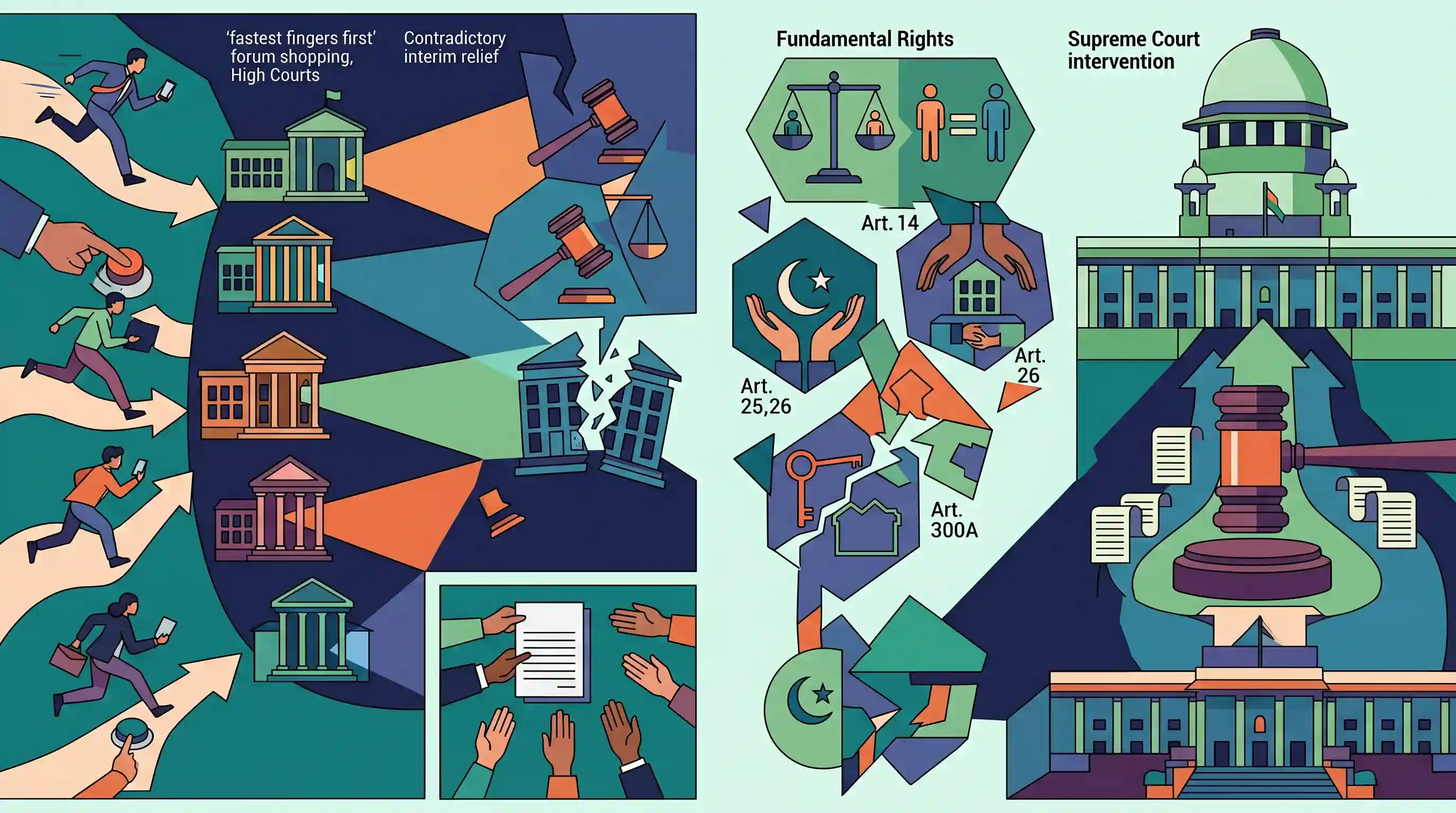
The article analyzes the legal turbulence surrounding the challenges to the Waqf Act, highlighting a trend where litigants rush to various High Courts to obtain quick interim relief—a phenomenon described as a 'game of fastest fingers first'. This forum shopping fragments the legal process, leading to potentially conflicting judgments on complex constitutional issues involving religious freedom (Articles 25 and 26), equality (Article 14), and property rights (Article 300A). Consequently, the Supreme Court is often forced to intervene, consolidating petitions to ensure a uniform constitutional interpretation. The debate brings to the fore critical UPSC topics such as the misuse of Public Interest Litigation (PIL), the balance of secularism with religious minority rights, and the systemic challenges within India's judicial structure.
Key Points
- The challenge to the Waqf Act has triggered a race among petitioners to file cases in different High Courts, characterized as a legal game of 'fastest fingers first'.
- This practice, akin to forum shopping, aims at securing favorable interim stay orders, which can lead to multiplicity of proceedings and conflicting judgments across jurisdictions.
- The underlying constitutional disputes involve the balance between the State's secular oversight and the autonomy of religious denominations under Articles 25 and 26, as well as property rights under Article 300A.
- Such fractured litigation often requires the Supreme Court to invoke its powers under Article 139A to transfer and consolidate cases to ensure uniform interpretation of the law.
- The scenario underscores broader systemic issues regarding the management of Public Interest Litigations (PILs) and the role of specialized tribunals.
Important Terms
Waqf Act, 1995

The primary central legislation regulating Muslim religious and charitable endowments in India, establishing a statutory framework for the administration of waqf properties through Boards and Tribunals.
UPSC context
GS Paper II (Governance/Minority Rights); tests the statutory framework for managing religious institutions and secularism in India.
Waqf (Amendment) Bill, 2024
Proposed legislation seeking to reform waqf governance by including non-Muslim members in boards, empowering District Collectors in property disputes, and allowing High Court appeals from Tribunal decisions.
UPSC context
GS Paper II (Judicial Review/Governance); tests current legislative debates on religious autonomy versus state oversight.
Forum Shopping
The practice of litigants deliberately choosing a specific court or bench where they expect a more favorable outcome, often leading to fragmented and conflicting judicial orders.
UPSC context
GS Paper II (Judiciary); tests understanding of judicial efficiency, legal ethics, and systemic challenges in the Indian legal process.
Article 139A
Constitutional provision empowering the Supreme Court to transfer cases involving similar substantial questions of law from High Courts to itself to ensure a uniform judicial interpretation.
UPSC context
GS Paper II (Judiciary); tests knowledge of the Supreme Court's supervisory jurisdiction and its role in maintaining legal consistency.
Waqf Board
Statutory state-level bodies established to act as custodians of waqf properties, ensuring they are registered and managed according to Islamic law for charitable purposes.
UPSC context
GS Paper II (Statutory Bodies); tests knowledge of the institutional structure for managing minority endowments.
Waqf Tribunal
Specialized quasi-judicial bodies established by state governments to resolve disputes concerning waqf properties, historically possessing the authority of a civil court with finality in its decisions.
UPSC context
GS Paper II (Administrative Law); tests understanding of specialized adjudication mechanisms and the impact of removing their finality.
Prelims Trap
Under Article 26, religious denominations have an absolute fundamental right to administer their property.
Article 26(d) explicitly limits this by stating administration must be 'in accordance with law.' The State can constitutionally regulate secular aspects of religious property.
Static Concepts Connected
What is Article 139A regarding the Supreme Court's power to transfer cases?
- 42nd Amendment: Introduced in 1976, it empowers the SC to withdraw and consolidate cases pending in different High Courts involving the same substantial question of law.
- Core Objective: Prevents fragmented litigation, avoids conflicting judgments across jurisdictions, and curbs 'forum shopping' by petitioners seeking favorable interim stays.
How do Articles 26 and 300A govern the administration of religious property?
- Article 26(d): Grants religious denominations the fundamental right to administer property, but strictly 'in accordance with law', permitting State regulation of secular administration.
- Article 300A: Ensures no person is deprived of property save by authority of law. It acts as a constitutional backstop against arbitrary state acquisition of religious endowments.
Cross-Topic Patterns
Waqf Act & Article 300A
Debates over Waqf tribunal powers overlap with Article 300A, examining how the State regulates or acquires endowed property without violating constitutional safeguards.
Secular Administration vs. ERP
Connects to Sabarimala and Hijab jurisprudence, where courts must constantly draw a line between secular property management and essential religious practices under Articles 25 and 26.

Expect a multi-statement polity question testing Article 139A (case transfers) alongside Article 26's limits on religious property rights.
Linked PYQs · 5
Linked PYQs · 5
- 2024MainsGS2
Explain the reasons for the growth of public interest litigation in India. As a result of it, has the Indian Supreme Court emerged as the world's most powerful judiciary ?
- 2024MainsGS2
Discuss India as a secular state and compare with the secular principles of the US constitution.
- 2025MainsGS2
Comment on the need of administrative tribunals as compared to the court system. Assess the impact of the recent tribunal reforms through rationalization of tribunals made in 2021.
- 2021PrelimsGS1
What is the position of the Right to Property in India?
- 2020PrelimsGS1
Consider the following statements: 1. The Constitution of India defines its 'basic structure' in terms of federalism, secularism, fundamental rights and democracy. 2. The Constitution of India provides for 'judicial review' to safeguard the citizens' liberties and to preserve the ideals on which the Constitution is based. Which of the statements given above is/are correct?
