Attention Economy and Social Media Misinformation Challenges
Source:Indian Express ↗
Why It Matters
Important for GS4 (ethics in digital communication and corporate governance), GS3 (security challenges posed by social media and fake news), and GS2 (regulatory frameworks for digital media). It provides strong arguments on how the design of digital platforms affects public discourse.
Summary
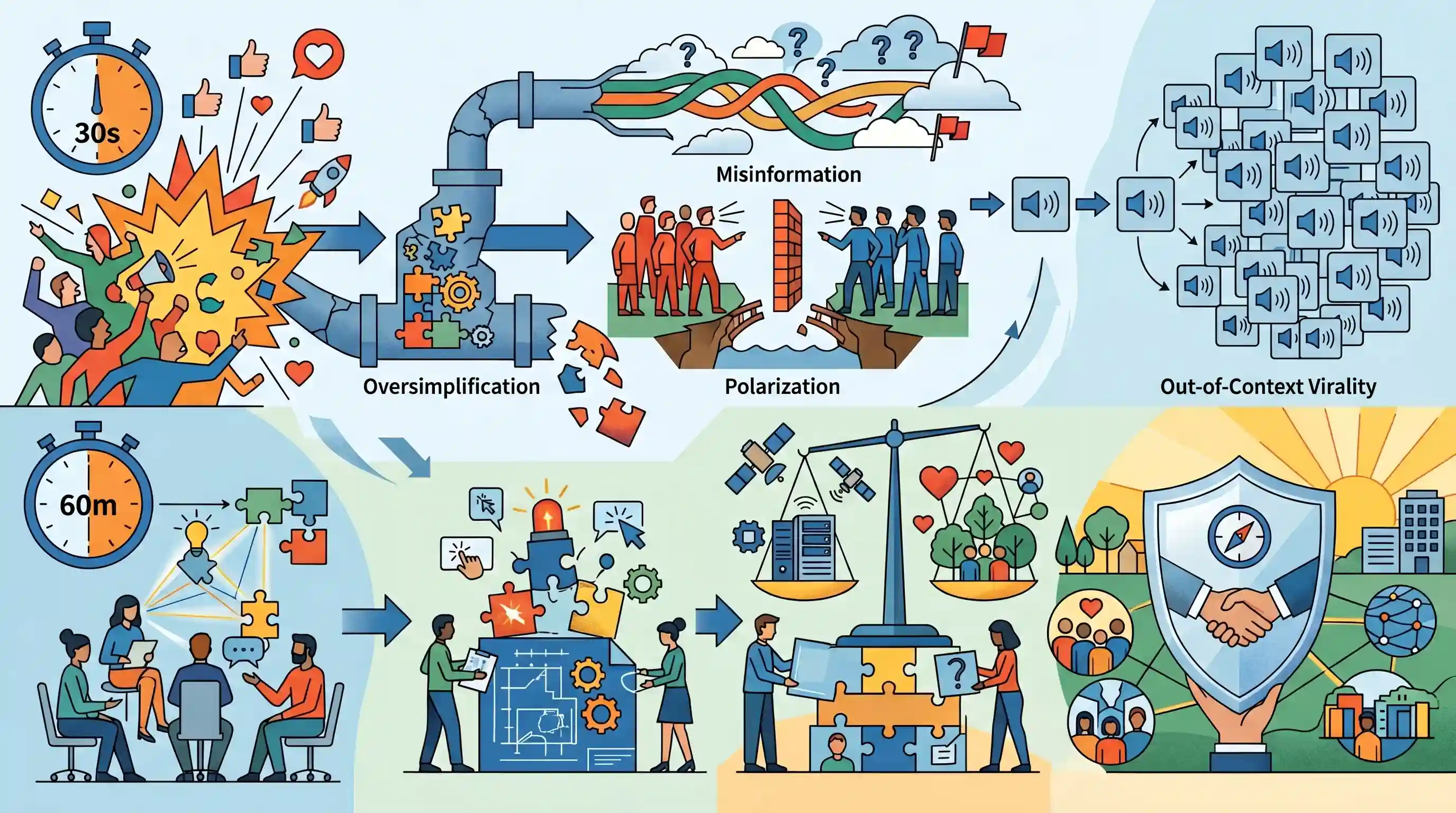
The article highlights the adverse impacts of the attention economy, wherein short, sensationalized 30-second clips dominate over nuanced, 60-minute conversations. This trend risks oversimplifying complex issues, fostering misinformation, and polarizing digital discourse through out-of-context virality. It emphasizes the ethical responsibility of tech leaders to 'build and communicate responsibly,' urging them to design algorithms that promote constructive dialogue rather than mere engagement. The piece underscores the need for a balance between technological innovation and social accountability to safeguard the integrity of public conversations in the digital age.
Key Points
- The rise of short-form content compromises nuanced discussions, as out-of-context 30-second clips overshadow long-form 60-minute conversations.
- Virality driven by algorithms prioritizing engagement often leads to misinformation, polarization, and a superficial understanding of public issues.
- Tech leaders bear an ethical responsibility to build platforms and algorithms that prioritize responsible communication and social harmony over pure attention metrics.
- Addressing the negative externalities of social media requires both ethical corporate governance and robust regulatory frameworks to manage digital discourse effectively.
Important Terms
Information Technology (Intermediary Guidelines and Digital Media Ethics Code) Rules, 2021

A legal framework regulating social media, OTT, and digital news, mandating grievance redressal and ethics codes to ensure accountability of digital intermediaries under the IT Act, 2000.
UPSC context
GS 2 (Governance) & GS 3 (Internal Security); tests knowledge of digital regulation and platform accountability.
Attention Economy
An economic model treating human attention as a scarce commodity, incentivizing platforms to use engagement-driven algorithms that often prioritize sensationalized content over nuanced dialogue.
UPSC context
GS 4 (Ethics) & GS 3 (Technology); relevant to digital ethics, misinformation, and cognitive autonomy.
Big Tech
Dominant global technology corporations (e.g., Meta, Google) that exercise immense control over data, market competition, and public discourse, often acting as digital gatekeepers.
UPSC context
GS 3 (Economics/Technology); focuses on anti-trust, data monopolies, and the regulation of global tech giants.
Social Media Intermediaries
Entities that facilitate online interaction between users. Under Indian law, those with over 50 lakh registered users are classified as Significant Social Media Intermediaries (SSMIs).
UPSC context
GS 3 (Internal Security); examines the role of platforms in information dissemination and their legal duties.
Misinformation
False or inaccurate information spread online, which can lead to social polarization, communal tension, and internal security threats when amplified by viral algorithms.
UPSC context
GS 3 (Internal Security); tests understanding of cyber challenges and the impact of social media on public order.
Algorithmic Accountability
The ethical and legal obligation for tech firms to be transparent and responsible for the social impacts, biases, and harms generated by their automated ranking systems.
UPSC context
GS 4 (Ethics) & GS 2 (Governance); discusses responsible innovation and the need for transparent digital governance.
Prelims Trap
"Social media platforms enjoy absolute 'safe harbour' immunity from content posted by users under the Information Technology Act."
Safe harbour (Section 79) is conditional. Intermediaries lose this immunity if they fail to comply with due diligence mandates under the IT Rules 2021.
Static Concepts Connected
What are the mandates for Significant Social Media Intermediaries (SSMIs) under IT Rules 2021?
- User Threshold: Platforms with over 50 lakh registered Indian users qualify as SSMIs, triggering stricter regulatory compliance and oversight.
- Appointed Officers: Must appoint a Chief Compliance Officer, a Nodal Contact Person, and a Resident Grievance Officer, all of whom must be Indian residents.
- First Originator: Messaging platforms must enable the identification of the 'first originator' of information to help law enforcement trace the source of severe offenses.
How does the 'Attention Economy' challenge media ethics and democratic discourse?
- Attention Commodification: Human attention is treated as a scarce, monetizable resource, incentivizing platforms to deploy addictive designs that maximize user retention for ad revenue.
- Algorithmic Bias: To maximize engagement, algorithms disproportionately promote sensational, emotionally charged, and polarizing content over factual, nuanced information.
- Echo Chambers: Engagement loops reinforce users' existing beliefs, limiting exposure to alternative viewpoints and degrading the capacity for constructive democratic debate.
Cross-Topic Patterns
Algorithmic amplification + Internal Security
The engagement-driven attention economy directly overlaps with GS3 internal security, as algorithms inadvertently amplify disinformation, hate speech, and radicalization to maximize screen time.
Corporate Governance + Tech Ethics
Tech companies face a GS4 ethical dilemma: optimizing algorithms for shareholder profit (engagement metrics) versus prioritizing social accountability (curbing fake news and polarization).

Expect a GS3 Mains question evaluating how the 'attention economy' and algorithmic amplification act as threats to internal security.
Linked PYQs · 2
Linked PYQs · 2
- 2025MainsGS4
In the present digital age, social media has revolutionised our way of communication and interaction. However, it has raised several ethical issues and challenges. Describe the key ethical dilemmas in this regard.
- 2024MainsGS3
Social media and encrypting messaging services pose a serious security challenge. What measures have been adopted at various levels to address the security implications of social media? Also suggest any other remedies to address the problem.
