Former management institute director jailed over fraud and harassment
Source:The Hindu ↗
Why It Matters
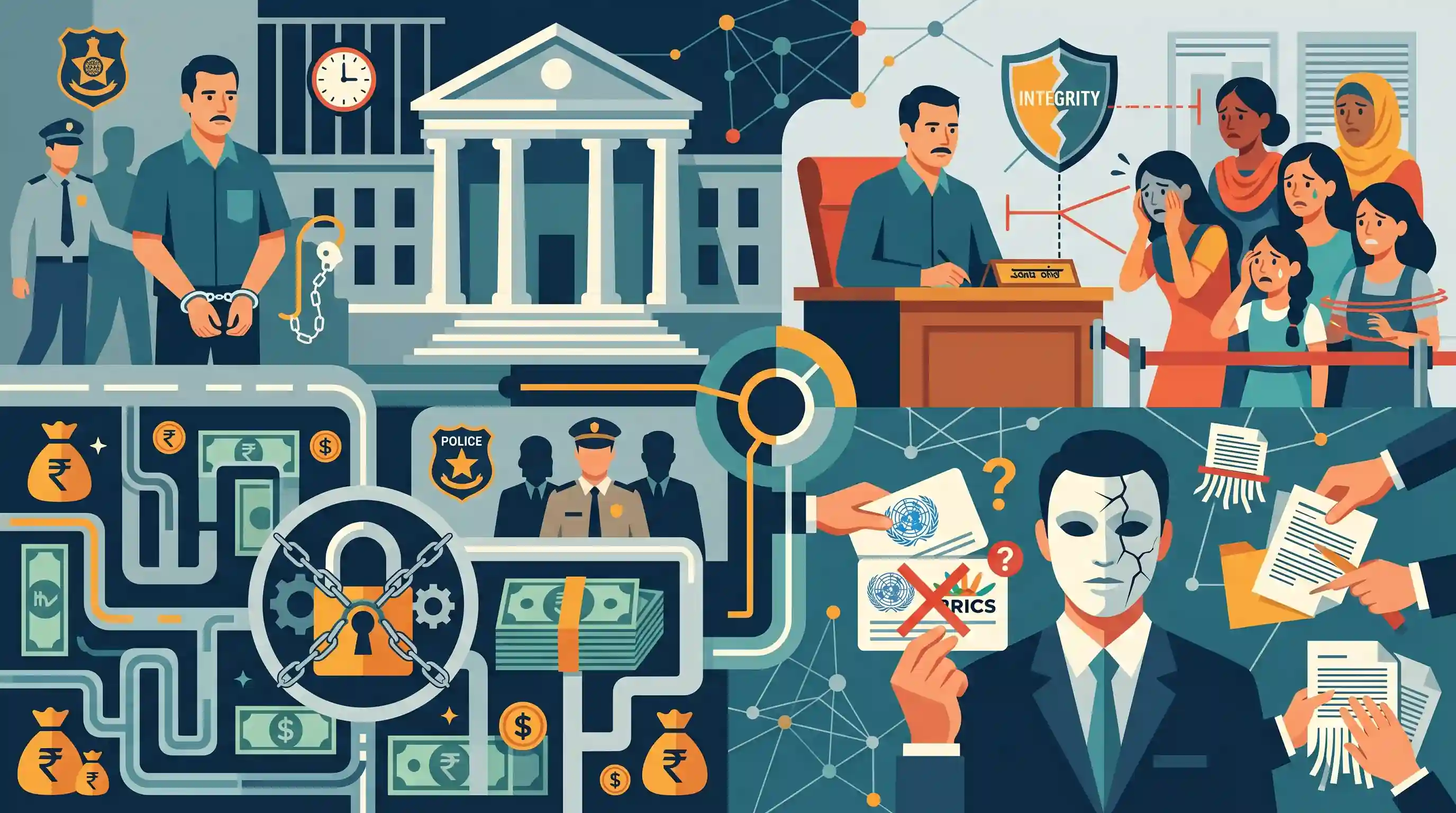
The case exemplifies severe breaches of institutional integrity, highlighting the ongoing vulnerability of students to sexual harassment in educational settings. It also underscores the nexus between white-collar crimes—such as financial fraud and forgery—and abuses of power, emphasizing the need for robust grievance redressal mechanisms and stricter financial scrutiny within institutions.
Summary
Chaitanyananda Saraswati, the former director of Shri Sharada Institute of Indian Management and Research, was remanded to 14 days in judicial custody by a Delhi court. He faces serious allegations, including the sexual harassment of female students, cheating, forgery, and criminal conspiracy. During the investigation, the Delhi Police froze ₹8 crore linked to his bank accounts after noting suspicious transactions. The probe also revealed that he carried fake visiting cards falsely claiming affiliations with the UN and BRICS, illustrating a severe breach of institutional ethics and white-collar fraud.
Key Points
- A Delhi court remanded Chaitanyananda Saraswati to 14-day judicial custody over charges of sexual harassment, cheating, and criminal conspiracy.
- As the former director of a management institute in Vasant Kunj, he allegedly exploited his position to harass female students.
- Authorities froze ₹8 crore from accounts linked to him after uncovering suspicious financial activity and cash withdrawals post-FIR.
- The accused was found in possession of fraudulent credentials claiming false associations with international bodies like the UN and BRICS.
Important Terms
Judicial Custody

Legal detention of an accused in a prison under a magistrate's order, distinct from police custody. The accused remains in the judiciary's care, limiting police interrogation without specific court permission.
UPSC context
GS Paper II: Tests knowledge of criminal justice procedures, fundamental rights, and the separation of powers between the executive and the judiciary.
Bharatiya Nyaya Sanhita (BNS)
The primary criminal law governing India since July 2024, replacing the colonial-era Indian Penal Code. It modernized the definitions of crimes including sexual harassment, fraud, and criminal conspiracy.
UPSC context
GS Paper II: Vital for understanding legal reforms and the contemporary framework for addressing institutional and social crimes.
BRICS
An influential intergovernmental alliance of major emerging economies (Brazil, Russia, India, China, South Africa, etc.) focused on fostering economic, political, and cultural cooperation among member states.
UPSC context
GS Paper II: Key for International Relations, testing India’s role in multilateral forums and the geopolitical significance of regional groupings.
United Nations (UN)
An international organization established in 1945 to maintain global peace and security. It includes specialized agencies like ECOSOC, often misrepresented by fraudsters to claim false institutional legitimacy.
UPSC context
GS Paper II: Core topic in International Relations, focusing on the role and structure of global governance institutions.
Money Laundering
The illegal process of making large amounts of money generated by criminal activity appear to come from a legitimate source, often involving complex financial transactions.
UPSC context
GS Paper III: Important for Internal Security and Economy, testing mechanisms like the PMLA used to combat financial crimes.
Probity in Governance
The adherence to high ethical standards, transparency, and integrity in public and institutional administration, ensuring that power is exercised for the common good rather than personal gain.
UPSC context
GS Paper IV: Essential for Ethics, evaluating the understanding of institutional accountability and the consequences of moral failure.
Prelims Trap
"The POSH Act, 2013 applies exclusively to formalized employer-employee relationships and excludes university students."
The POSH Act defines "workplace" broadly to include educational institutions, and an "aggrieved woman" includes students, not just formal employees.
Static Concepts Connected
How does the POSH Act protect women in educational institutions?
- Workplace Definition: The Act explicitly includes educational and research institutions under its broad definition of a workplace.
- Aggrieved Woman Scope: It covers students, researchers, and visitors, ensuring protection regardless of whether they have an employment contract.
- ICC Mandate: It mandates the formation of an Internal Complaints Committee (ICC) to address grievances against staff or management.
What is the legal basis for police to freeze bank accounts?
- BNSS Authority: Under Section 106 of the BNSS (formerly Sec 102 CrPC), police can freeze assets suspected to be stolen or linked to a crime.
- Magistrate Intimation: The investigating officer must promptly report the seizure or freezing of accounts to the Magistrate having jurisdiction.
Cross-Topic Patterns
GS4: Leadership vs Abuse of Power
The dual charge of sexual harassment and financial fraud offers a prime GS4 case study on the lack of probity, fiduciary failure, and abuse of power by educational leaders.
White-Collar Crime and Financial Fraud
The use of fake international credentials (UN, BRICS) to facilitate ₹8 crore in suspicious transactions highlights the sophistication of modern white-collar crimes demanding strict BNSS/PMLA enforcement.

Expect a GS2 or GS4 question evaluating the effectiveness of Internal Complaints Committees (ICCs) in higher educational institutions.
Linked PYQs · 3
Linked PYQs · 3
- 2023MainsGS2
Explain the constitutional perspectives of Gender Justice with the help of relevant Constitutional Provisions and case laws.
- 2024MainsGS4
“The 'Code of Conduct' and 'Code of Ethics' are the sources of guidance in public administration. There is code of conduct already in operation, whereas code of ethics is not yet put in place. Suggest a suitable model for code of ethics to maintain integrity, probity and transparency in governance.”
- 2021MainsGS3
Discuss how emerging technologies and globalisation contribute to money laundering. Elaborate measures to tackle the problem of money laundering both at national and international levels.
