US Lawmaker Demands White House Briefing on TikTok Deal
Source:Indian Express ↗
Why It Matters
The TikTok divestment saga illustrates the practical challenges of 'tech decoupling' and securing national data assets from adversarial states. It serves as a crucial global case study for India's own digital sovereignty strategies, including its approach to foreign app bans, social media intermediary guidelines, and safeguarding democratic discourse from algorithmic manipulation.
Summary
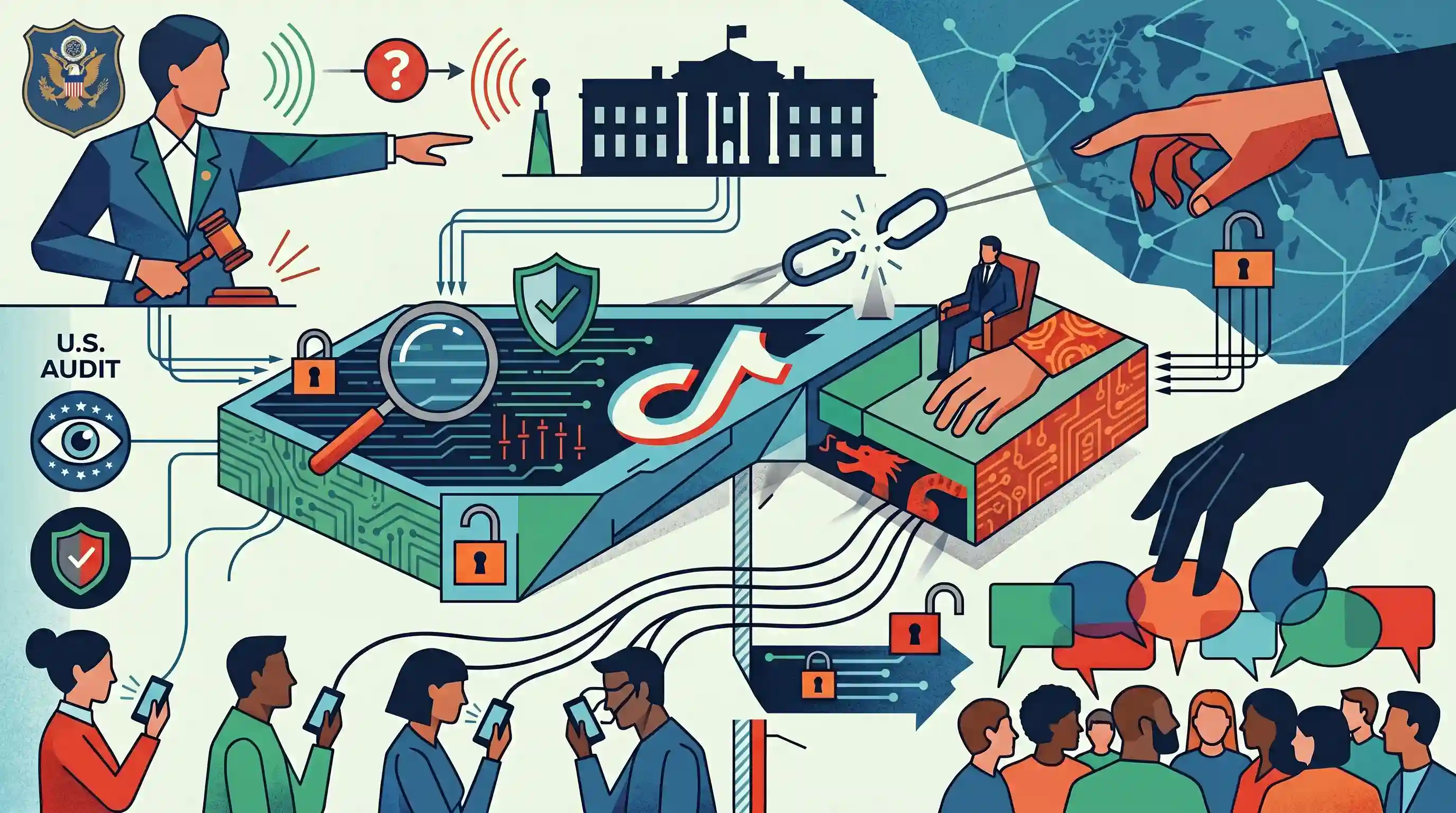
The chairman of the US House Select Committee on the Chinese Communist Party has demanded an urgent White House briefing regarding the framework deal to transition TikTok's US ownership. Despite assurances that the proposed $14 billion deal—which involves Oracle auditing the platform's algorithm—will protect user data, lawmakers and security experts remain concerned. They argue that allowing TikTok's Chinese parent company, ByteDance, to retain a minority stake and a board seat fails to fulfill the legal mandate of complete divestiture, potentially leaving the app vulnerable to Beijing's influence over US public discourse.
Key Points
- A US House committee chair, Rep. John Moolenaar, requested an urgent White House briefing to scrutinize the proposed TikTok divestment deal, stressing the need to entirely sever operational ties with ByteDance.
- The framework agreement values TikTok\'s US operations at approximately $14 billion, with a US consortium holding an 80% stake while ByteDance retains up to 20% and one board seat.
- US tech firm Oracle is slated to audit and monitor TikTok\'s highly engaging recommendation algorithm to ensure data security and mitigate bias.
- National security experts argue that any residual board presence or technical role for ByteDance circumvents the divestment law\'s mandate, enabling potential Chinese influence over US public discourse.
- The forced divestment reflects broader geopolitical tensions and US efforts to secure sovereign control over digital platforms and user data against perceived adversarial interference.
Important Terms
TikTok Divestment Law (PAFACA)

The 2024 federal law requiring TikTok’s parent company, ByteDance, to sell its US operations or face a nationwide ban due to national security concerns regarding foreign adversary control.
UPSC context
GS Paper II & III: International Relations and Cyber Security. Tests understanding of data sovereignty, legislation against foreign influence, and tech-geopolitics.
Select Committee on the Chinese Communist Party
A US House of Representatives committee created to investigate and provide policy recommendations on the economic, technological, and security challenges posed by the People’s Republic of China’s ruling party.
UPSC context
GS Paper II: Bilateral Relations. Important for analyzing legislative oversight in foreign policy and the strategic framing of US-China competition.
ByteDance
The Beijing-based multinational technology company that owns TikTok; its relationship with the Chinese state and data access laws are the primary drivers of US divestment demands.
UPSC context
GS Paper III: Internal Security/Cyber Security. Illustrates the risks of foreign-controlled digital infrastructure and the concept of 'technology decoupling.'
Oracle
A US-based software giant acting as TikTok’s 'trusted technology provider' to host US data domestically and audit the platform’s algorithms under the 'Project Texas' security framework.
UPSC context
GS Paper III: Science & Technology. Demonstrates technical mitigation strategies like algorithmic auditing, data localization, and public-private security partnerships.
Chinese Communist Party (CCP)
The founding and sole ruling party of China, which exercises pervasive control over private firms and data through national security laws, central to the US 'foreign adversary' designation.
UPSC context
GS Paper II: International Relations. Crucial for understanding the ideological and structural roots of the US-China 'New Cold War' and global digital governance.
US Supreme Court
The highest US judicial body, which plays a critical role in adjudicating the balance between national security-driven divestment mandates and constitutional protections like the First Amendment.
UPSC context
GS Paper II: Comparative Constitution/Polity. Relevant for analyzing how democratic judiciaries handle national security restrictions on digital speech and foreign ownership.
Prelims Trap
India addresses sovereign data threats from foreign social media apps by enforcing mandatory equity divestiture.
India regulates adversarial digital platforms primarily through outright bans under Section 69A of the IT Act, not through mandated corporate equity divestiture or forced sales.
Static Concepts Connected
What are the core powers under Section 69A of the IT Act, 2000?
- Blocking access: Empowers the Centre to block public access to any information generated, transmitted, or hosted in any computer resource.
- Statutory grounds: Can be invoked in the interest of sovereignty/integrity of India, defense, state security, friendly foreign relations, or public order.
- Confidentiality requirement: The specific requests, complaints, and proceedings under this blocking rule are mandated to remain strictly confidential.
How does Data Sovereignty differ from Data Localization?
- Data Sovereignty: The broader legal concept that digital data is subject to the laws and governance structures of the nation where it is collected.
- Data Localization: A specific physical manifestation of sovereignty requiring the storage of data on servers geographically located within a country's borders.
- Algorithmic Governance: Ensuring that algorithmic recommendation engines operate transparently and without foreign adversarial bias or manipulation.
Cross-Topic Patterns
Splinternet and Non-Tariff Barriers
Forced divestitures and national app bans are increasingly viewed as digital non-tariff barriers, blurring the lines between national security measures and technological protectionism in global trade.
Cognitive Warfare via Algorithms
The shift from protecting data storage to auditing recommendation engines highlights the emerging internal security threat of "cognitive warfare" and algorithmic narrative manipulation.

Expect a GS-3 mains question comparing India's IT Act Sec 69A app-blocking powers with Western "forced divestiture" balkanization models.
Linked PYQs · 3
Linked PYQs · 3
- 2024MainsGS3
Social media and encrypting messaging services pose a serious security challenge. What measures have been adopted at various levels to address the security implications of social media? Also suggest any other remedies to address the problem.
- 2016MainsGS3
Use of Internet and social media by non-state actors for subversive activities is a major security concern. How have these been misused in the recent past? Suggest effective guidelines to curb the above threat.
- 2021MainsGS2
“The USA is facing an existential threat in the form of a China, that is much more challenging than the erstwhile Soviet Union.” Explain.
