Maharashtra Mandates Piped Natural Gas in New Housing Projects
Source:Indian Express ↗
Why It Matters
This highlights the interplay between energy security, urban infrastructure, and global geopolitics. Expanding the CGD network mitigates reliance on volatile imported LPG, contributing to Sustainable Development Goals by ensuring reliable, clean energy access. It is highly relevant for GS3 Energy and Infrastructure discussions.
Summary
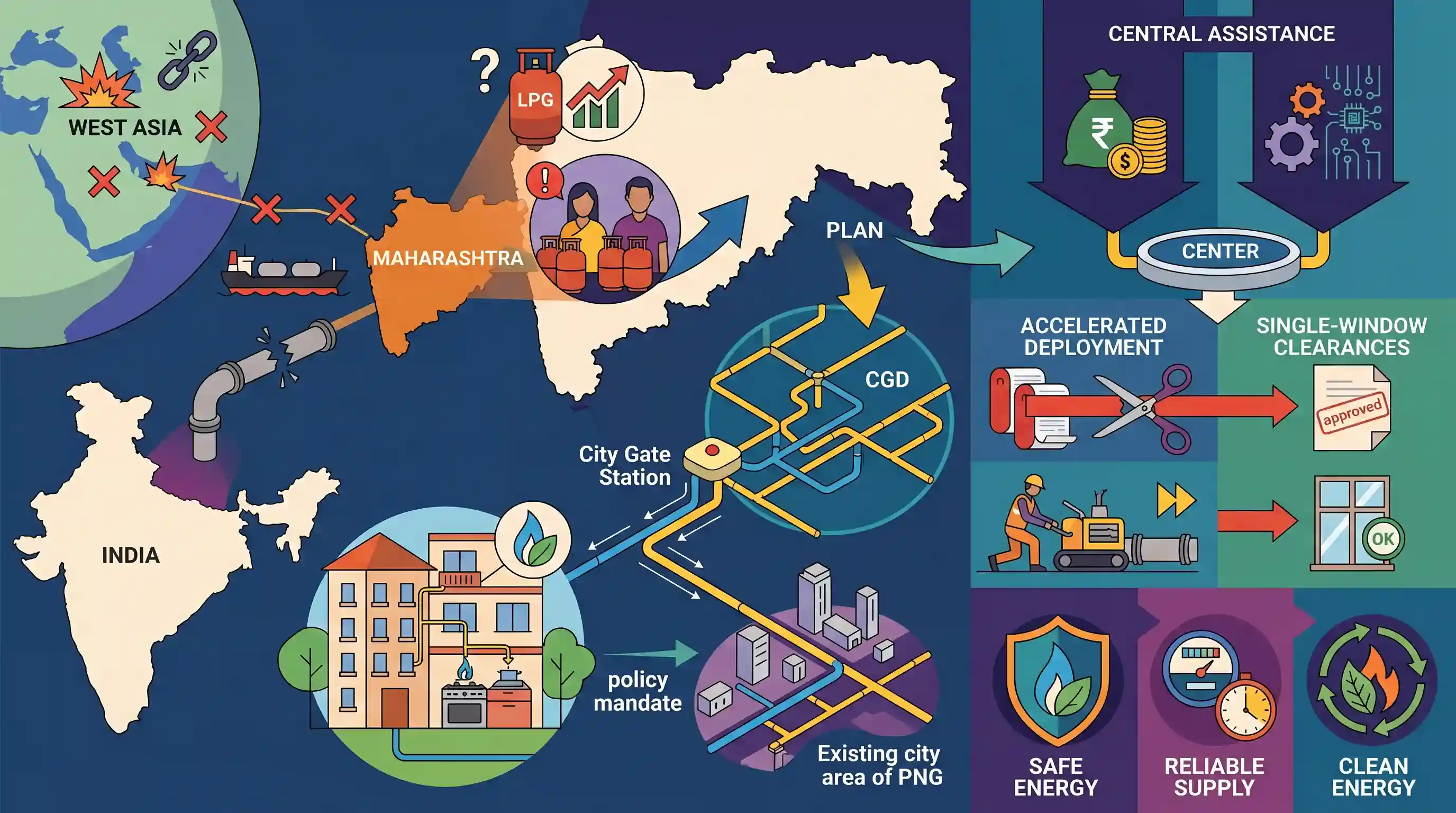
Maharashtra plans to mandate Piped Natural Gas (PNG) infrastructure in new housing projects, requiring central financial and technological assistance to expand its City Gas Distribution (CGD) network. Driven by concerns over LPG supply disruptions from West Asia conflicts, the transition to PNG aims to secure affordable, safe, and reliable clean energy for citizens. The state is accelerating deployment by streamlining pipeline-laying permissions and introducing single-window clearances.
Key Points
- Maharashtra government plans to make Piped Natural Gas (PNG) installations mandatory for new housing projects prior to granting completion certificates.
- The state has sought financial and technological assistance from the Centre to support the massive expansion of the City Gas Distribution (CGD) network.
- Volatility in West Asia threatening global LPG supply chains has underscored the strategic need to pivot toward domestic PNG networks.
- To expedite the rollout, Maharashtra is facilitating CGD operators by streamlining permissions, waiving certain NOCs, and providing single-window clearances.
Important Terms
City Gas Distribution (CGD) network

Interconnected underground pipeline infrastructure delivering Piped Natural Gas (PNG) to households/industries and Compressed Natural Gas (CNG) to transport sectors within a specific geographical area.
UPSC context
GS-3 (Infrastructure: Energy); tests understanding of India's target to increase gas in the energy mix to 15% by 2030.
Petroleum and Natural Gas Regulatory Board (PNGRB)
A statutory body established under the PNGRB Act, 2006, to regulate downstream petroleum/natural gas activities including refining, storage, and distribution while protecting consumer interests.
UPSC context
GS-3 (Energy Regulation/Statutory Bodies); tests knowledge of regulatory oversight and the distinction between upstream and downstream sectors.
Piped Natural Gas (PNG)
Natural gas (primarily methane) supplied directly to consumers via pipelines, offering a safer, cleaner, and more continuous alternative to pressurized LPG cylinders.
UPSC context
GS-3 (Energy); tests chemical composition differences (Methane vs Propane/Butane) and benefits for urban sustainable development.
Energy Security
The reliable and affordable supply of energy sources, vital for economic stability and national security by reducing dependence on vulnerable global supply routes.
UPSC context
GS-3 (Infrastructure/Security); tests analysis of India's import dependence and geopolitical risks (e.g., Strait of Hormuz conflict).
Single-window Clearance
A streamlined administrative mechanism where all necessary project clearances and approvals are provided through a single point of entry to reduce delays.
UPSC context
GS-3 (Economy/Infrastructure); tests measures for "Ease of Doing Business" and administrative reforms to expedite public infrastructure projects.
Prelims Trap
PNG primarily consists of propane and butane, making it heavier than air.
PNG is mostly methane and lighter than air, meaning it disperses safely. LPG is propane/butane and heavier than air, pooling dangerously upon leaks.
Static Concepts Connected
What distinguishes Piped Natural Gas (PNG) from Liquefied Petroleum Gas (LPG)?
- Chemical Composition: PNG is predominantly methane. LPG is a mixture of propane and butane.
- Vapor Density: PNG is lighter than air and dissipates quickly. LPG is heavier than air and settles at ground level, increasing fire risk.
What is the role of the Petroleum and Natural Gas Regulatory Board (PNGRB)?
- Statutory Origin: Established under the PNGRB Act, 2006 to regulate refining, processing, storage, transport, and distribution of petroleum/natural gas.
- CGD Authorization: It is the sole nodal agency authorizing entities to develop City Gas Distribution (CGD) networks for PNG/CNG.
Cross-Topic Patterns
Energy Security + West Asian Chokepoints
India imports roughly 60% of its LPG via maritime chokepoints like the Strait of Hormuz. Transitioning to domestic PNG shields urban households from geopolitical supply shocks.
Gas-Based Economy targets
Expanding the CGD network is vital for India's macroeconomic goal to raise natural gas from 6% to 15% of the primary energy mix by 2030.

A multi-statement question combining the chemical properties of PNG/LPG and PNGRB's statutory mandate is highly probable for Prelims 2026.
Linked PYQs · 2
Linked PYQs · 2
- 2018MainsGS3
“Access to affordable, reliable, sustainable and modern energy is the sine qua non to achieve Sustainable Development Goals (SDGs).” Comment on the progress made in India in this regard.
- 2016PrelimsGS1
'Net metering' is sometimes seen in the news in the context of promoting the
