Supreme Court Ruling on State Cess and Sales Tax Powers
Source:The Hindu ↗
Why It Matters
This judgment is vital for UPSC aspirants studying fiscal federalism, Centre-State financial relations, and the constitutional interpretation of legislative powers under the Seventh Schedule.
Summary
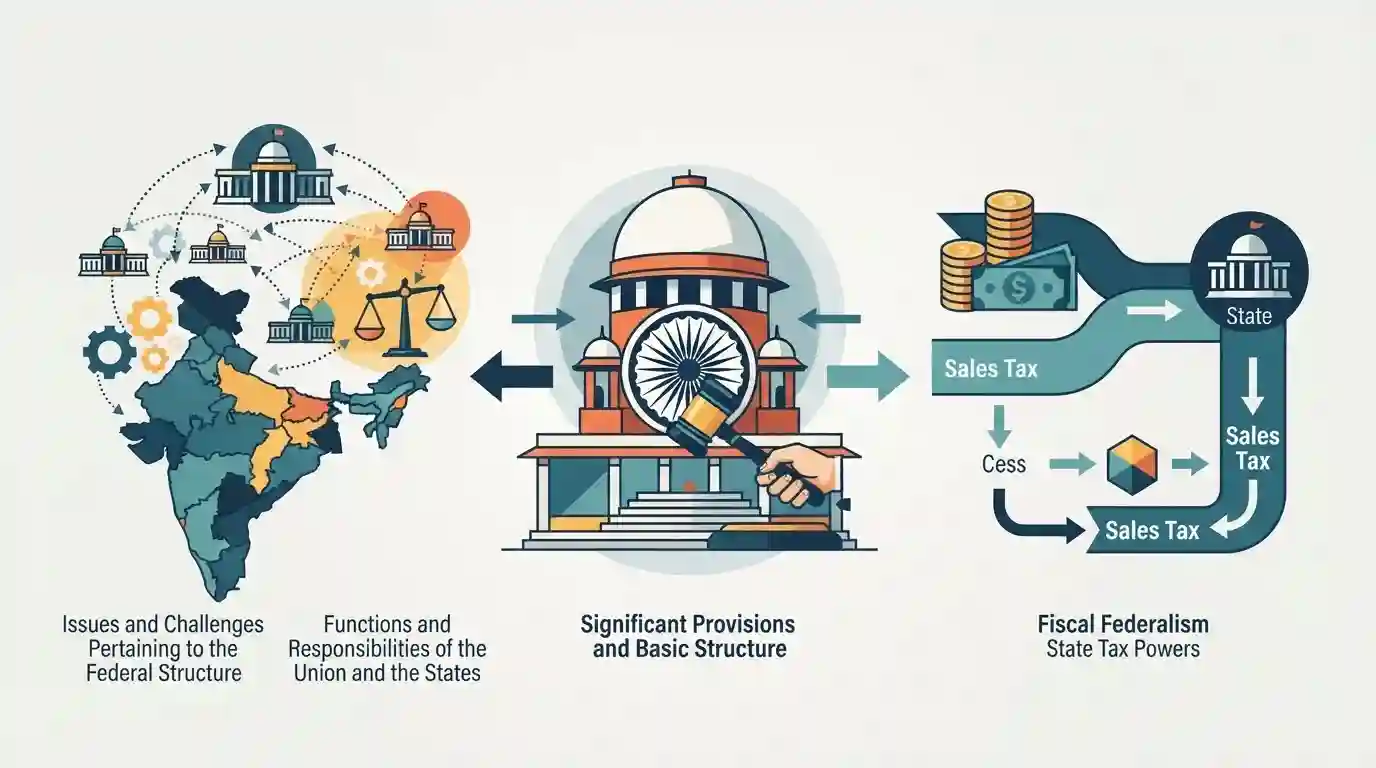
The Supreme Court of India held that a cess levied as an increment to sales tax remains within the legislative jurisdiction and scope of State governments, clarifying constitutional provisions concerning state tax powers and fiscal federalism.
Key Points
- The Supreme Court ruled that a cess levied as an increment to sales tax falls within the legislative competence of States.
- The judgment reinforces the scope of State taxing powers under the constitutional framework of fiscal federalism.
- Distinguishes between cesses levied as independent imposts versus those structured as increments to existing state-level taxes like sales tax.
Important Terms
Fiscal Federalism

The constitutional arrangement of financial and revenue-raising powers between the central government and state governments, outlining autonomy, resource sharing, and fiscal dependencies within a federal structure.
UPSC context
UPSC GS Paper II (Indian Constitution - Federal Structure, devolution of powers and financial relations between Union and States).
Cess and Surcharge
A tax levied on top of an existing tax or base rate, often utilized by governments to raise additional revenue for specific public purposes or general funds.
UPSC context
UPSC GS Paper II & III (Taxation powers, division of legislative powers, and resource mobilization).
Seventh Schedule
The division of legislative powers between Parliament and State Legislatures under the Seventh Schedule of the Constitution, delineating Union, State, and Concurrent Lists.
UPSC context
UPSC GS Paper II (Indian Constitution - Features, Distribution of Legislative Powers between Union and States).
Prelims Trap
GST abolished all state sales tax powers and rendered any pre-GST cess litigation entirely irrelevant.
Aspirants often assume GST abolished all state-level taxing powers entirely, missing that pre-GST arrears, transitional disputes, and specific non-GST items still involve historical List II interpretation.
Static Concepts Connected
What is the scope and constitutional significance of Entry 54 of List II (State List)?
- Scope: Deals exclusively with taxes on the sale or purchase of goods other than newspapers, subject to provisions of Entry 92A of List I.
- Post-GST Status: Significantly curtailed post-101st Constitutional Amendment Act (GST), which subsumed most indirect taxes into Goods and Services Tax.
Cross-Topic Patterns
Fiscal Federalism & GST Impact
State taxing powers under List II, Entry 54 are frequently tested alongside the post-2017 GST constitutional amendments and compensation cess mechanism.
State Autonomy & Fiscal Federalism
The constitutional debate over 'tax on tax' and incidental cesses connects cooperative federalism with judicial review of state fiscal autonomy.

Supreme Court rulings on State List taxing powers (Entry 54) and cess distinctions will likely feature in federalism MCQs.
Linked PYQs · 3
Linked PYQs · 3
- 2023MainsGS2
Explain the significance of the 101st Constitutional Amendment Act. To what extent does it reflect the accommodative spirit of federalism?
- 2025MainsGS2
Examine the evolving pattern of Centre-State financial relations in the context of planned development in India. How far have the recent reforms impacted the fiscal federalism in India?
- 2024PrelimsGS1
Which one of the following statements is correct as per the Constitution of India?
