Colonial Legacy and Vacancy of Mumbai Sheriff Position
Source:Indian Express ↗
Why It Matters
The topic underscores the evolution of urban governance in India and the transition from colonial-era administrative structures (Presidency towns) to modern municipal bodies. It serves as an excellent case study for Mains answers regarding the rationalisation of administrative posts and the functional empowerment of local governments.
Summary
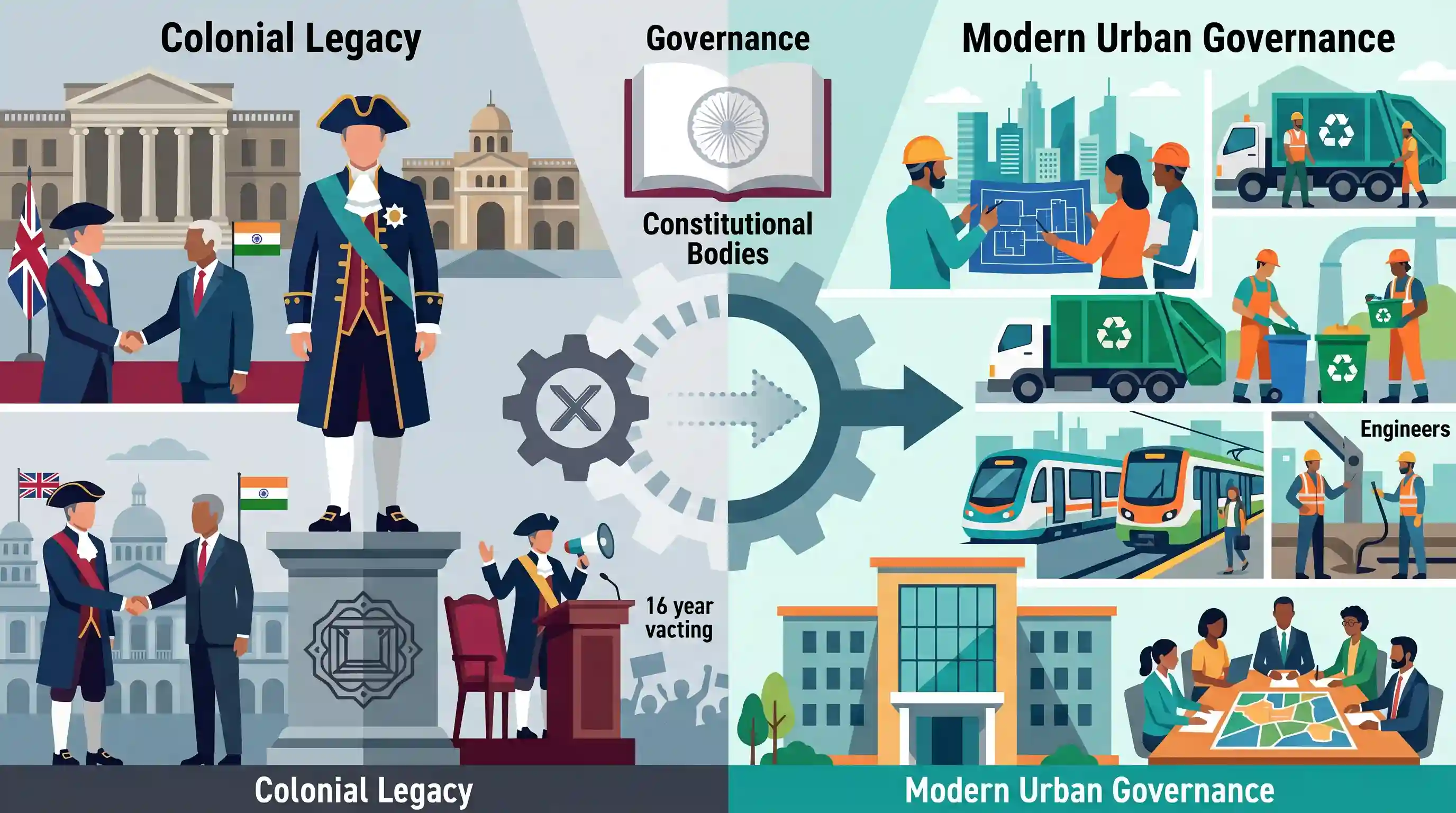
The ceremonial post of the Sheriff of Mumbai, a relic of the British-era administrative system in the former Presidency towns, has remained vacant for 16 years. Originally endowed with significant social prestige and symbolic duties—such as receiving foreign dignitaries and convening public meetings—the Sheriff served as an officer of the High Court with no executive powers. This prolonged vacancy illustrates a gradual shift in modern Indian urban governance, which increasingly prioritizes functional local bodies over titular, colonial-era figureheads, raising broader questions about the continued relevance of such ceremonial posts.
Key Points
- The Sheriff of Mumbai is a titular, non-executive post established during the British era, serving as an officer of the High Court.
- Historically, the Sheriff's duties included receiving foreign dignitaries, convening public condolence meetings for prominent citizens, and acting as a ceremonial figurehead for the city.
- The post has remained vacant for 16 years, reflecting the administrative neglect and phasing out of purely ceremonial colonial-era roles.
- Similar Sheriff positions were historically present in other former Presidency towns like Kolkata and Chennai, highlighting the diverse ways states have managed colonial administrative legacies.
Important Terms
Sheriff of Mumbai

An honorary, apolitical titular office in Mumbai established in 1823. An officer of the High Court, the Sheriff performs ceremonial duties like receiving foreign dignitaries but lacks any executive or legislative authority.
UPSC context
GS Paper II (Governance/Polity). Relates to colonial administrative relics and the evolution of urban ceremonial protocols.
Presidency Towns
Historical administrative centers established by the British East India Company in Madras, Bombay, and Calcutta. They served as the primary hubs for British trade, judicial systems, and colonial governance in India.
UPSC context
GS Paper I (Modern History). Tests understanding of British administrative divisions and the historical development of major Indian metropolises.
74th Constitutional Amendment Act
The 1992 legislation that granted constitutional status to municipalities in India. It institutionalized urban decentralization via a three-tier structure and defined 18 functional responsibilities under the Twelfth Schedule.
UPSC context
GS Paper II (Polity/Governance). Essential for topics on democratic decentralization and local self-government.
Urban Local Bodies (ULBs)
Institutions of local self-government in cities and towns, such as Municipal Corporations and Councils. They are responsible for urban planning, public health, and sanitation under the constitutional framework of Part IXA.
UPSC context
GS Paper II (Governance). Covers the functional aspects of urban administration and fiscal decentralization.
Titular Post
A ceremonial position that holds a formal title but lacks substantive executive powers. These roles, like the Mumbai Sheriff, primarily fulfill symbolic and protocol-related functions rather than policy-making ones.
UPSC context
GS Paper II (Polity). Differentiates between ceremonial figureheads and executive authorities in Indian governance structures.
High Court
The highest judicial authority at the state level in India. In former Presidency towns, the High Court oversees officers like the Sheriff for executing judicial processes and property attachments.
UPSC context
GS Paper II (Judiciary). Tests knowledge of judicial hierarchy and administrative roles within the court system.
Prelims Trap
The Sheriff exercises executive magisterial powers over city police and is elected by the Municipal Corporation.
Aspirants often confuse the title 'Sheriff' with US law enforcement. In India, it is an unpaid, ceremonial officer of the High Court with no police powers.
Static Concepts Connected
What is the timeline of the earliest municipal bodies in British India?
- Madras 1687: The first Municipal Corporation in India was established in Madras in 1687-88 to manage local civic affairs.
- Royal Charter 1726: This charter authorized the establishment of Mayor's Courts and formalized municipal bodies in the Bombay and Calcutta presidencies.
- Lord Ripon's Resolution: The 1882 resolution advocated for elected local bodies and is regarded as the 'Magna Carta' of local self-government in India.
How is a Mayor different from a Municipal Commissioner in a Municipal Corporation?
- Mayor: The ceremonial and political head of the Municipal Corporation, usually elected by councilors (or directly by citizens), but lacking significant executive powers.
- Municipal Commissioner: The actual executive authority who implements policies and manages administration, typically an IAS officer appointed by the state government.
Cross-Topic Patterns
Colonial Relics & Cantonment Boards
The phasing out of purely ceremonial British roles parallels the recent Ministry of Defence initiative to excise civilian areas from colonial-era Cantonment Boards, merging them with state municipalities.
High Court Officers vs. State Executive
Though appointed by the Governor on the CM's recommendation, the Sheriff functions legally as an officer of the High Court, highlighting a unique historical overlap of executive and judicial administration.

Questions on early British judicial and civic administration (Charter of 1726, Mayor's Courts) may appear as statement-based Prelims items.
Linked PYQs · 4
Linked PYQs · 4
- 2022MainsGS1
The political and administrative reorganization of states and territories has been a continuous ongoing process since the mid-nineteenth century. Discuss with examples.
- 2023MainsGS2
“The states in India seem reluctant to empower urban local bodies both functionally as well as financially.” Comment.
- 2020MainsGS2
The strength and sustenance of local institutions in India has shifted from their formative phase of 'Functions, Functionaries and Funds' to the contemporary stage of 'Functionality'. Highlight the critical challenges faced by local institutions in terms of their functionality in recent times.
- 2022PrelimsGS1
In the Government of India Act 1919, the functions of Provincial Government were divided into "Reserved" and "Transferred" subjects. Which of the following were treated as "Reserved" subjects? 1. Administration of Justice 2. Local Self-Government 3. Land Revenue 4. Police Select the correct answer using the code given below:
