Potato MIS procurement price in UP and farmer income distress
Source:The Hindu ↗
Why It Matters
Understanding the operational limits of the Market Intervention Scheme (MIS) for perishable horticultural crops is vital for assessing government responses to agrarian distress. The persistent gap between input costs and government procurement prices underscores the systemic need for transitioning from simple procurement measures to robust food-processing and value-addition linkages to sustainably double farmers' income.
Summary
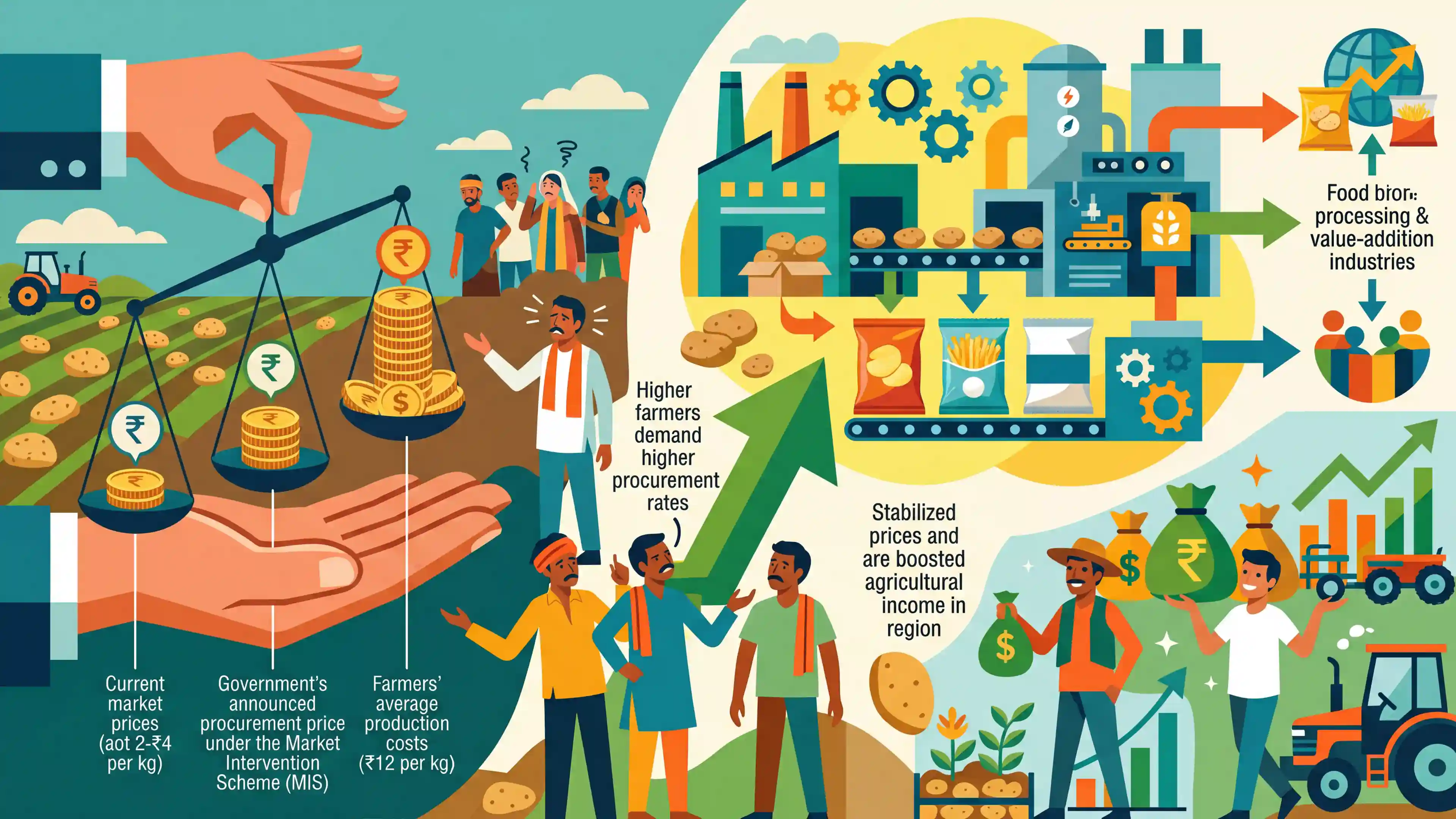
Farmers' bodies in Uttar Pradesh have raised concerns that the Centre's recently announced procurement price for potatoes under the Market Intervention Scheme (MIS) is substantially lower than production costs. While the government fixed the procurement rate at ₹6.5 per kg to prevent distress sales after market prices crashed to ₹2-₹4 per kg, farmers highlight that their input costs alone average ₹12 per kg. Along with immediate demands for higher procurement rates, farmers are advocating for the establishment of food processing and value-addition industries in the region to permanently stabilize crop prices and boost agricultural incomes.
Key Points
- The Union Agriculture Ministry approved the procurement of 20 lakh metric tonnes of potatoes in Uttar Pradesh under the Market Intervention Scheme (MIS) for 2025-26 at ₹6.5 per kg.
- Farmers' bodies, notably the BKU, state that the procurement price does not cover the input cost, which is around ₹12 per kg, and demand a price of at least ₹15 per kg.
- Market prices for potatoes in UP had crashed to ₹2-₹4 per kg following unseasonal rains and other factors, leading to distress sales.
- Farmers are urging the government to promote food processing and value-addition industries in the potato belt to offer sustainable long-term solutions.
- The Centre has also approved MIS procurement for chickpeas in Andhra Pradesh and pigeon pea in Karnataka to secure remunerative prices for producers.
Important Terms
Market Intervention Scheme (MIS)

An ad-hoc procurement scheme for perishable horticultural and agricultural commodities not covered by MSP, triggered during bumper harvests to prevent price crashes below production costs.
UPSC context
GS Paper III (Agriculture). Tests knowledge of price support mechanisms and government interventions for horticultural stability.
Bharatiya Kisan Union (BKU)
A non-partisan pressure group representing Indian farmers, primarily in North India, advocating for remunerative crop prices, subsidies, and policy reforms through organized protests and advocacy.
UPSC context
GS Paper II (Pressure Groups). Important for studying agrarian movements and their impact on public policy.
Distress Sale
The forced sale of crops at extremely low prices because of their perishable nature, lack of storage facilities, or the farmer's urgent need for cash.
UPSC context
GS Paper III. A central concept highlighting gaps in agricultural marketing, infrastructure, and financial security for farmers.
NAFED
The apex body of agricultural marketing cooperatives in India, serving as a key central agency for procuring crops under MIS and the Price Support Scheme.
UPSC context
GS Paper III. Tests understanding of institutional frameworks in agricultural marketing and government procurement agencies.
Market Intervention Price (MIP)
The specific procurement rate fixed under the MIS for a limited duration and quantity to stabilize markets for crops not covered by the regular MSP.
UPSC context
GS Paper III. Crucial for distinguishing between permanent support mechanisms (MSP) and temporary price interventions (MIS).
Prelims Trap
The Market Intervention Scheme (MIS) is used to procure all agricultural crops, including MSP-mandated pulses, during distress sales.
MIS exclusively covers agricultural and horticultural commodities NOT covered under the Minimum Support Price (MSP). MSP-mandated crops during distress are procured under the Price Support Scheme (PSS).
Static Concepts Connected
What are the core components of the PM-AASHA umbrella scheme?
- Price Support Scheme (PSS): Physical procurement of pulses, oilseeds, and copra by Central Nodal Agencies at MSP. Losses are fully borne by the Centre.
- Price Deficiency Payment Scheme (PDPS): Direct payment of the difference between MSP and the selling/modal price to pre-registered farmers. Physical procurement is not required.
- Market Intervention Scheme (MIS): An ad-hoc mechanism for perishables (like potatoes/onions) not covered by MSP, triggered by a 10% price fall or 10% production spike.
How is the Market Intervention Scheme (MIS) triggered and funded?
- Trigger Condition: Implemented only upon the specific request of a State/UT government when market prices crash by at least 10% compared to previous normal years.
- Cost Sharing: Financial losses from procurement are shared 50:50 between the Central and State Governments (75:25 ratio for North-Eastern states).
- Procurement Limit & DBT: Recent revisions increased the procurement limit from 20% to 25% of total production, and states can now use Direct Benefit Transfers to pay farmers the price difference.
Cross-Topic Patterns
Food processing as an inflation stabilizer
The persistent crash in potato and onion prices repeatedly highlights the lack of backward linkages (cold storage) and forward linkages (agro-processing) in India's agricultural supply chain, a core GS3 theme.
Subsidy vs Capital Expenditure trade-off
Rising expenditure on ad-hoc market interventions (MIS) limits the fiscal space available for permanent capital creation in agriculture, such as mega food parks and localized rural infrastructure.

Expect a 2026 Prelims statement differentiating MIS (perishables, not under MSP) from PSS (pulses/oilseeds under MSP) within PM-AASHA.
Linked PYQs · 5
Linked PYQs · 5
- 2018MainsGS3
What do you mean by Minimum Support Price (MSP)? How will MSP rescue the farmers from the low income trap?
- 2017MainsGS3
How do subsidies affect the cropping pattern, crop diversity and economy of farmers? What is the significance of crop insurance, minimum support price and food processing for small and marginal farmers?
- 2020MainsGS3
What are the challenges and opportunities of food processing sector in the country? How can income of the farmers be substantially increased by encouraging food processing?
- 2022MainsGS3
Elaborate the scope and significance of the food processing industry in India.
- 2025MainsGS3
Examine the scope of the food processing industries in India. Elaborate the measures taken by the government in the food processing industries for generating employment opportunities.
