PM KUSUM scheme solar pump adoption for tribal agriculture
Source:ianslive ↗
Why It Matters
PM-KUSUM is a crucial scheme for achieving India's renewable energy goals while simultaneously addressing water security and energy costs in the agriculture sector. Understanding state-specific enhancements to central schemes (like Gujarat's 70% top-up for tribal farmers) is highly relevant for state civil services exams.
Summary
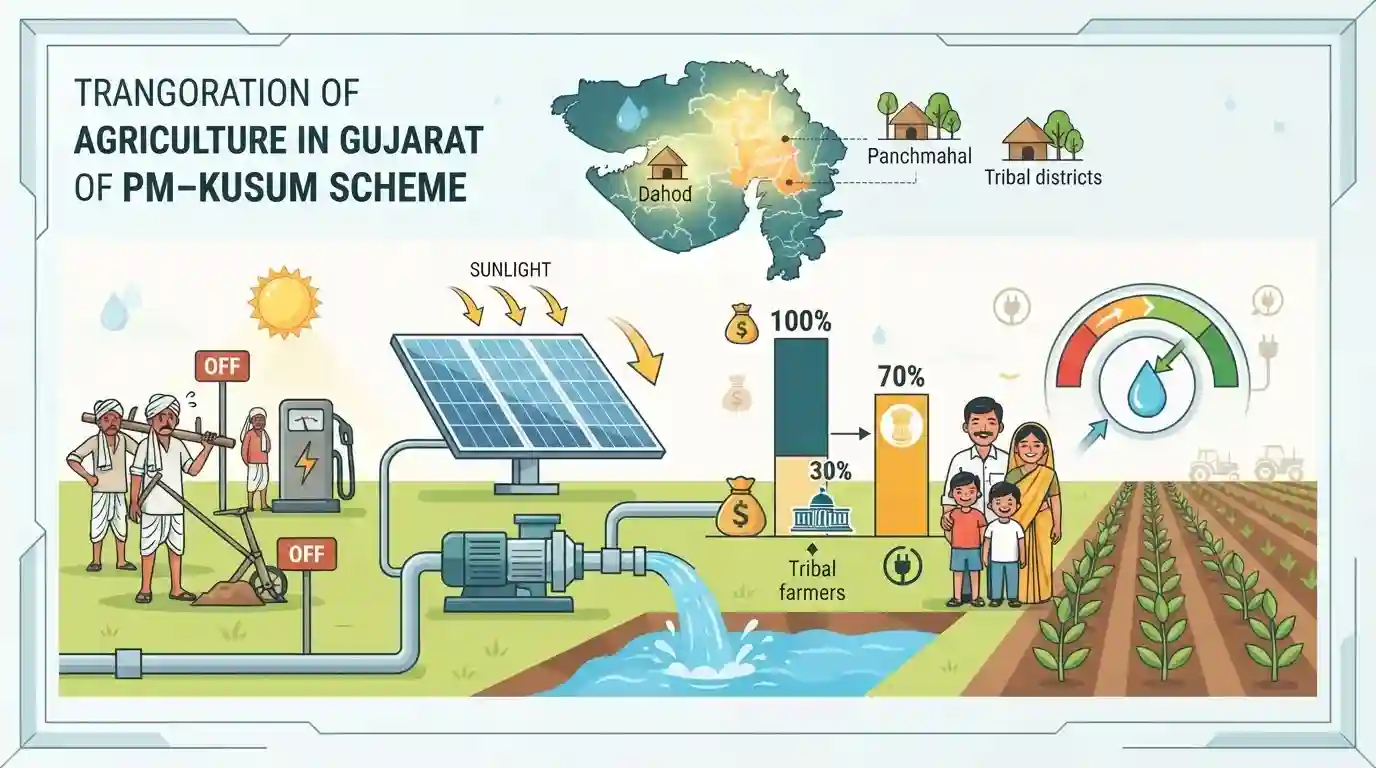
The Centre's PM-KUSUM scheme is significantly transforming agriculture in Gujarat by promoting the use of solar-powered pumps. This initiative ensures continuous irrigation without the burden of electricity costs, allowing farmers, especially in remote and tribal areas like Dahod and Panchmahal, to grow multiple crops a year. With a combination of a 30% Central subsidy and an additional 70% state subsidy for tribal farmers, the financial barrier to adopting solar energy is largely eliminated. The scheme has successfully led to the commissioning of 695 MW of solar capacity and the solarisation of hundreds of thousands of agricultural pumps in the state, strengthening water security and agricultural incomes.
Key Points
- The PM-KUSUM scheme is driving the adoption of solar-powered agricultural pumps in Gujarat, particularly benefiting farmers in remote, tribal, and forest areas like Dahod and Panchmahal.
- The scheme provides a 30% Central subsidy for standalone solar pumps and solarisation of grid-connected agricultural pumps.
- In Gujarat, farmers in tribal and forest regions receive an additional 70% subsidy from the state government, effectively covering the entire installation cost.
- The initiative ensures continuous day-time irrigation without electricity bills, enabling farmers to cultivate multiple crops annually and improve yields in arid regions like Kutch and Banaskantha.
- As of recent data, Gujarat has commissioned 256 solar power plants with a capacity of 695 MW, solarised about 2.97 lakh agricultural pumps, and installed 22,787 new solar pumps under the scheme.
Important Terms
PM-KUSUM (Pradhan Mantri Kisan Urja Suraksha evam Utthaan Mahabhiyan)

A flagship scheme of the Ministry of New and Renewable Energy launched in 2019 to solarise Indian agriculture, promote decentralized solar power, reduce diesel pump reliance, and provide stable daytime irrigation and income.
UPSC context
GS Paper-II (Government Schemes) and GS Paper-III (Agricultural Technology). Tests structural reforms in rural energy and farmer income.
Solarisation of Agriculture
The transition of agricultural energy needs to solar power by installing standalone solar pumps and converting grid-connected pumps, reducing fossil fuel reliance, power theft, and grid losses.
UPSC context
GS Paper-III (Infrastructure: Energy, Technology in Agriculture). Tests solutions for power subsidies, DISCOM losses, and sustainable development.
Agricultural Subsidies
Financial incentives, direct cash transfers, or price supports (like fertilizer, power, or seed subsidies) provided by governments to farmers to lower input costs, enhance yields, and ensure national food security.
UPSC context
GS Paper-III (Issues related to Direct and Indirect Farm Subsidies). Tests fiscal impact, groundwater conservation, and WTO compliance.
Central Government
The federal administrative authority of India, also known as the Union Government, established under Part V of the Constitution to manage national portfolios, federal administration, and central scheme funding.
UPSC context
GS Paper-II (Indian Constitution, Federal Structure). Tests the division of executive powers and Union-State coordination in development schemes.
State Government of Gujarat
The subnational administrative authority representing Gujarat under Part VI of the Constitution, responsible for executing state-specific developmental, tribal welfare, and agricultural initiatives.
UPSC context
GS Paper-II (Functions of States, Federalism). Tests the decentralization of welfare delivery and coordination with the Centre on subsidies.
Prelims Trap
Farmers can choose cheap, imported high-efficiency solar modules under the subsidized components of PM-KUSUM.
PM-KUSUM strictly mandates Domestic Content Requirement (DCR), making it compulsory to use Indian-manufactured solar cells and modules for all subsidized installations, preventing cheap imports.
Static Concepts Connected
What is Domestic Content Requirement (DCR) and its WTO implications?
- Core Definition: Mandates that a specific percentage of components used in solar power installations must be manufactured domestically within India.
- WTO Conflict: India's DCR rules under early solar missions were successfully challenged by the US at the WTO for violating National Treatment rules (GATT Article III:4).
- Policy Workaround: Subsidized schemes like PM-KUSUM maintain DCR by structuring solar integration as government-procured public utility/subsidy support, avoiding direct commercial trade conflicts.
What is the economic rationale behind Feeder-level Solarisation?
- Feeder vs Pump: Rather than solarising individual pumps, a single large solar plant solarises the entire agricultural electricity feeder line at the substation.
- Cost Efficiency: Drastically lowers capital deployment costs and eliminates the logistical complexity of maintaining thousands of scattered individual farm installations.
- Grid Integration: Allows surplus power to be fed back into the regional grid, creating a stable, secondary revenue stream for local distribution companies (DISCOMs).
Cross-Topic Patterns
Green energy vs WTO National Treatment
Aligning domestic solar mandates (DCR under KUSUM) with WTO rules highlights the friction between domestic farm subsidies and global trade agreements.
Solar pumping and groundwater depletion
Zero marginal cost solar power risks incentivizing unrestricted groundwater extraction, linking clean energy schemes to critical water resource management challenges.

UPSC may couple PM-KUSUM's components with WTO's DCR rules and groundwater depletion risks in a multi-statement 2026 GS-3 question.
Linked PYQs · 4
Linked PYQs · 4
- 2026GPSC_PRELIMSGS1
Which of the following statement/s is/are correct regarding Renewable Energy Installed Capacity in India? 1. Wind energy is second only to solar energy in the Indian renewable sector. 2. Biomass power capacity accounts for around 30% of India's total renewable energy. 3. India ranks among the top three countries in the world in Hydropower Installed Capacity. Choose the correct option from the following.
- 2025GPSC_PRELIMSGS1
Under the Green Open Access Rules, 2022, the minimum size of the renewable energy project eligible for open access is
- 2025GPSC_PRELIMSGS1
Which of the following statements is/are correct regarding the G-SAFAL scheme?
- 2026GPSC_PRELIMSGS1
Consider the following statements regarding 'Nano Urea' recently promoted by the Government of India for agricultural use: 1. It replaces the need for Phosphorus and Potash fertilizers entirely, simplifying the fertilizer application process for farmers. 2. It has a higher nutrient use efficiency compared to conventional granular urea, leading to reduced soil degradation and water pollution. Which of the above statement(s) is/are correct?
