India Foreign Policy: Evolution of Middle East Diplomatic Stance
Source:Indian Express ↗
Why It Matters
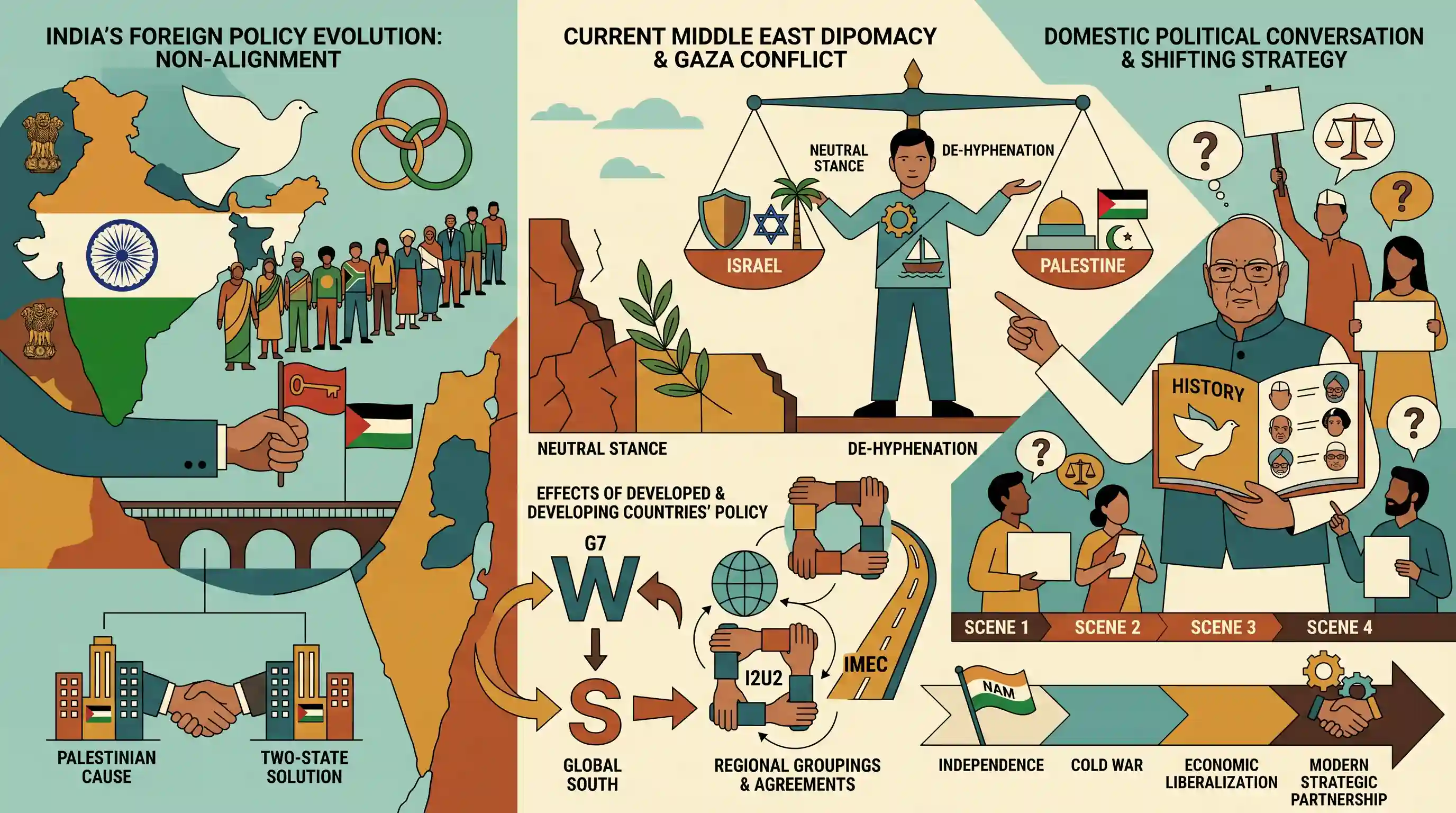
Understanding the historical context and evolution of India's stance on the Israel-Palestine conflict is crucial for UPSC candidates, as it illustrates the shift from ideological non-alignment to pragmatic, 'de-hyphenated' strategic autonomy in international relations.
Summary
NCP chief Sharad Pawar has publicly criticized the Union Government's 'neutral' stance on the ongoing conflict in Gaza, arguing that it contradicts India's traditional foreign policy. Historically, India has been a staunch supporter of the Palestinian cause, a position deeply rooted in the Non-Aligned Movement. Pawar's remarks underscore the domestic political conversations regarding India's shifting Middle East diplomacy, which currently seeks to balance a strategic partnership with Israel—termed the 'de-hyphenation' policy—with its historical advocacy for a two-state solution and Palestinian rights.
Key Points
- NCP leader Sharad Pawar criticized the Indian government's neutral stance regarding the ongoing conflict and aggression in Gaza.
- Pawar asserted that this neutrality is a departure from India's traditional foreign policy position, which has historically shown strong solidarity with the Palestinian cause.
- The statement highlights the domestic political debate surrounding India's evolving 'de-hyphenated' Middle East policy, which balances deepening strategic ties with Israel while maintaining support for a two-state solution.
Important Terms
De-hyphenation Policy

A foreign policy strategy where India manages relations with adversarial pairs (e.g., Israel and Palestine) independently, based on national interests rather than their mutual conflict.
UPSC context
GS Paper II (International Relations). Tests India's pragmatic shift in Middle East diplomacy and balancing strategic vs. historical interests.
Two-State Solution
A proposed resolution to the Israeli-Palestinian conflict envisioning two independent, sovereign states—Israel and Palestine—coexisting peacefully side-by-side, typically based on pre-1967 borders.
UPSC context
GS Paper II (International Relations). Essential for questions on West Asian geopolitics and India's consistent official stance on peace.
Non-Aligned Movement (NAM)
An international forum of 120 developing nations not formally aligned with any major power bloc, emphasizing sovereignty, anti-colonialism, and strategic independence.
UPSC context
GS Paper II (International Relations). Tests historical foundations of India’s foreign policy and its evolution into modern strategic autonomy.
Strategic Autonomy
The ability of a nation to pursue its national interests and make independent foreign policy decisions without being constrained by external powers or formal alliances.
UPSC context
GS Paper II. Core theme in contemporary Indian foreign policy, balancing multi-alignment with various global groupings.
Nationalist Congress Party (NCP)
A recognized national political party in India, founded in 1999 by Sharad Pawar. It primarily operates in Maharashtra, emphasizing secularism and democratic federalism.
UPSC context
GS Paper II (Governance/Polity). Relevant for understanding the role of political parties in critiquing Union Government foreign policy.
Union Government of India
The supreme governing authority of the Republic of India, established by the Constitution, comprising the Executive, Legislature (Parliament), and Judiciary.
UPSC context
GS Paper II (Polity). Tests the executive's constitutional role in conducting international relations and sovereign foreign policy.
Prelims Trap
"India officially recognized the State of Israel only in 1992."
India recognized Israel much earlier, in 1950. The year 1992 marks the establishment of full formal diplomatic relations, ending decades of maintaining only consular-level ties.
Static Concepts Connected
What is India's "De-hyphenation" policy regarding Israel and Palestine?
- Independent Ties: Engaging with Israel and Palestine mutually independent of each other, formally abandoning the traditional zero-sum diplomatic approach.
- Strategic Autonomy: Allows India to deepen defense and tech ties with Israel while continuing to advocate for a sovereign two-state solution for Palestine.
What is the historical timeline of India's official recognition of Palestine?
- 1974 Recognition: India became the first non-Arab state to recognize the PLO as the sole legitimate representative of the Palestinian people.
- 1988 Statehood: India was among the earliest nations globally to officially recognize the sovereign State of Palestine, rooted in its anti-colonial legacy.
Cross-Topic Patterns
De-hyphenation & the I2U2 Quad
India's independent ties with Israel facilitated its entry into the I2U2 grouping (India, Israel, UAE, US), demonstrating how de-hyphenation enables new minilateral architectures in the Middle East.
Diaspora and Energy Security limits
India’s nuanced UN voting on Gaza reflects a tightrope walk: protecting critical defense ties with Israel while safeguarding millions of Indian expats and energy interests in the Arab world.

GS2 Mains will likely test India's West Asia shift from ideological NAM roots to pragmatic de-hyphenation and multi-alignment.
Linked PYQs · 2
Linked PYQs · 2
- 2018MainsGS2
“India’s relations with Israel have, of late, acquired a depth and diversity, which cannot be rolled back.” Discuss.
- 2019MainsGS2
‘Too little cash, too much politics, leaves UNESCO fighting for life.’ Discuss the statement in the light of US' withdrawal and its accusation of the cultural body as being 'anti-Israel bias'.
