Tribal Welfare Schemes Outreach Campaign and PVTG Development
Source:Indian Express ↗
Why It Matters
This article covers major welfare architectures targeting Particularly Vulnerable Tribal Groups (PVTGs) and remote tribal habitations, directly testing students' understanding of inclusive development, last-mile delivery of government schemes, and policies for vulnerable sections.
Summary
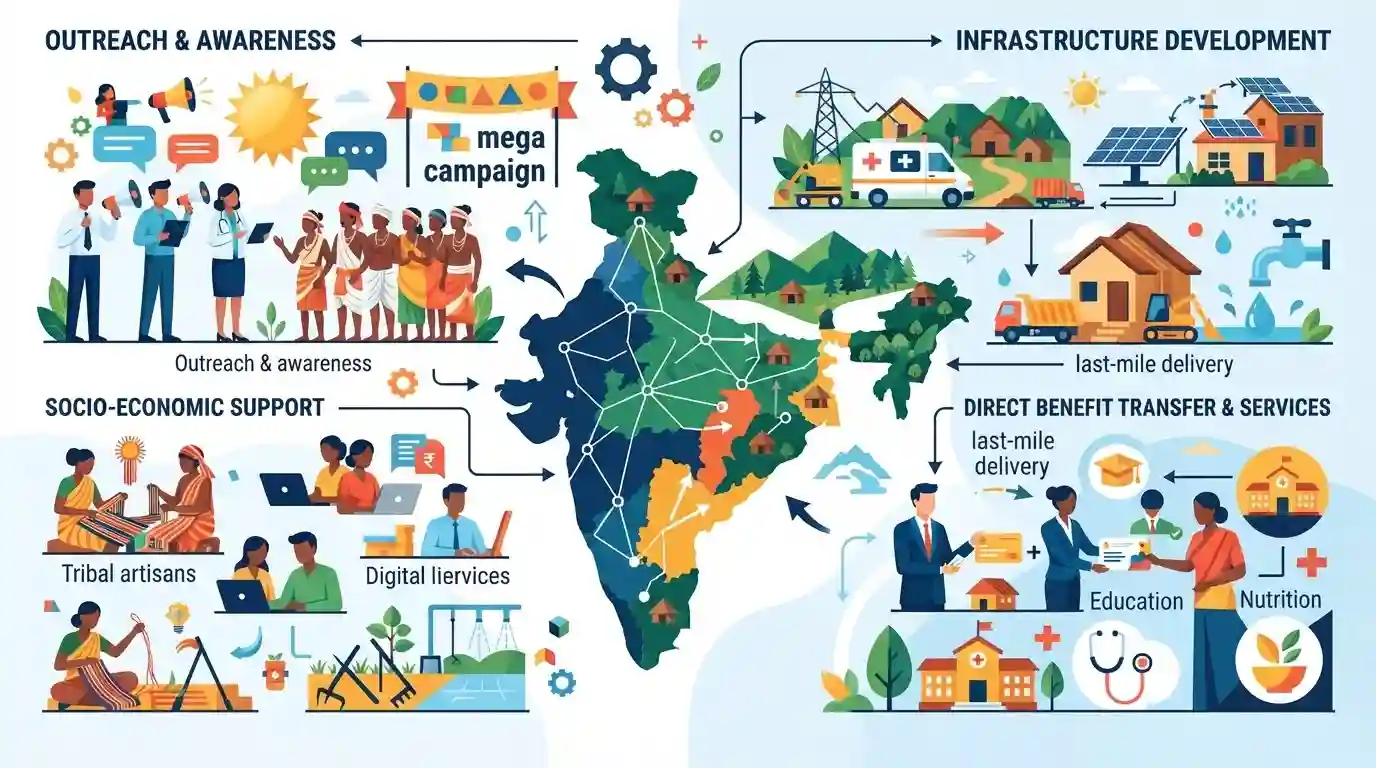
The central government has initiated a mega nationwide outreach campaign to push flagship tribal welfare schemes, notably PM JANMAN and the Dharti Aaba Janjatiya Gram Utkarsh Abhiyan. These schemes focus on saturation-level delivery of welfare services, infrastructure, and socio-economic support to Particularly Vulnerable Tribal Groups (PVTGs) and remote tribal habitations. The campaign highlights the administrative push to tackle last-mile delivery challenges, enhance public awareness, and foster inclusive development for India's tribal communities.
Key Points
- The central government launched a mega outreach campaign to accelerate the implementation of flagship tribal welfare schemes, specifically PM JANMAN and Dharti Aaba Janjatiya Gram Utkarsh Abhiyan.
- PM JANMAN focuses on Particularly Vulnerable Tribal Groups (PVTGs) by providing basic infrastructure like housing, safe drinking water, road connectivity, and healthcare access.
- Dharti Aaba Janjatiya Gram Utkarsh Abhiyan aims for saturation-level delivery of critical socio-economic development interventions across thousands of tribal villages.
- The outreach campaign underscores the importance of grassroots awareness and active community involvement in bridging developmental gaps for vulnerable sections.
Important Terms
PM JANMAN

A central scheme launched to improve socio-economic conditions of Particularly Vulnerable Tribal Groups (PVTGs) by providing housing, clean water, healthcare, and education across isolated habitations.
UPSC context
UPSC GS Paper II (Government Policies & Interventions for Vulnerable Sections). Frequently asked regarding welfare targets for PVTGs.
Dharti Aaba Janjatiya Gram Utkarsh Abhiyan
An ambitious nationwide campaign aimed at comprehensive development and saturation of basic services and infrastructure in tribal-majority villages across India.
UPSC context
UPSC GS Paper II (Social Justice & Inclusive Development). Important for schemes addressing last-mile delivery and rural infrastructure.
Ministry of Tribal Affairs
The apex central government ministry in India responsible for policy formulation, planning, and coordination of programs for the development of Scheduled Tribes (STs).
UPSC context
UPSC GS Paper II (Statutory Bodies and Ministries). Tests institutional frameworks governing tribal welfare and rights in India.
Prelims Trap
PM-JANMAN aims to provide saturation-level delivery of welfare services to all Scheduled Tribes across India.
Aspirants often assume PM-JANMAN covers all Scheduled Tribes, whereas it specifically targets the 75 identified Particularly Vulnerable Tribal Groups (PVTGs) across 18 States and UTs.
Static Concepts Connected
What are the constitutional criteria and safeguards for Particularly Vulnerable Tribal Groups (PVTGs)?
- Identification Criteria: Criteria include pre-agricultural level of technology, stagnant or declining population, extremely low literacy, and a subsistence economy.
- Nomenclature Change: Originally known as Primitive Tribal Groups (PTGs), they were renamed PVTGs in 2006 to focus targeted developmental interventions.
- Constitutional Basis: Article 342 empowers the President to specify tribes as Scheduled Tribes, while special protections fall under the Fifth and Sixth Schedules.
Cross-Topic Patterns
Tribal Welfare & Whole-of-Government Governance
Convergence of 11 critical interventions across 9 ministries in PM-JANMAN reflects cooperative federalism and whole-of-government approaches tested in governance questions.
PVTGs & Constitutional Safeguards for Scheduled Tribes
Focus on Particularly Vulnerable Tribal Groups (PVTGs) ties closely with Fifth and Sixth Schedule constitutional provisions on tribal self-governance.

PM-JANMAN (75 PVTGs, 11 interventions) and Dharti Aaba Abhiyan will likely feature as a matching or multi-statement Prelims question.
Linked PYQs · 3
Linked PYQs · 3
- 2023MainsGS2
“Development and welfare schemes for the vulnerable, by its nature, are discriminatory in approach.” Do you agree? Give reasons for your answer.
- 2019MainsGS2
Performance of welfare schemes that are implemented for vulnerable sections is not so effective due to absence of their awareness and active involvement at all stages of policy process. Discuss.
- 2019PrelimsGS1
Consider the following statements about Particularly Vulnerable Tribal Groups (PVTGs) in India : 1. PVTGs reside in 18 States and one Union Territory. 2. A stagnant or declining population is one of the criteria for determining PVTG status. 3. There are 95 PVTGS officially notified in the country so far. 4. Irular and Konda Reddi tribes are included in the list of PVTGs. Which of the statements given above are correct?
