Centre Fiscal Outlook Faces Geopolitical and Revenue Risks
Source:The Hindu ↗
কেন এটি গুরুত্বপূর্ণ
Understanding fiscal policy challenges is crucial for GS Paper 3. Aspirants must be able to link external geopolitical events with domestic macroeconomic stability, budget management, and fiscal deficit targets.
সারসংক্ষেপ
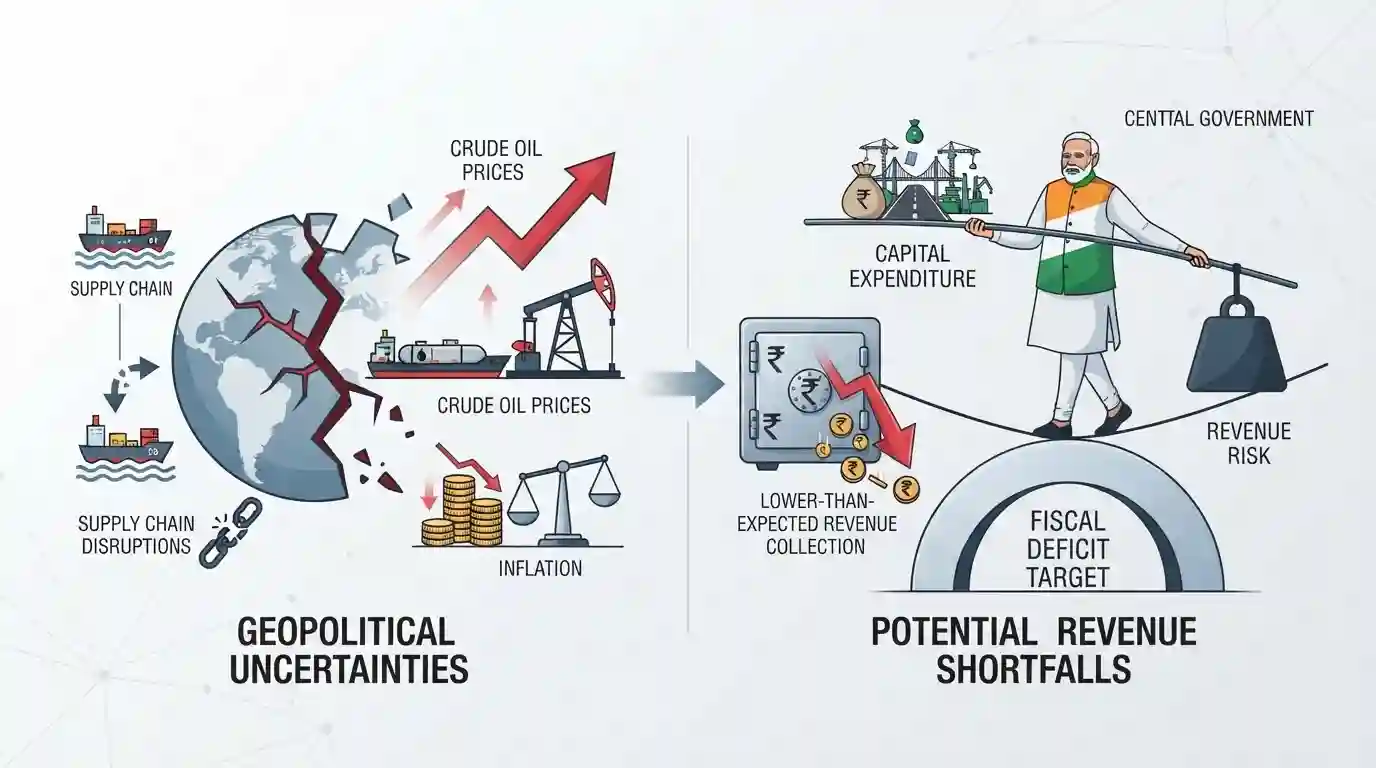
The article analyzes the fiscal challenges facing the Central government, highlighting the dual threats of geopolitical uncertainties and potential revenue shortfalls. Geopolitical risks, such as global conflicts and supply chain disruptions, threaten to increase crude oil prices and import costs, thereby impacting inflation and subsidy burdens. Concurrently, the government faces risks on the revenue front, necessitating prudent fiscal management to adhere to fiscal deficit targets without compromising on growth-inducing capital expenditure.
মূল বিষয়
- The Centre's fiscal outlook is currently vulnerable to external geopolitical tensions that could disrupt supply chains and commodity prices.
- Geopolitical risks, particularly concerning global crude oil prices, pose a significant threat to inflation management and the import bill.
- There are potential risks of revenue shortfalls, which could stem from lower tax collections or underperformance in non-tax revenues like disinvestment.
- Balancing fiscal deficit targets while maintaining public capital expenditure is a key challenge for macroeconomic stability.
গুরুত্বপূর্ণ শব্দ
Fiscal Responsibility and Budget Management (FRBM) Act

A 2003 law enacted to institutionalize financial discipline, reduce India's fiscal deficit, and improve macroeconomic management by setting binding limits on government borrowing and debt.
UPSC context
Highly relevant for GS Paper 3. Frequently tested regarding fiscal consolidation targets, escape clauses, and N.K. Singh Committee recommendations.
Fiscal Deficit
The shortfall in a government's total income compared to its total expenditure, excluding borrowings. It represents the total amount the government must borrow in a financial year to meet its expenses.
UPSC context
Crucial for GS Paper 3 (Economy). Tests understanding of government budgeting, macroeconomic stability, and public debt management.
Capital Expenditure
Government spending focused on acquiring, building, or upgrading long-term physical and financial assets like infrastructure, machinery, and schools, which generate future economic benefits.
UPSC context
Core GS Paper 3 topic. Evaluates candidates' grasp of government budgeting components and how public investment stimulates economic growth.
Reserve Bank of India (RBI)
India's central bank and regulatory authority, responsible for managing the money supply, issuing currency, and executing monetary policy to ensure price stability and economic growth.
UPSC context
Central to GS Paper 3. Tests knowledge of monetary policy tools, inflation targeting, and fiscal-monetary policy coordination.
Ministry of Finance
The central ministry responsible for India's macroeconomic policies, taxation, financial legislation, and the formulation and presentation of the annual Union Budget.
UPSC context
Links to GS Paper 2 (Governance) and GS Paper 3 (Economy). Important for understanding the administrative machinery behind fiscal policy.
প্রিলিমস ফাঁদ
RBI surplus transfers to the Union Government are classified as Capital Receipts since they are non-recurring lump-sum transfers.
Surplus transfers from the RBI are classified as Non-Tax Revenue Receipts in the Union Budget, as they do not create liabilities or reduce assets.
সংযুক্ত স্থির ধারণা
What is the RBI's Economic Capital Framework and surplus transfer mechanism?
- Bimal Jalan Panel: Established the framework recommending a Contingent Risk Buffer (CRB) of 5.5% to 6.5% of RBI's balance sheet to handle shocks.
- Surplus Source: RBI earns income primarily from foreign currency assets, interest on government securities, and liquidity operations.
- Fiscal Impact: The surplus remaining after meeting the targeted CRB level is transferred to the government, classified as non-tax revenue receipt.
How are Revenue Receipts distinguished from Capital Receipts in the Union Budget?
- Revenue Receipts: Receipts that neither create a liability nor reduce the assets of the government, including tax revenues and non-tax revenues like RBI surplus.
- Capital Receipts: Receipts that either create a liability (debt) or reduce the financial assets (non-debt, like disinvestment) of the government.
আন্তঃবিষয় প্যাটার্ন
Energy Security + West Asian Geopolitics
India's 88.7% crude dependency and Hormuz vulnerability link fiscal deficit stability directly to maritime security and West Asian diplomatic balancing.
RBI Autonomy + Fiscal Consolidation
Using record central bank dividends to meet fiscal consolidation targets tests the delicate balance between structural fiscal discipline and central bank capital adequacy.

Multi-statement questions will likely link the components of non-tax revenue (RBI surplus) with the FRBM consolidation roadmap.
সংযুক্ত PYQ · 3
সংযুক্ত PYQ · 3
- 2019MainsGS3
The public expenditure management is a challenge to the Government of India in the context of budget making during the post-liberalization period. Clarify it.
- 2018MainsGS3
How would the recent phenomena of protectionism and currency manipulations in world trade affect macroeconomic stability of India?
- 2021MainsGS3
Distinguish between Capital Budget and Revenue Budget. Explain the components of both these Budgets.
