Centre and West Bengal launch joint rural infrastructure push
Source:eletsonline ↗
Why It Matters
This news highlights critical Central schemes (MGNREGS, PMGSY, DAY-NRLM, Digital Agriculture Mission) operating in West Bengal. It is highly relevant for WBCS Prelims and Mains (Economy and Governance sections), particularly regarding West Bengal's economic geography, rural development, and Centre-State relations.
Summary
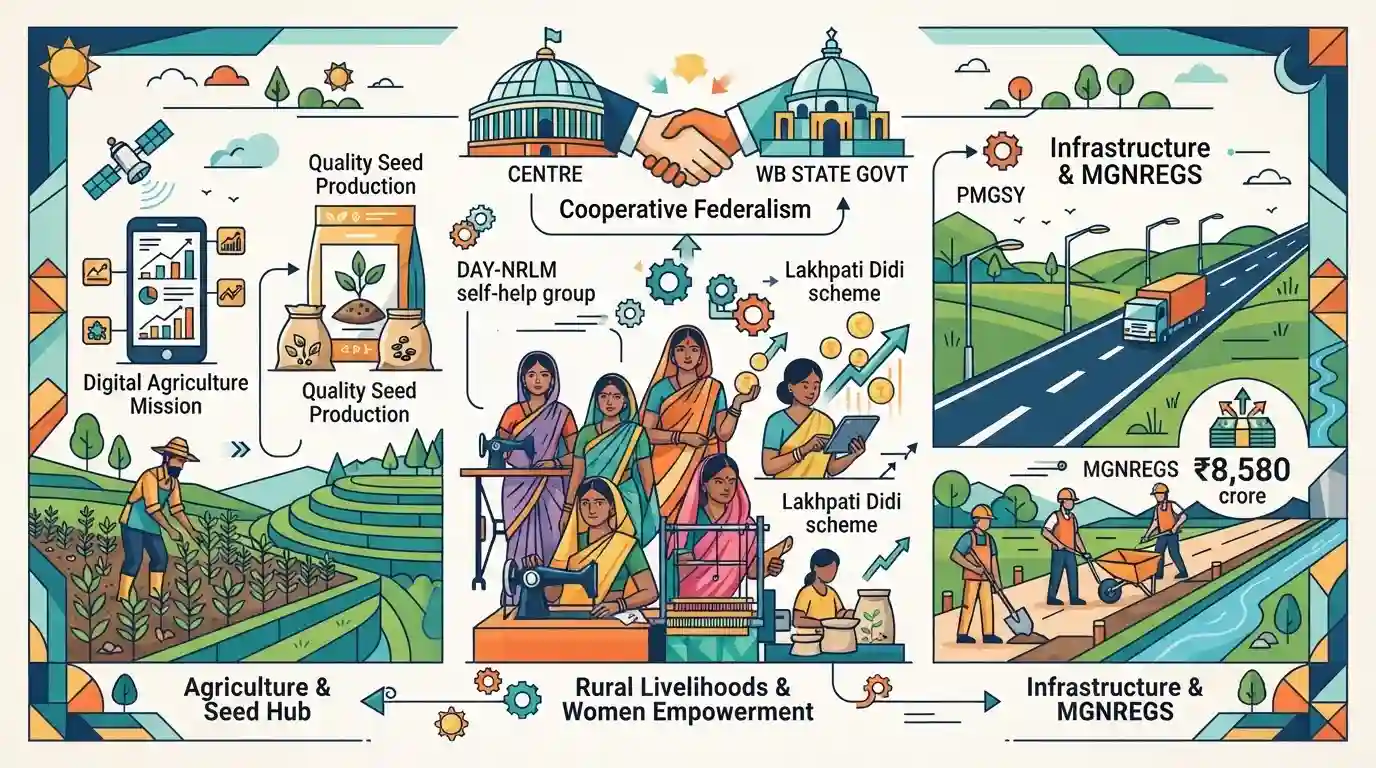
In a strong display of cooperative federalism, the Centre and West Bengal government have announced joint initiatives to boost infrastructure and agricultural development in the state. Key highlights include an ₹8,580 crore allocation for MGNREGS, the rollout of the Digital Agriculture Mission, and making Bengal a hub for quality seed production. Furthermore, rural women empowerment and infrastructure are being prioritized through schemes like DAY-NRLM, Lakhpati Didi, and PMGSY.
Key Points
- The Centre and West Bengal government have agreed to jointly push infrastructure, agriculture, and rural development projects in the state.
- A major allocation of ₹8,580 crore has been sanctioned for West Bengal under the MGNREGS for the current financial year.
- West Bengal is slated to become a major hub for quality seed production, including hybrid maize and potato, alongside the upgrade of the Chinsurah Rice Research Station into a Centre of Excellence.
- The Digital Agriculture Mission and robust financial assistance under DAY-NRLM and the Lakhpati Didi initiative aim to modernize farming and empower rural women.
- Infrastructure development focuses on national highways, rural connectivity under PMGSY, and pipeline projects.
Important Terms
Mahatma Gandhi National Rural Employment Guarantee Scheme (MGNREGS)

A poverty alleviation and social security scheme providing a legal guarantee of 100 days of unskilled manual wage employment in a financial year to rural households.
UPSC context
Crucial for GS Paper 2 (Social Justice) and GS 3 (Employment); tests understanding of rural economic security mechanisms.
Lakhpati Didi Initiative
An initiative under DAY-NRLM aimed at empowering women in Self-Help Groups (SHGs) to earn a sustainable annual household income exceeding ₹1 lakh through diversified livelihoods, financial inclusion, and skill development.
UPSC context
Important for GS 2 (Welfare Schemes) and GS 3; focuses on women's economic empowerment and SHG-led micro-enterprises.
Deendayal Antyodaya Yojana - National Rural Livelihoods Mission (DAY-NRLM)
A flagship poverty alleviation program by the Ministry of Rural Development that organizes rural poor women into Self-Help Groups (SHGs), providing capacity building, affordable credit access, and sustainable livelihood opportunities.
UPSC context
Relevant for GS 2 (Poverty Alleviation) and GS 3 (Inclusive Growth); emphasizes community-based institutions and grassroots empowerment.
Digital Agriculture Mission
A mission creating a Digital Public Infrastructure for agriculture, featuring Agri Stack for Farmer IDs and a Krishi Decision Support System to boost precision farming, data-driven decision-making, and targeted service delivery.
UPSC context
Key for GS 3 (E-technology in aid of farmers); tests knowledge of digital public infrastructure and data-driven governance.
Pradhan Mantri Gram Sadak Yojana (PMGSY)
A Centrally Sponsored Scheme launched to provide all-weather road connectivity to eligible unconnected rural habitations, enhancing access to markets, education, and healthcare to drive rural economic integration and poverty reduction.
UPSC context
Vital for GS 3 (Infrastructure) and GS 2 (Rural Development); tests infrastructure's role in socio-economic mobility.
Prelims Trap
MGNREGS guarantees 100 days of wage employment exclusively to Below Poverty Line (BPL) rural households.
MGNREGS is a universal right in rural areas; any adult member of a rural household willing to do unskilled manual work is eligible. It is explicitly NOT restricted to BPL families.
Static Concepts Connected
What are the foundational components of India's AgriStack?
- Farmer Registry: An Aadhaar-linked digital identity (Kisan e-ID) for every farmer to streamline targeted delivery of schemes, subsidies, and credit.
- Crop Sown Registry: A dynamic record of crops planted, mapped via mobile apps and satellite data to aid crop insurance and government procurement.
- Geo-referenced Maps: Digitized cadastral village records to resolve land disputes, optimize resource allocation, and enable precision farming.
How does DAY-NRLM structurally empower rural women?
- Social Mobilization: Organizing at least one woman from every rural poor household into grassroots Self Help Groups (SHGs) to build social capital.
- Financial Inclusion: Providing revolving funds, community investment support, and facilitating massive bank linkages to ensure access to affordable credit.
- Targeted Income: The Lakhpati Didi initiative specifically targets a sustained minimum annual household income of ₹1 lakh through diversified livelihoods and skill training.
Cross-Topic Patterns
Cooperative Federalism via CSS financing
The Centre-State joint funding architecture in schemes like PMGSY and MGNREGS acts as a practical lever of cooperative federalism, balancing national development priorities with state-level execution realities.
Feminization of Agriculture & SHGs
Lakhpati Didi intersects with the feminization of agriculture, utilizing DAY-NRLM networks to channel modern seed technology, financial credit, and digital agricultural tools directly to rural women.

Expect a Prelims 2026 question linking AgriStack's digital public infrastructure with targeted credit delivery under DAY-NRLM.
Linked PYQs · 4
Linked PYQs · 4
- 2015WBCS_PRELIMSGS1
The credit co-operative institution at the village level is called
- 2024WBCS_PRELIMSGS1
Golden Quadrilateral is a
- 2020WBCS_PRELIMSGS1
Select from the following rice-producing districts in West Bengal in ascending order:
- 2024WBCS_PRELIMSGS1
Which one of the following is not the attribute/main function of NABARD?
