Solid Waste Management and Municipal Corporation Accountability
Source:Indian Express ↗
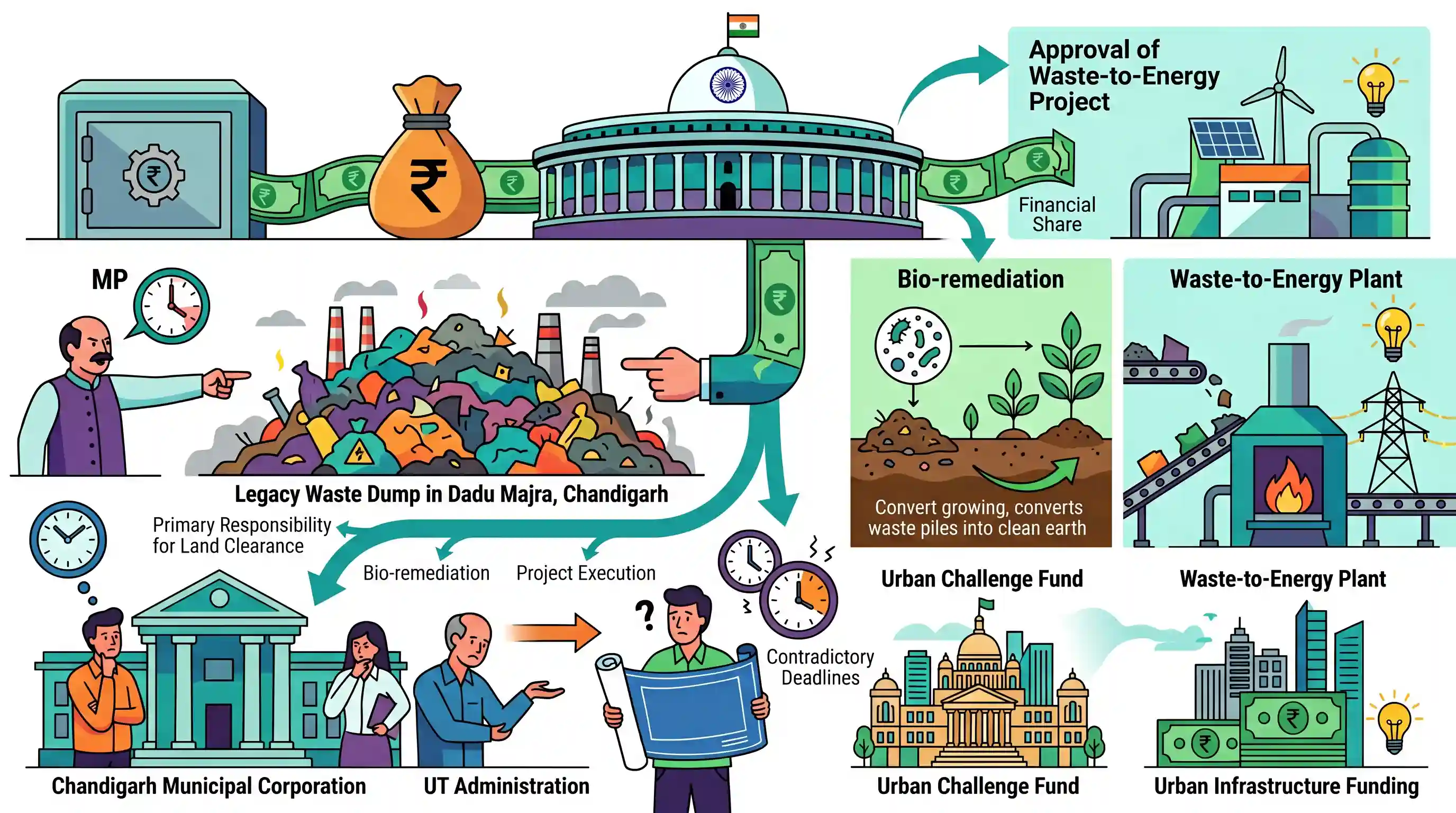
Why It Matters
The article serves as an excellent case study on the disconnect between central funding and local execution. It highlights the governance gaps and accountability issues of Municipal Corporations (GS2) while simultaneously illustrating the environmental/health crises caused by poor Solid Waste Management and the need for bio-remediation (GS3).
Summary
The Union Government has approved a Waste-to-Energy project and its financial share to address the legacy waste dump in Dadu Majra, Chandigarh. However, the Centre clarified in Parliament that the primary responsibility for land clearance, bio-remediation, and project execution rests with the Chandigarh Municipal Corporation and UT Administration. The issue, raised by MP Manish Tewari, highlights the persistent laxity and contradictory deadlines of local bodies, which continue to pose severe environmental and public health hazards. The intervention also noted broader financial frameworks like the ₹1 lakh crore 'Urban Challenge Fund' meant to support urban infrastructure.
Key Points
- The Union Government approved a Waste-to-Energy project and allocated funds to clear the Dadu Majra garbage dump in Chandigarh.
- The Centre explicitly stated that the onus of executing the project, conducting bio-remediation, and clearing legacy waste lies solely with the Chandigarh Municipal Corporation and UT Administration.
- The issue highlights systemic laxity and shifting deadlines by Urban Local Bodies (ULBs), causing prolonged environmental and health hazards for local residents.
- The funding reflects the Centre's broader urban infrastructure push, as seen with the recently approved ₹1 lakh crore 'Urban Challenge Fund' to assist cities.
Important Terms
Urban Challenge Fund (UCF)

A ₹1 lakh crore central initiative to drive market-linked urban infrastructure. It provides 25% central assistance, requiring cities to raise 50% via municipal bonds or private investment.
UPSC context
Relevant for GS Paper III (Infrastructure/Economy). Tests knowledge of innovative financing models and urban reforms.
Waste-to-Energy (WtE)
Technological processes (like incineration or gasification) that convert non-recyclable solid waste into usable heat, electricity, or fuel, often integrated into circular economy frameworks.
UPSC context
GS Paper III (Environment). Crucial for questions on solid waste management and sustainable energy alternatives.
Bio-remediation
The use of microorganisms (bacteria/fungi) to break down contaminants in soil or water. In urban contexts, it is primarily used to clear old garbage mounds (legacy waste).
UPSC context
GS Paper III (Science & Tech/Environment). Tests understanding of biological solutions to environmental pollution.
Legacy Waste
Large volumes of historical waste accumulated at dumpsites over years, which have not been processed and pose severe environmental and health risks.
UPSC context
GS Paper III (Environment). A key term in urban sanitation and NGT compliance discussions.
Swachh Bharat Mission-Urban (SBM-U 2.0)
The second phase of the flagship mission aiming for 'Garbage Free Cities' through 100% waste processing, remediation of dumpsites, and water conservation in urban areas.
UPSC context
GS Paper II (Social Justice/Schemes). Central to urban development and sanitation policy questions.
Urban Local Bodies (ULBs)
Constitutional bodies (74th Amendment) responsible for civic administration, including sanitation and waste management, at the city or town level.
UPSC context
GS Paper II (Polity/Governance). Focuses on decentralization and the functional efficiency of local governance.
Prelims Trap
The Union Government is statutorily responsible for executing bio-remediation of legacy waste dumps using Central funds.
Under the 12th Schedule (74th CAA), sanitation and solid waste management are strictly the responsibility of Urban Local Bodies (ULBs), not the Centre.
Static Concepts Connected
What are the core mandates of the Solid Waste Management Rules, 2016?
- Three-way Segregation: Mandates waste generators to segregate at source into biodegradable (wet), non-biodegradable (dry), and domestic hazardous streams.
- WtE Routing: Non-recyclable waste with a calorific value over 1500 Kcal/kg cannot be landfilled; it must be utilized for energy generation or co-processing.
How does the 12th Schedule allocate responsibilities to Urban Local Bodies?
- Article 243W: Empowers State Legislatures to devolve powers to Municipalities regarding the 18 items listed in the 12th Schedule.
- Item 6: Specifically lists public health, sanitation conservancy, and solid waste management as the functional domain of Municipalities.
Cross-Topic Patterns
SWM vs. Air Quality (NCAP)
Waste-to-Energy projects utilizing incineration often clash with National Clean Air Programme targets if unsegregated, low-calorific waste is burnt, generating toxic emissions like dioxins.
Urban Challenge Fund & Municipal Bonds
The Urban Challenge Fund caps central aid at 25%, forcing ULBs to float municipal bonds or engage in PPPs to fund heavy infrastructure like bio-remediation plants.

Expect a multi-statement question linking SWM Rules 2016 calorific criteria with ULB financial autonomy under the Urban Challenge Fund.
Linked PYQs · 2
Linked PYQs · 2
- 2018MainsGS3
What are the impediments in disposing the huge quantities of discarded solid wastes which are continuously being generated? How do we remove safely the toxic wastes that have been accumulating in our habitable environment?
- 2024MainsGS2
Analyse the role of local bodies in providing good governance at local level and bring out the pros and cons merging the rural local bodies with the urban local bodies.
