Centre Reviews Progress of Lakhwar Hydropower Project on Yamuna
Source:the-statesman ↗
Why It Matters
The Lakhwar Multipurpose Project is a national priority providing critical electricity generation and irrigation/drinking water to upper Yamuna basin states (Delhi, UP, Haryana, Rajasthan). Evaluating the project through the lens of the Dam Safety Act, 2021 is crucial for understanding water infrastructure governance.
Summary
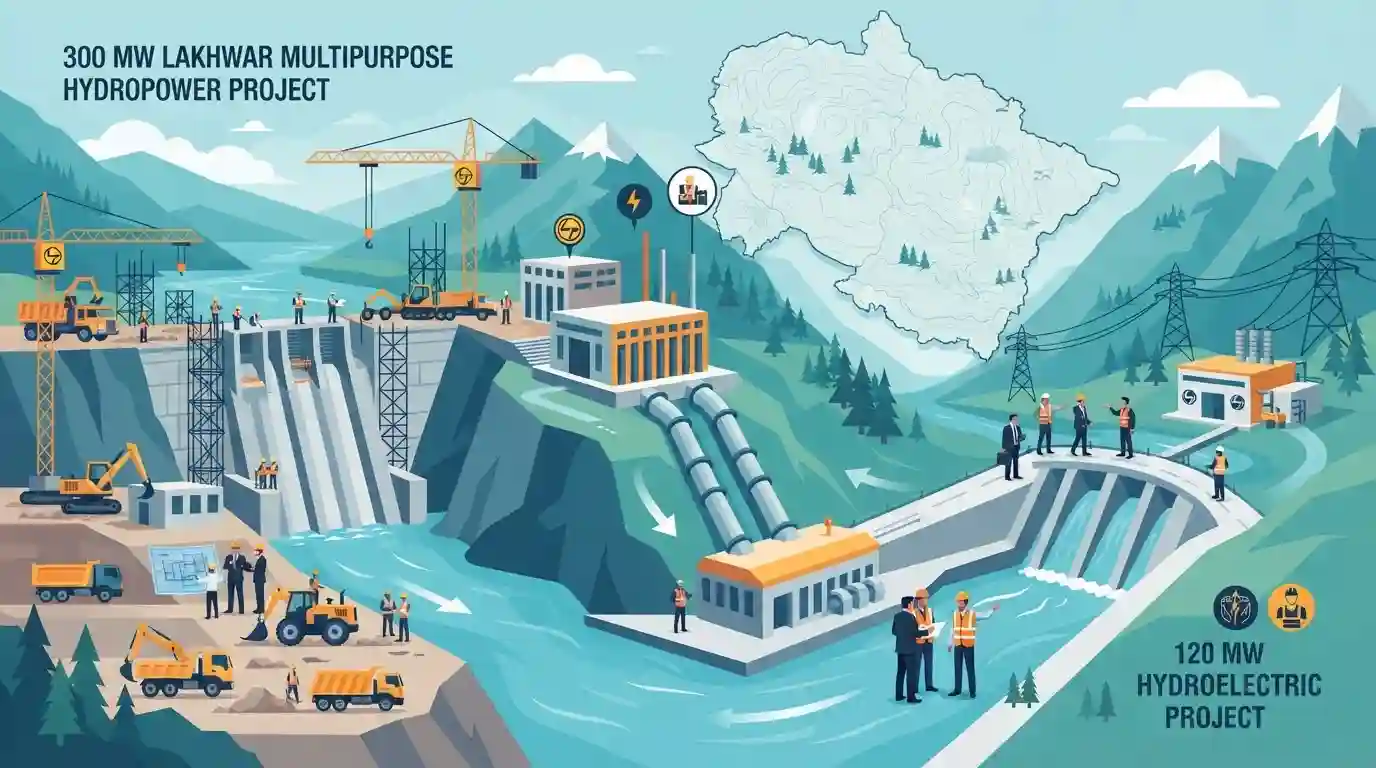
The Centre has directed Uttarakhand to ensure the timely completion of the 300 MW Lakhwar Multipurpose Hydropower Project on the Yamuna River. Construction is being executed by Larsen & Toubro (L&T) under the supervision of the state's nodal agency, UJVNL. Concurrently, officials from the National Dam Safety Authority (NDSA)—established under the Dam Safety Act, 2021—inspected both the Lakhwar dam and the nearby 120 MW Vyasi Hydroelectric Project to review construction progress and compliance with safety standards.
Key Points
- The Centre has urged Uttarakhand to complete the 300 MW Lakhwar Multipurpose Hydropower Project on the Yamuna River without missing the deadline.
- The National Dam Safety Authority (NDSA), constituted under the Dam Safety Act of 2021, recently inspected the construction progress of the dam.
- The project is executed by Larsen & Toubro (L&T), with Uttarakhand Jal Vidyut Nigam Limited (UJVNL) serving as the nodal agency for the state.
- An NDSA member also evaluated the 120 MW Vyasi Hydroelectric Project, which is situated downstream on the Yamuna river, emphasizing the structural and safety protocols.
Important Terms
Lakhwar Multipurpose Hydropower Project

A 300 MW under-construction dam on the Yamuna River in Uttarakhand designed to provide electricity and meet water requirements for Uttarakhand and neighboring states.
UPSC context
Tests GS-I Geography and GS-III Infrastructure regarding inter-state water distribution and Himalayan hydropower projects.
Dam Safety Act, 2021
A comprehensive legal framework ensuring the surveillance, inspection, operation, and maintenance of specified dams across India to prevent dam-failure disasters and protect downstream ecology.
UPSC context
Relevant for GS-II (Polity) and GS-III (Disaster Management), evaluating India's regulatory frameworks for critical infrastructure safety.
National Dam Safety Authority (NDSA)
A statutory body established under the Dam Safety Act, 2021, to regulate national dam safety policies, enforce safety standards, and resolve inter-state dam management disputes.
UPSC context
Crucial for GS-II (Statutory Bodies), testing institutional mechanisms for infrastructure oversight and inter-state coordination.
Vyasi Hydroelectric Project
A 120 MW run-of-the-river hydropower station on the Yamuna River in Uttarakhand, serving as a key power generation component alongside the larger Lakhwar project.
UPSC context
Tests GS-I Geography and GS-III Infrastructure knowledge relating to river systems and regional energy development.
Prelims Trap
The Dam Safety Act, 2021 applies to all dams and reservoirs constructed across India regardless of their height.
The Act applies only to "specified dams"—those over 15 metres high, or between 10 and 15 metres if they meet specific structural and design criteria.
Static Concepts Connected
What are the key institutional mechanisms established under the Dam Safety Act, 2021?
- National Committee (NCDSA): Formulates national policies and recommends regulations regarding dam safety standards across the country.
- National Authority (NDSA): Implements policies, resolves disputes between State Dam Safety Organisations, and functions as the state body where none exists.
- State Organisations (SDSO): Responsible for the continuous surveillance, inspection, and maintenance of specified dams within their respective state jurisdictions.
What is the geographical profile and tributary structure of the Yamuna River?
- Source origin: Originates from the Yamunotri Glacier on the southwestern slopes of Banderpunch peaks in the Lower Himalayas.
- Right-bank tributaries: Chambal, Sind, Betwa, and Ken join the Yamuna, draining the Vindhya range and Malwa plateau.
- Left-bank tributaries: Tons, Hindon, and Giri; the Tons river is its largest and most significant mountainous tributary.
Cross-Topic Patterns
Himalayan Hydro Projects & GLOF risks
Dam safety in Uttarakhand directly connects to disaster management topics like Glacial Lake Outburst Floods (GLOFs) and seismic vulnerability of Himalayan infrastructure, heavily scrutinized after the Teesta-III dam failure.
Inter-state River Valley Projects
The Lakhwar project benefits six basin states, testing the intersection of Geography (Yamuna basin) and Polity (Entry 56 of the Union List regulating inter-state rivers and cooperative federalism).

Expect a Prelims question matching Himalayan hydro projects (Lakhwar, Vyasi, Ratle) with their rivers, linked to the Dam Safety Act 2021.
Linked PYQs · 3
Linked PYQs · 3
- 2024UKPSC_PRELIMSGS1
Match the hydroelectric projects with the river on which they are constructed : | Name of Project | River | |---|---| | A. Koteshwar | 1. Asan | | B. Kulhal | 2. Alaknanda | | C. Tapoban Vishnugad | 3. Bhagirathi | | D. Vishnuprayag | 4. Dhalui | A B C D
- 2016UKPSC_PRELIMSGS1
The biggest Hydro-Electric Project of Uttarakhand State is:
- 2025UKPSC_PRELIMSGS1
Which of the following is the correct order of rivers from west to east in Uttarakhand?
