Centre opposes state level paddy procurement bonus scheme
Source:The Hindu ↗
Why It Matters
This issue perfectly illustrates the tension between central fiscal policy (managing buffer stocks and subsidy bills) and state-level agricultural interventions (supporting local farmers). It is highly relevant for GS-3 topics on food security, MSP, and buffer stocks, as well as GS-2 topics concerning fiscal federalism.
Summary
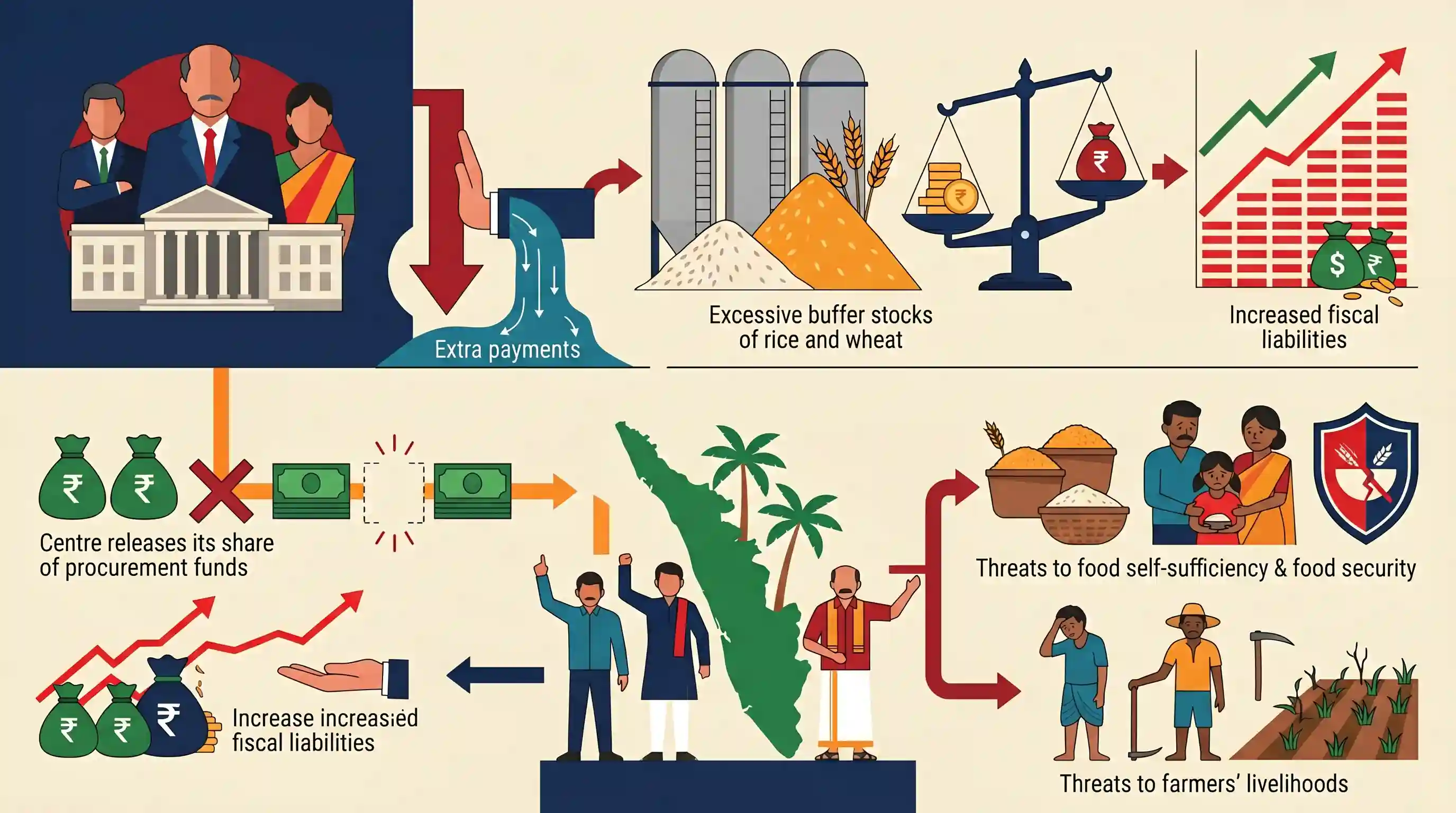
The Centre has instructed the Kerala government to discontinue the additional bonus it provides to farmers for paddy procurement. The Union Finance Ministry cites that such bonuses incentivize overproduction, leading to excessive buffer stocks of rice and wheat and increased fiscal liabilities. Kerala currently offers an extra ₹6.31 per kg over the central price. The Left Democratic Front (LDF) strongly opposed this directive, calling it detrimental to India's food self-sufficiency, food security, and farmers' livelihoods, while also pointing out the existing crisis caused by delays in the Centre releasing its share of procurement funds.
Key Points
- The Union government has directed Kerala to halt its practice of paying an additional bonus on paddy procurement.
- The Centre argues that such state bonuses encourage excess paddy cultivation, leading to over-storage of rice and wheat and increasing the financial burden on the public exchequer.
- Kerala currently pays an additional ₹6.31 per kg above the central procurement price to support its paddy farmers.
- The LDF has opposed the directive, asserting it threatens national food security, undermines self-sufficiency, and negatively impacts farmers.
- The issue also highlights friction in Centre-State financial relations, compounded by delays in the disbursement of the central share of procurement funds to Kerala.
Important Terms
Minimum Support Price (MSP)

The pre-announced floor price at which the government purchases crops from farmers to prevent distress sales and ensure income stability. It incentivizes production of essential grains like paddy and wheat.
UPSC context
GS Paper 3 (Agriculture); tests knowledge of price support, cropping patterns, and impact on the fiscal deficit.
Buffer Stocks
Strategic food grain reserves maintained by the government to stabilize market prices, ensure supply during shortages, and meet requirements for welfare schemes like the Public Distribution System (PDS).
UPSC context
GS Paper 3 (Economy/Agriculture); focuses on food management, storage infrastructure, and price stabilization mechanisms.
Centre-State Financial Relations
The constitutional and institutional framework governing the distribution of revenue, grants-in-aid, and financial powers between the Union and State governments under Articles 268 to 293.
UPSC context
GS Paper 2 (Polity/Federalism); examines fiscal federalism, Finance Commission roles, and state fiscal autonomy.
Food Security
A condition where all citizens have physical, economic, and social access to safe and nutritious food. It is implemented through the National Food Security Act (NFSA) 2013.
UPSC context
GS Paper 3 (Social Justice/Agriculture); evaluates PDS efficiency, malnutrition, and the legal right to food.
Agricultural Subsidies
Financial aid (direct or indirect) given to farmers to reduce production costs, such as fertilizer, power, and state-specific bonuses added to the central Minimum Support Price.
UPSC context
GS Paper 3 (Agriculture); covers WTO trade distortion issues, fiscal burden, and economic efficiency in farming.
Union Finance Ministry
The nodal central ministry responsible for India's fiscal policy, the Union Budget, and taxation. It monitors state-level financial liabilities and ensures national fiscal discipline.
UPSC context
GS Paper 3 (Economy); critical for understanding the budget process, revenue management, and federal financial oversight.
Prelims Trap
The Central Government legally prohibits State Governments from declaring any bonus over the MSP.
The Centre cannot legally ban state bonuses. Instead, it uses policy deterrents like restricting central procurement from that state or capping food subsidy reimbursements to the MSP limit.
Static Concepts Connected
What is the Decentralized Procurement Scheme (DCP)?
- State execution: State agencies directly procure, store, and distribute foodgrains for the Targeted Public Distribution System (TPDS).
- Subsidy reimbursement: The Centre reimburses states for the entire difference between the state's economic cost of procurement and the Central Issue Price (CIP).
- Core objective: Introduced to reduce FCI's transit costs, promote local procurement, and expand MSP outreach to non-traditional states.
How does Open-Ended Procurement work?
- Uncapped buying: Government agencies must buy all offered wheat and rice that meet Fair Average Quality (FAQ) norms at the declared MSP.
- Buffer overflow: Because buying is uncapped, surplus states generate massive stocks, frequently pushing the central pool far beyond the mandated buffer norms.
- OMSS linkage: Surplus grains acquired through open-ended procurement are routinely offloaded in the open market to cool prices and clear warehouse space.
Cross-Topic Patterns
Ecological cost of MSP bonuses
Extra financial incentives for paddy aggravate groundwater depletion and defeat crop diversification efforts aimed at promoting climate-resilient millets, pulses, and oilseeds.
WTO AMS limits and State subsidies
State-level bonuses add to India's product-specific Aggregate Measurement of Support (AMS), directly complicating New Delhi's defense of its food security programs at the WTO.

Expect a 2026 multi-statement question linking Decentralised Procurement (DCP) mechanics, state MSP bonuses, and WTO AMS calculations.
Linked PYQs · 5
Linked PYQs · 5
- 2024MainsGS3
Elucidate the importance of buffer stocks for stabilizing agricultural prices in India. What are the challenges associated with the storage of buffer stock? Discuss.
- 2018MainsGS3
What do you mean by Minimum Support Price (MSP)? How will MSP rescue the farmers from the low income trap?
- 2017MainsGS3
How do subsidies affect the cropping pattern, crop diversity and economy of farmers? What is the significance of crop insurance, minimum support price and food processing for small and marginal farmers?
- 2025MainsGS2
Examine the evolving pattern of Centre-State financial relations in the context of planned development in India. How far have the recent reforms impacted the fiscal federalism in India?
- 2024MainsGS2
What changes has the Union Government recently introduced in the domain of Centre-State relations ? Suggest measures to be adopted to build the trust between the Centre and the States and for strengthening federalism.
