Union government unveils new maternal and child health initiatives
Source:The Hindu ↗
Why It Matters
Provides critical data on India's demographic and public health progress (MMR, TFR) and details new policy interventions for maternal and child healthcare, directly relevant to GS2 social justice and health questions.
Summary
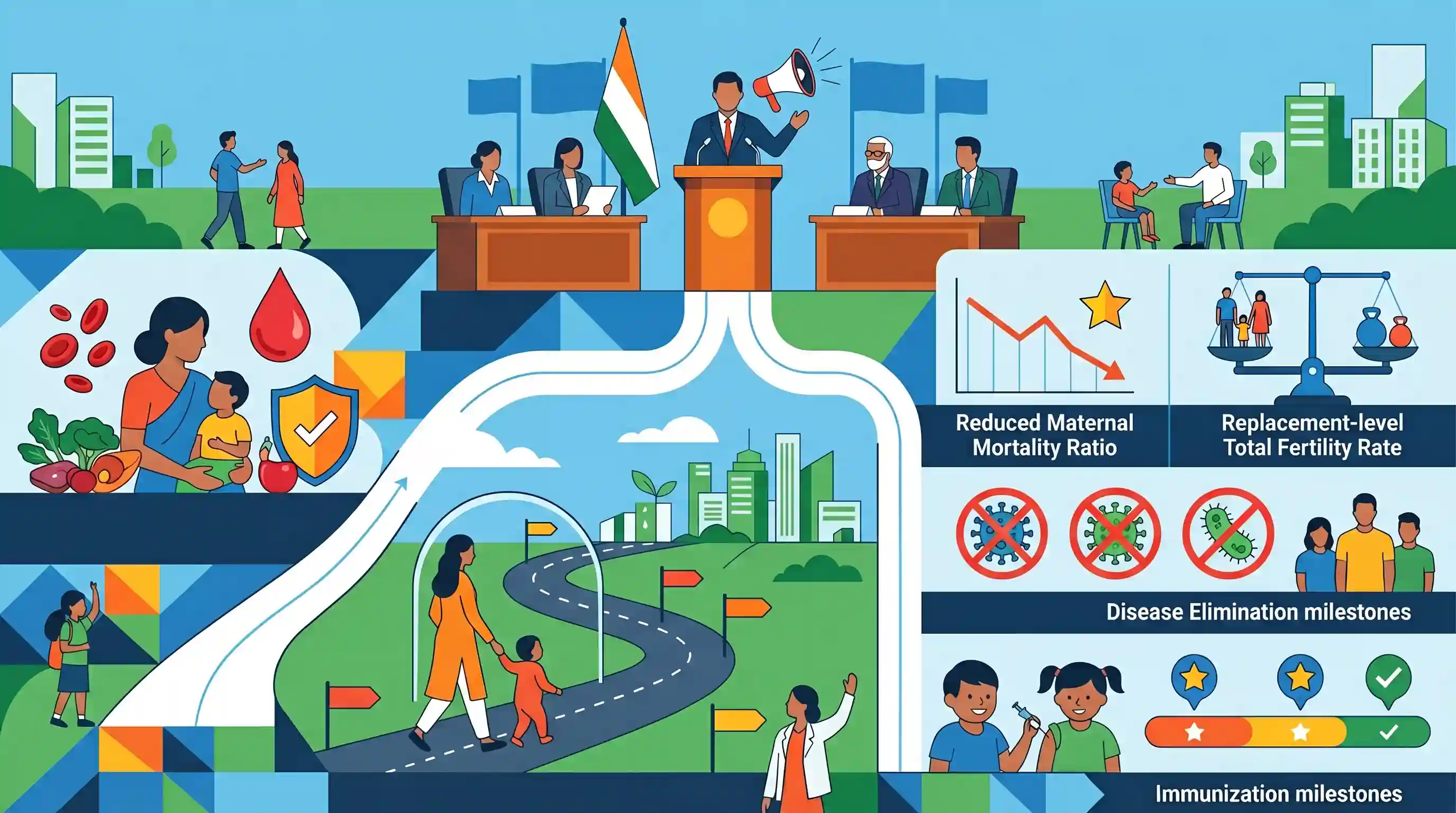
The Union government launched new maternal and child health initiatives at the 16th Conference of the Central Council of Health and Family Welfare (CCHFW), including a revised Anaemia Mukt Bharat Abhiyaan and the SUMAN Roadmap 2030. The event highlighted India's progress in health indicators, such as a reduced Maternal Mortality Ratio (MMR), achievement of replacement-level Total Fertility Rate (TFR), and milestones in disease elimination and immunization.
Key Points
- The revised Anaemia Mukt Bharat emphasizes saturation-based screening, digital tracking, and dietary diversification.
- The SUMAN Roadmap 2030 targets a reduction in preventable maternal and newborn deaths.
- Samagra Shishu Bal Swasthya Karyakram integrates care for newborns and young children up to five years of age.
- India's Maternal Mortality Ratio (MMR) has declined from 130 to 87 per 1 lakh live births since 2014.
- India has achieved a Total Fertility Rate (TFR) of 2.0 and an increase in life expectancy to 70.3 years.
Important Terms
Anaemia Mukt Bharat Abhiyaan

A national strategy revised in 2026 to a '7x7x7' framework, adding low-birth-weight infants as beneficiaries and shifting to a 'Test, Treat, Talk, and Track' (T4) model for therapeutic management.
UPSC context
GS Paper II: Welfare schemes for vulnerable sections; tests knowledge of specific health targets and strategy shifts (6x6x6 to 7x7x7).
SUMAN Roadmap 2030
A strategic framework launched to achieve Sustainable Development Goals by 2030 by reducing preventable maternal and newborn deaths through a life-cycle care approach (pre-pregnancy to postnatal) in 130 high-burden districts.
UPSC context
GS Paper II: Health/Governance; tests understanding of India's roadmap to meet international SDG targets for maternal health.
Samagra Shishu Bal Swasthya Karyakram (SSBSK)
A unified program for children from birth to 36 months that integrates existing Home-Based Newborn and Young Child care schemes, utilizing a risk-stratified approach and digital tracking to ensure child survival.
UPSC context
GS Paper II: Issues relating to development/management of Social Sector; tests knowledge of integrated child healthcare delivery and the first 1,000 days.
Central Council of Health and Family Welfare (CCHFW)
An apex advisory body established under Article 263 of the Indian Constitution to consider and recommend health policies and promote coordination between the Central and State governments.
UPSC context
GS Paper II: Statutory/Regulatory/Quasi-judicial bodies; tests understanding of constitutional mechanisms for Centre-State health cooperation.
Maternal Mortality Ratio (MMR)
The number of maternal deaths per 100,000 live births; it is a critical health indicator used to measure the quality of obstetric and maternal healthcare services.
UPSC context
GS Paper I & II: Population and associated issues/Health; tests data-driven analysis of India's progress in social development.
Total Fertility Rate (TFR)
The average number of children born to a woman during her childbearing years; India’s TFR has reached 2.0, falling below the replacement level of 2.1.
UPSC context
GS Paper I: Social issues/Demography; tests understanding of demographic transition and population stabilization trends in India.
Prelims Trap
"The Central Council of Health and Family Welfare is a statutory body established under the National Health Mission."
CCHFW is actually a Constitutional body set up under Article 263 (Inter-State Council provisions), not a statutory or executive body.
Static Concepts Connected
What does India's Total Fertility Rate (TFR) falling to 2.0 signify?
- Replacement Level: TFR of 2.1 is the rate at which a population exactly replaces itself from one generation to the next.
- Population Stabilization: At 2.0, India is below replacement level, ensuring long-term population stabilization and eventual decline.
- Demographic Dividend: A lower TFR reduces the child dependency ratio, expanding the working-age demographic dividend window.
What are the key Sustainable Development Goal (SDG 3) targets for maternal and child health?
- MMR Target: Reduce the global Maternal Mortality Ratio (MMR) to less than 70 per 100,000 live births by 2030 (India is currently at 87).
- Neonatal Mortality: Reduce Neonatal Mortality Rate (NMR) to at least as low as 12 per 1,000 live births.
- Under-5 Mortality: Reduce the Under-5 Mortality Rate (U5MR) to at least as low as 25 per 1,000 live births.
Cross-Topic Patterns
Health + Article 263 federalism
Health is a State Subject, making Article 263 constitutional mechanisms like the CCHFW critical for Centre-State cooperative federalism to achieve national SDG-3 targets.
Anaemia Mukt Bharat + Biofortified crops
The revised Anaemia Mukt Bharat's push for "dietary diversification" aligns directly with agricultural initiatives promoting biofortified crops (e.g., zinc-rich rice, iron-rich pearl millet) to combat hidden hunger.

Expect a multi-statement question combining TFR dipping below replacement level (2.0) with India's shifting demographic dependency ratio.
Linked PYQs · 5
Linked PYQs · 5
- 2024MainsGS2
In a crucial domain like the public healthcare system the Indian State should play a vital role to contain the adverse impact of marketisation of the system. Suggest some measures through which the State can enhance the reach of public healthcare at the grassroots level.
- 2020MainsGS2
In order to enhance the prospects of social development, sound and adequate health care policies are needed particularly in the fields of geriatric and maternal health care. Discuss.
- 2024PrelimsGS1
The total fertility rate in an economy is defined as:
- 2023PrelimsGS1
Consider the following statements in the context of interventions being undertaken under Anaemia Mukt Bharat Strategy: 1. It provides prophylactic calcium supplementation for pre-school children, adolescents and pregnant women. 2. It runs a campaign for delayed cord clamping at the time of child-birth. 3. It provides for periodic deworming to children and adolescents. 4. It addresses non-nutritional causes of anaemia in endemic pockets with special focus on malaria, hemoglobinopathies and fluorosis. How many of the statements given above are correct?
- 2017PrelimsGS1
Which of the following are the objectives of 'National Nutrition Mission'? 1. To create awareness relating to malnutrition among pregnant women and lactating mothers. 2. To reduce the incidence of anaemia among young children, adolescent girls and women. 3. To promote the consumption of millets, coarse cereals and unpolished rice. 4. To promote the consumption of poultry eggs. Select the correct answer using the code given below:
