Manipur political developments and Article 356 application limits
Source:Indian Express ↗
Why It Matters
Understanding the political and constitutional reluctance to impose President's Rule in a conflict-ridden state provides a real-world case study for Centre-State relations, internal security dynamics, and the evolution of Article 356 post-S.R. Bommai guidelines.
Summary
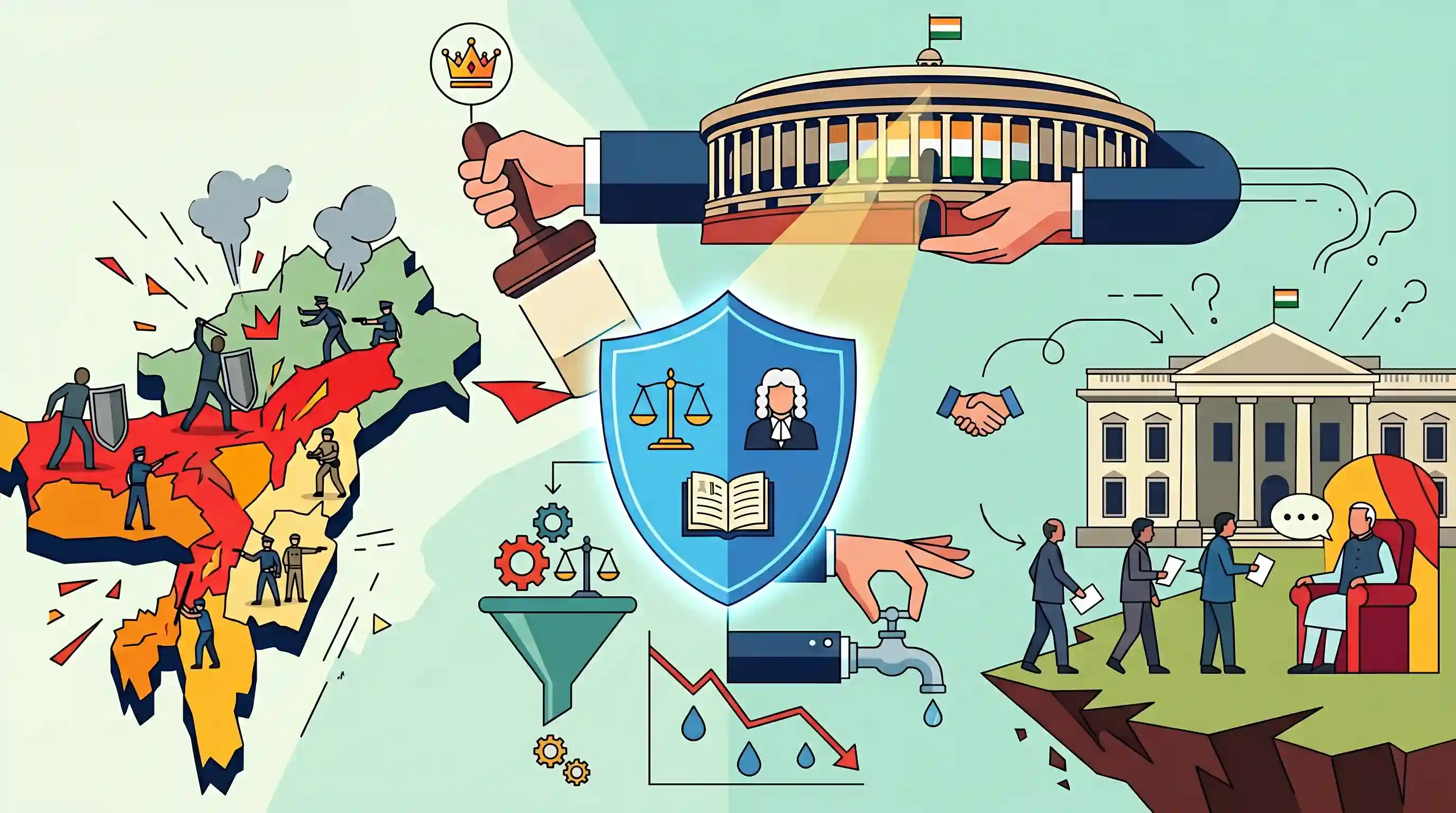
Despite the protracted ethnic conflict and law-and-order challenges in Manipur, the Central government is reportedly unlikely to invoke President's Rule (Article 356). Speculation about political instability or a potential leadership change arose after several MLAs met the Governor, but the BJP has downplayed these as mere "courtesy visits." For UPSC aspirants, this scenario illustrates the practical application of Centre-State relations, the reduced frequency of invoking Article 356 due to political factors and judicial scrutiny (S.R. Bommai case), and the ongoing internal security challenges in Northeast India.
Key Points
- The Central government is unlikely to invoke President's Rule (Article 356) in Manipur despite ongoing ethnic conflict and law-and-order challenges.
- Recent meetings between ruling MLAs and the Governor have been downplayed by the BJP as routine 'courtesy visits', denying rumors of internal revolt or political instability.
- The reluctance to use Article 356 highlights the political constraints and judicial safeguards (such as the S.R. Bommai judgment) that have reduced its frequency of use since the 1990s.
- The situation underscores the complexities of managing internal security, ethnic divides, and constitutional machinery in border states.
Important Terms
Article 356

Constitutional provision allowing the President to dismiss a state government and assume its functions if the 'constitutional machinery' has failed. Often termed 'State Emergency' or 'Constitutional Emergency.'
UPSC context
GS Paper II (Polity). Tests understanding of federalism, emergency provisions, and the Centre's power to intervene in state governance.
Article 355
A constitutional mandate requiring the Union government to protect states against external aggression and 'internal disturbance,' and ensuring they function according to the Constitution.
UPSC context
GS Paper II/III. Crucial for Manipur-related questions where the Centre provides security assistance without fully dismissing the state government.
S.R. Bommai Case
The 1994 Supreme Court judgment that made the invocation of Article 356 justiciable (subject to judicial review) and mandated that a government's majority be tested on the floor of the House.
UPSC context
GS Paper II. The primary legal safeguard against the arbitrary dismissal of state governments; essential for federalism topics.
President's Rule
The administrative state in which the President, usually through the Governor, manages a state's executive functions after the suspension of the elected government under Article 356.
UPSC context
GS Paper II. Focuses on the impact on state autonomy and the legislative role of Parliament during the emergency.
Constitutional Machinery
The legal threshold for invoking Article 356; it refers to a situation where a state government can no longer function in accordance with the provisions of the Constitution.
UPSC context
GS Paper II. A key technical term used to evaluate the legitimacy of central intervention in state affairs.
Role of the Governor
The constitutional head of a state who acts as an intermediary, providing the official report to the President regarding the stability or failure of the state's administration.
UPSC context
GS Paper II. Frequently tested regarding discretionary powers and the neutrality of the office in Centre-State conflicts.
Prelims Trap
"The State Legislative Assembly is automatically dissolved upon the proclamation of President's Rule under Article 356."
Post the S.R. Bommai judgment, the President cannot dissolve the Assembly immediately. It can only be kept in suspended animation until both Houses of Parliament approve the proclamation.
Static Concepts Connected
What did the S.R. Bommai judgement (1994) rule regarding Article 356?
- Judicial Review: The President's satisfaction in invoking Article 356 is not absolute and is strictly subject to judicial review on grounds of mala fide intent.
- Assembly Dissolution: The state legislative assembly can only be suspended, not dissolved, prior to parliamentary approval of the proclamation.
- Floor Test: The majority of the state government must be tested on the assembly floor, rather than determined by the Governor's subjective opinion.
What are the key differences between Article 355 and Article 356?
- Duty vs Power: Article 355 mandates the Union's duty to protect states from internal disturbance, while Article 356 is the power to take over the state machinery.
- State Government Status: Article 355 allows central intervention (e.g., troop deployment) without dismissing the elected state government, whereas Article 356 removes the state executive.
Cross-Topic Patterns
Article 355 vs. 356 in internal security
The Union's duty to protect states (Art 355) allows central intervention—like deploying forces or unified command—without dismissing the elected government (Art 356), a strategy increasingly used in Northeast security crises.
Governor's discretion + Border state dynamics
In states with severe law and order breakdowns or Sixth Schedule areas, the Governor's "subjective" report to the Centre becomes the critical constitutional trigger, frequently sparking Centre-State friction.

The interplay between Article 355 (duty to protect) and Article 356 (President's Rule) in border states is a high-probability 2026 mains Q.
Linked PYQs · 3
Linked PYQs · 3
- 2023MainsGS2
Account for the legal and political factors responsible for the reduced frequency of using Article 356 by the Union Governments since mid 1990s.
- 2018PrelimsGS1
If the President of India exercises his power as provided under Article 356 of the Constitution in respect of a particular State, then
- 2017MainsGS3
The North-East region of India has been infested with insurgency for a very long time. Analyze the major reasons for the survival of armed insurgency in this region.
