Centre Proposes Inquiry into Unallotted JNNURM Flats in Delhi
Source:The Hindu ↗
Why It Matters
Illustrates the critical gaps between the creation of social infrastructure and its actual delivery to beneficiaries, heavily impacted by political friction and federal governance complexities in regions like Delhi.
Summary
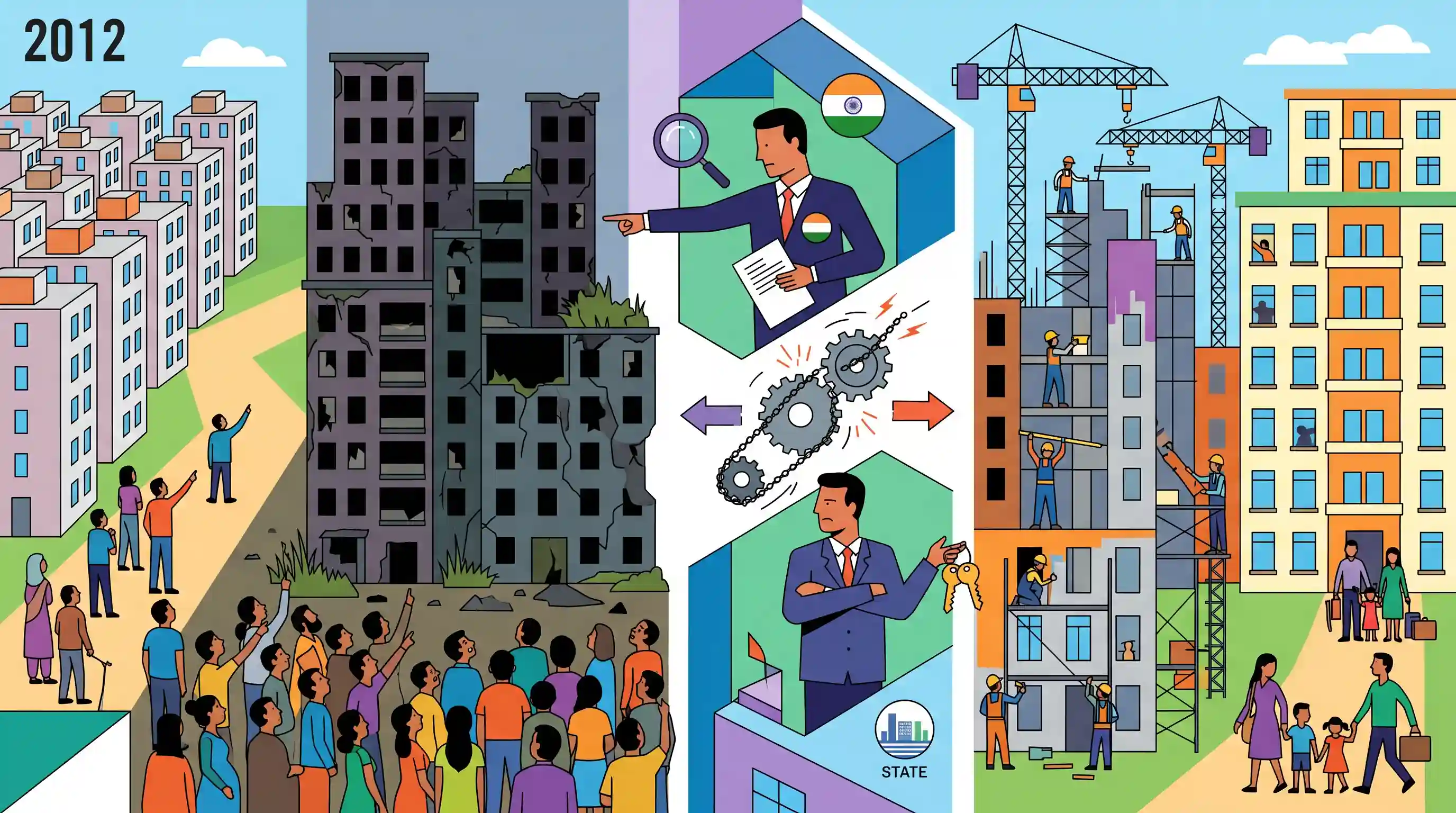
Union Housing and Urban Affairs Minister Manohar Lal announced that the Centre is considering an inquiry into the failure to allot around 48,000 flats constructed for the poor in Delhi under the Jawaharlal Nehru National Urban Renewal Mission (JNNURM). Constructed in 2012, the vast majority of the 52,344 flats were left vacant and have severely deteriorated. The issue highlights political friction, with accusations that the previous AAP government deliberately withheld allotments. The current administration now plans to repair or reconstruct the unlivable units to finally provide housing for slum dwellers.
Key Points
- The Centre is considering an inquiry into the non-allotment of nearly 48,000 flats built in Delhi for the urban poor under the JNNURM scheme.
- Despite the construction of 52,344 flats in 2012 with joint Central and State support, only 4,871 were actually allotted, leading to the deterioration of the remaining units.
- Rajya Sabha MP Swati Maliwal accused the former AAP-led Delhi government of stalling the housing allotments due to vote bank politics.
- Union Housing and Urban Affairs Minister Manohar Lal stated that the current Delhi government plans to repair or reconstruct the dilapidated flats for eventual allotment to slum dwellers.
Important Terms
Jawaharlal Nehru National Urban Renewal Mission (JNNURM)

Launched in 2005, it was India's first major urban modernization scheme. It focused on infrastructure and providing basic services, including housing (BSUP/IHSDP), to the urban poor across major mission cities.
UPSC context
GS Paper II (Welfare Schemes) & GS III (Urbanization). Important for understanding the evolution of urban poverty alleviation and legacy project challenges.
Pradhan Mantri Awas Yojana - Urban (PMAY-U)
Launched in 2015 to achieve 'Housing for All,' this flagship mission provides pucca houses to urban poor. It includes verticals like In-situ Slum Redevelopment and Credit Linked Subsidy.
UPSC context
GS Paper II (Social Justice/Welfare) & GS III (Infrastructure). A core scheme for urban development and housing rights questions.
Slum Rehabilitation
A policy objective to replace informal, dilapidated slum dwellings with permanent housing, providing residents with legal tenure, improved sanitation, and basic amenities, often using land as a resource.
UPSC context
GS Paper I (Urbanization) & GS II (Vulnerable Sections). Tests analysis of urban poverty alleviation and inclusive city planning strategies.
Centre-State Relations
The constitutional and administrative framework governing interactions between the Union and States. It covers legislative, administrative, and financial powers, often tested during the implementation of Central schemes.
UPSC context
GS Paper II (Federal Structure). Essential for analyzing cooperative federalism and political-administrative friction in governance.
Rajya Sabha
The Upper House of Parliament, representing States and Union Territories. It serves as a permanent house for legislative review and a platform for holding the executive accountable.
UPSC context
GS Paper II (Parliament). Tests knowledge of federal representation, parliamentary oversight, and legislative procedures.
Question Hour
The first hour of a parliamentary sitting where members pose questions to ministers. It is a vital tool for ensuring executive accountability and public transparency.
UPSC context
GS Paper II (Legislature). Key for understanding tools of parliamentary control over the executive.
Prelims Trap
The Delhi Urban Shelter Improvement Board (DUSIB) and Delhi Development Authority (DDA) both function directly under the Union Government.
While the Delhi Development Authority (DDA) is under the Union Ministry of Housing and Urban Affairs, DUSIB operates under the Delhi State Government.
Static Concepts Connected
How does Article 239AA distribute administrative control over Delhi's urban development?
- Special Status: Added by the 69th Constitutional Amendment Act (1991), it provides a Legislative Assembly for the National Capital Territory of Delhi.
- Reserved Subjects: 'Land', 'Public Order', and 'Police' remain exclusively under the Union Government's jurisdiction, limiting the State's control over spatial planning.
- Multiplicity of Authorities: This division creates overlapping jurisdictions between Central bodies (DDA) and State/Municipal bodies (DUSIB, MCD), often leading to policy paralysis in housing.
How did urban housing policy transition from JNNURM to PMAY-U?
- JNNURM approach: Launched in 2005, it focused on integrated urban infrastructure and providing basic services to the urban poor (BSUP) through state-led projects.
- Mission Subsumption: JNNURM was eventually subsumed; its housing components evolved into the Pradhan Mantri Awas Yojana-Urban (PMAY-U), launched in 2015.
- Demand-driven shift: PMAY-U shifted towards demand-driven mechanisms like Credit Linked Subsidy Schemes (CLSS) and In-situ Slum Redevelopment, moving away from purely supply-driven state construction.
Cross-Topic Patterns
Urban flooding & governance paralysis
Overlapping jurisdictions delaying slum housing mirror the administrative paralysis often blamed for poor disaster response and recurring urban flooding in metropolitan cities like Delhi and Bengaluru.
Dead capital vs asset monetization
The deterioration of 48,000 vacant public flats exemplifies "dead public capital," a core governance inefficiency that the National Monetisation Pipeline aims to prevent in current infrastructure planning.

Expect a GS2 Mains question linking the multiplicity of authorities in Delhi (Article 239AA) to urban policy paralysis.
Linked PYQs · 4
Linked PYQs · 4
- 2023MainsGS1
Does urbanization lead to more segregation and/or marginalization of the poor in Indian metropolises?
- 2022MainsGS2
Besides the welfare schemes, India needs deft management of inflation and unemployment to serve the poor and the underprivileged sections of the society. Discuss.
- 2016MainsGS2
Discuss the essentials of the 69th Constitutional Amendment Act and anomalies, if any, that have led to recent reported conflicts between the elected representatives and the institution of the Lieutenant Governor in the administration of Delhi. Do you think that this will give rise to a new trend in the functioning of the Indian federal politics?
- 2018MainsGS2
Whether the Supreme Court Judgement (July 2018) can settle the political tussle between the Lt. Governor and elected government of Delhi? Examine.
