Trade Margin Capping on Non Scheduled Cancer Drugs for Affordability
Source:The Hindu ↗
हे का महत्त्वाचे आहे
This policy intervention addresses the critical challenge of high out-of-pocket expenditure on catastrophic illnesses like cancer, highlighting the state's regulatory role in healthcare affordability and market correction.
सारांश
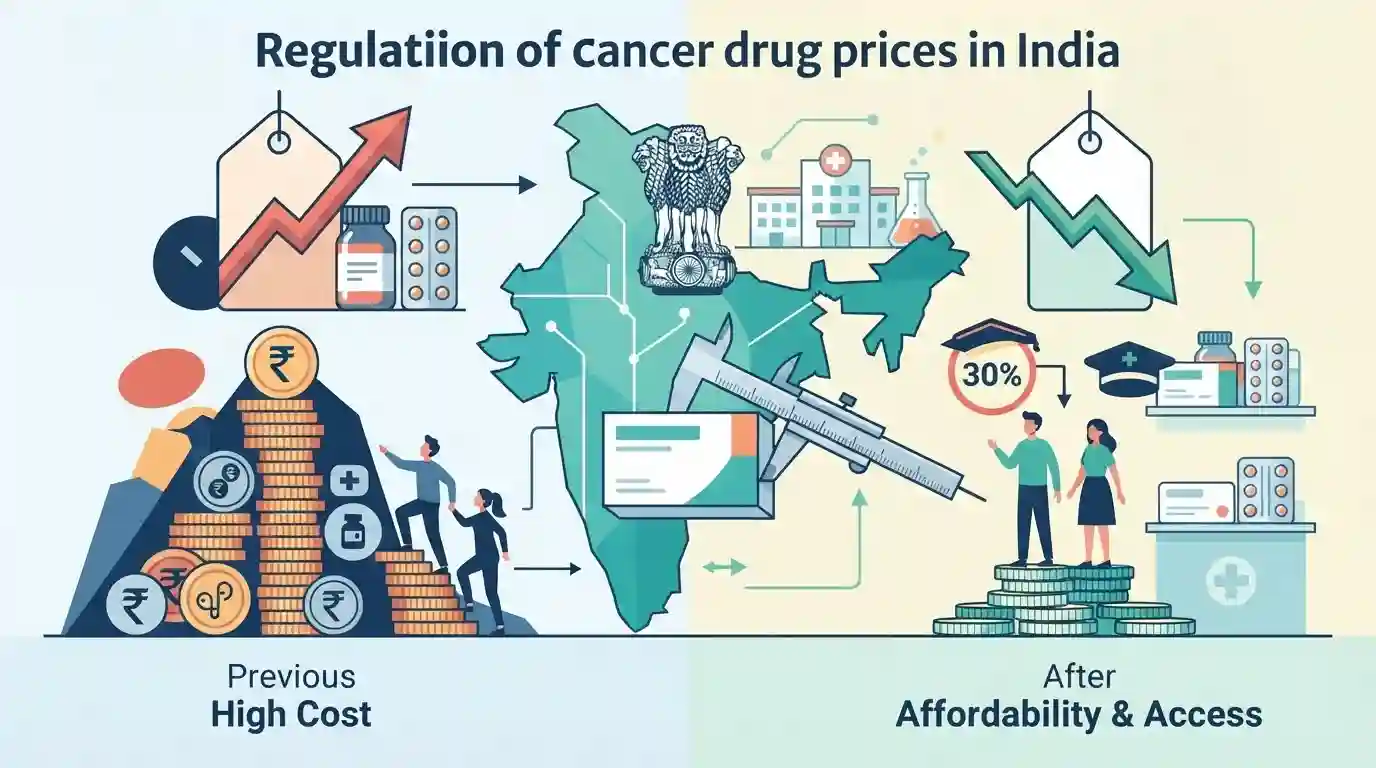
The Indian government has moved to cap trade margins on non-scheduled cancer drugs at 30% of the MRP to address high out-of-pocket healthcare costs and make critical oncological therapies more accessible and affordable.
मुख्य मुद्दे
- The Central government has decided to cap trade margins on non-scheduled cancer drugs at 30% of the Maximum Retail Price (MRP).
- The move aims to make anti-cancer medications more affordable and reduce out-of-pocket expenditure for patients suffering from cancer.
- The National Pharmaceutical Pricing Authority (NPPA) exercises statutory powers to monitor and regulate drug prices in India to curb exorbitant margins charged across the supply chain.
महत्त्वाच्या संज्ञा
National Pharmaceutical Pricing Authority

An independent regulatory body established under the Ministry of Chemicals and Fertilizers to fix and revise prices of pharmaceutical products and enforce the provisions of the DPCO in India.
UPSC context
GS Paper II (Health Policy, Governance) & GS Paper III (Economy). Tests knowledge of regulatory institutions controlling drug affordability and public healthcare.
Drugs Prices Control Order
An order issued by the Government of India under the Essential Commodities Act to regulate the prices of essential medicines and cap trade margins to prevent overpricing.
UPSC context
GS Paper II (Social Justice, Health) & GS Paper III (Indian Economy). Tests understanding of price controls, welfare economics, and market regulation.
Ministry of Chemicals and Fertilizers
The central ministry in India responsible for policy formulation, regulation, and development of the chemical, petrochemical, and pharmaceutical industries, including drug pricing oversight.
UPSC context
GS Paper II (Government Ministries and Governance). Tests understanding of executive machinery and ministerial jurisdictions governing public health and industrial policy.
पूर्वपरीक्षा सापळा
NPPA fixes prices for all medicines in India under executive guidelines without statutory backing from the Essential Commodities Act.
Aspirants often assume price caps and trade margin rationalisation apply uniformly to all patented and non-scheduled drugs without statutory backing, missing the DPCO/Essential Commodities Act framework.
संबंधित स्थिर संकल्पना
What are the core statutory powers and functions of the National Pharmaceutical Pricing Authority (NPPA) in India?
- Creation & Ministry: Established in 1997 as an independent body of the Department of Pharmaceuticals, Ministry of Chemicals and Fertilizers.
- Statutory Basis: Enforces the Drugs (Prices Control) Order (DPCO) issued under Section 3 of the Essential Commodities Act, 1955.
- Core Function: Fixes and revises prices of scheduled formulations and monitors prices of non-scheduled drugs to prevent profiteering.
आंतर-विषय नमुने
Healthcare Affordability & Multidimensional Poverty
Trade margin rationalisation and out-of-pocket health expenditure directly impact multidimensional poverty measurements and household vulnerability indices tracked by NITI Aayog.
DPCO & Essential Commodities Act Linkages
The DPCO operates under the Essential Commodities Act, linking pharmaceutical market interventions with statutory food and drug security enforcement mechanisms.

Expect statement-based questions on NPPA powers, DPCO applicability to scheduled vs non-scheduled drugs, and statutory vs executive pricing tools.
संबंधित PYQ · 1
संबंधित PYQ · 1
- 2024MainsGS2
In a crucial domain like the public healthcare system the Indian State should play a vital role to contain the adverse impact of marketisation of the system. Suggest some measures through which the State can enhance the reach of public healthcare at the grassroots level.
