Centre Plans Amendments to Plant Varieties and Farmers Rights Act
Source:The Hindu ↗
Why It Matters
The intersection of Intellectual Property Rights (IPR), traditional farming, and international treaties is a critical UPSC theme. The expansion of the Multilateral System (MLS) under ITPGRFA directly threatens India's sovereign control over its rich plant genetic resources and highlights the ongoing global debate between protecting national biodiversity and facilitating open access for food security.
Summary
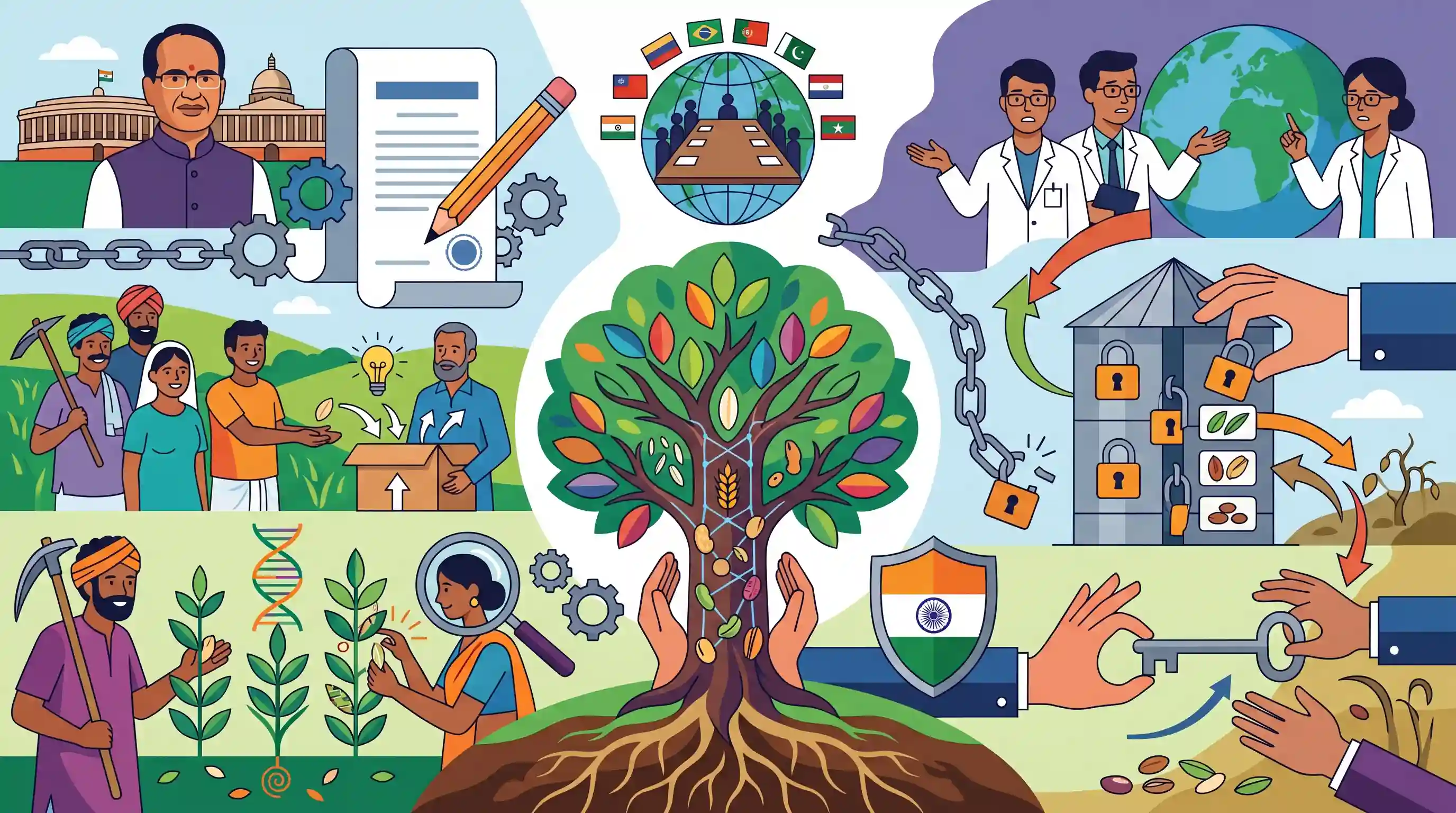
Union Agriculture Minister Shivraj Singh Chouhan announced that the Protection of Plant Varieties and Farmers' Rights Act (PPV&FRA) will be amended to simplify the registration of traditional seed varieties and enhance awareness among farmers. Simultaneously, a group of scientists has urged the government to protect India's sovereign rights over its plant genetic wealth at the upcoming 11th Session of the Governing Body of the International Treaty on Plant Genetic Resources for Food and Agriculture (ITPGRFA) in Lima. They raised concerns over proposals to expand the Multilateral System (MLS), which could mandate India to open its entire national seed collection to global access, potentially compromising the rights of Indian farmers and the nation's biological sovereignty.
Key Points
- The Centre announced plans to amend the Protection of Plant Varieties and Farmers' Rights Act (PPV&FRA) to simplify seed registration processes for farmers and boost awareness.
- A financial incentive mechanism will be introduced to encourage the conservation of traditional seed varieties by farmers.
- More than 6,000 farmers' plant varieties have been registered under the PPV&FRA so far.
- Indian scientists warned the government about protecting India's sovereign rights over its genetic wealth at the 11th Session of the Governing Body of ITPGRFA in Lima.
- Concerns are focused on proposals to expand the Multilateral System (MLS) beyond its current 64 crops, which could force India to provide global access to its entire national seed collections.
Important Terms
Protection of Plant Varieties and Farmers' Rights (PPV&FR) Act, 2001

An Indian sui generis law providing intellectual property protection for plant varieties while uniquely ensuring farmers can save, use, and sell farm-saved seeds, even of protected varieties.
UPSC context
GS Paper III (Agriculture/IPR). Tests understanding of India's balance between commercial breeder rights and traditional farmer rights.
International Treaty on Plant Genetic Resources for Food and Agriculture (ITPGRFA)
A legally binding international agreement (the 'Seed Treaty') dedicated to conserving crop diversity and ensuring fair sharing of benefits derived from plant genetic resources.
UPSC context
GS Paper II (International Treaties) and Paper III (Environment). Relevant for food security and global biodiversity governance.
Multilateral System (MLS)
A global gene pool created by the ITPGRFA that facilitates access to genetic materials of specific food crops for research, breeding, and training under standardized benefit-sharing rules.
UPSC context
GS Paper III (Biodiversity). Crucial for debates on global seed access versus national sovereign rights over genetic wealth.
Plant Genetic Resources for Food and Agriculture (PGRFA)
Genetic material of plant origin—including seeds and tissues—having actual or potential value for food and agriculture, forming the basis of global food security and crop improvement.
UPSC context
GS Paper III (Agriculture). The technical term for the biological capital tested in biodiversity and conservation topics.
UPOV (International Union for the Protection of New Varieties of Plants)
An intergovernmental organization providing a standardized plant variety protection system. Unlike India's Act, UPOV's 1991 convention significantly restricts farmers' rights to save and reuse seeds.
UPSC context
GS Paper III (IPR). Essential comparison point for India's unique 'sui generis' legal framework in international trade.
Sui Generis System
A 'unique' or 'of its own kind' legal framework. India used this approach for the PPV&FR Act to comply with WTO/TRIPS while protecting non-commercial farming practices.
UPSC context
GS Paper III (IPR). Tests knowledge of India's specialized legal strategies to adapt international property norms to local needs.
Prelims Trap
Farmers are prohibited from selling farm-saved seeds of a protected plant variety under the PPV&FR Act.
Under the PPV&FRA 2001, Indian farmers possess the explicit legal right to save, use, sow, exchange, share, and sell unbranded seeds, even if they belong to a legally protected variety.
Static Concepts Connected
What are the unique rights granted under India's PPV&FR Act, 2001?
- Sui Generis System: Acts as an alternative to patenting, fulfilling WTO TRIPS obligations while protecting plant breeders and farmers.
- Farmers' Rights: Farmers can save, sow, exchange, and sell unbranded farm produce, including seeds of a registered variety.
- Breeders' Rights: Grants exclusive rights to breeders to produce, sell, market, and distribute the registered variety commercially.
- Researchers' Rights: Allows use of any registered variety for conducting experiments or research by scientists.
How does the ITPGRFA (Seed Treaty) Multilateral System function?
- FAO Framework: A legally binding FAO treaty ensuring conservation and sustainable use of global plant genetic resources for food security.
- Annex 1 Crops: Pools 64 major food and forage crops into a global repository, facilitating shared access for research and breeding.
- Benefit Sharing: Requires recipients who commercialize genetic materials to share financial benefits, which are directed to developing countries.
Cross-Topic Patterns
Seed Treaty vs. Biological Diversity Act
Expanding the FAO's Multilateral System could bypass India's Biological Diversity Act, 2002, which mandates strict National Biodiversity Authority (NBA) approval before foreign entities can access indigenous genetic resources.
IPR vs. Corporate Agriculture (PepsiCo Case)
The PPV&FRA debate directly recalls the 2019 PepsiCo case, where the company sued Gujarat farmers for growing its registered FC5 potato variety, testing the limits of breeders' vs. farmers' rights.

Expect a 2026 multi-statement prelims question mapping India's PPV&FRA (farmers' right to sell unbranded seeds) against the FAO Seed Treaty.
Linked PYQs · 3
Linked PYQs · 3
- 2019PrelimsGS1
Consider the following statements : 1. According to the Indian Patents Act, a biological process to create a seed can be patented in India. 2. In India, there is no Intellectual Property Appellate Board. 3. Plant varieties are not eligible to be patented in India. Which of the statements given above is/are correct?
- 2014PrelimsGS1
Consider the following international agreements : 1. The International Treaty on Plant Genetic Resources for Food and Agriculture 2. The United Nations Convention to Combat Desertification 3. The World Heritage Convention Which of the above has/have a bearing on the biodiversity?
- 2014MainsGS3
In a globalized world, Intellectual Property Rights assume significance and are a source of litigation. Broadly distinguish between the terms-Copyrights, Patents and Trade Secrets.
