Centre Bars New Hydel Projects in Upper Ganga to Prevent Disasters
Source:The Hindu ↗
Why It Matters
This development is a crucial case study for UPSC aspirants regarding the conflict between renewable energy infrastructure (hydropower) and ecological conservation in fragile zones like the Himalayas. It touches upon environmental impact assessments, the carrying capacity of river basins, disaster management (flash floods/cloudbursts), and the role of inter-ministerial expert committees in policymaking.
Summary
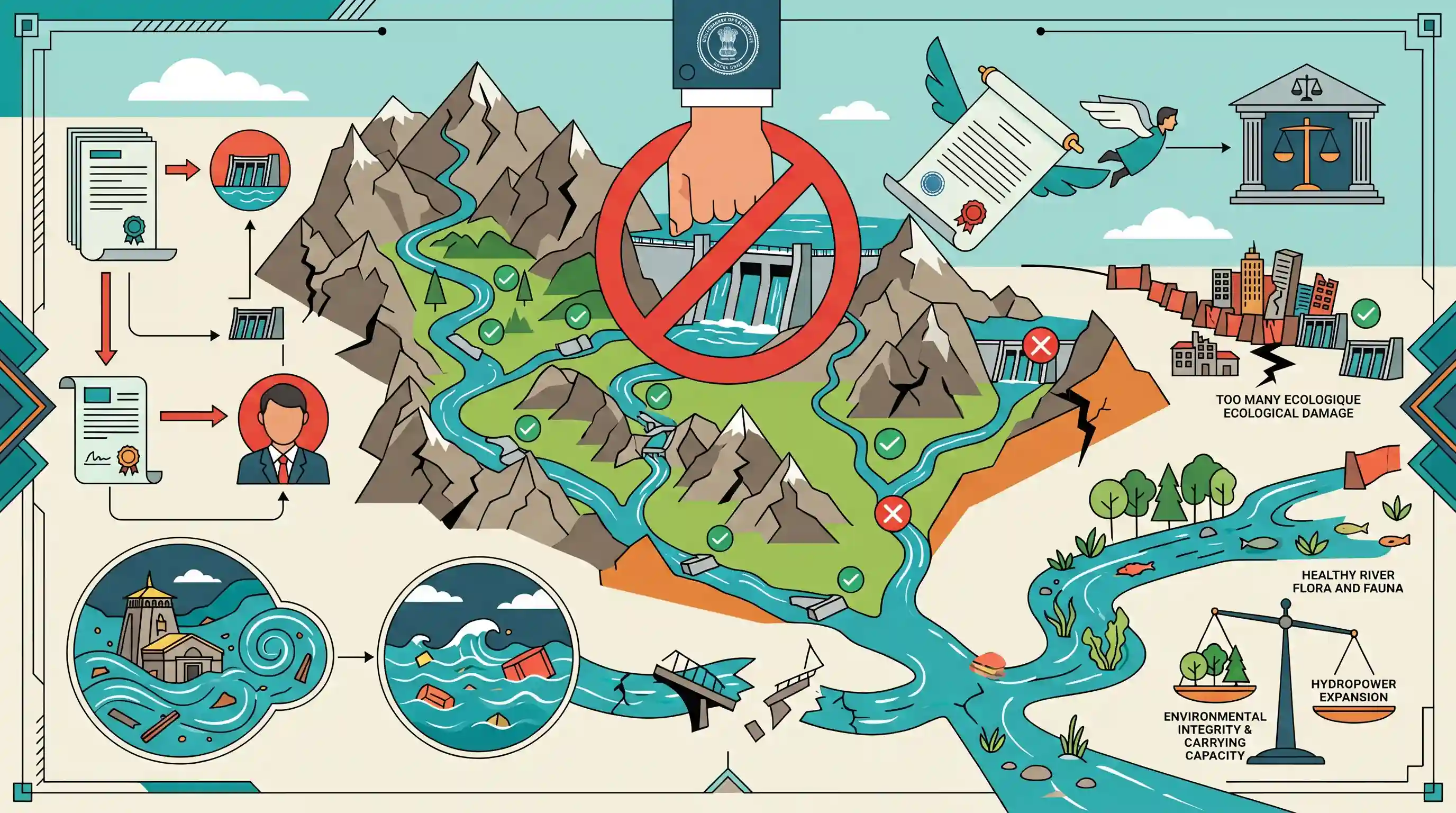
The Union government has submitted an affidavit to the Supreme Court declaring that no new hydroelectric projects will be permitted in the upper reaches of the Ganga in Uttarakhand, specifically within the Alaknanda and Bhagirathi river basins. Citing the region's seismic fragility, cumulative ecological damage from 'bumper-to-bumper' dams, and recurring disasters like the 2013 Kedarnath and 2025 Dharali floods, the Centre restricted operations to seven existing or nearly completed projects. This decision reverses earlier recommendations by the Somanathan committee to build additional dams, prioritizing the carrying capacity and environmental integrity of the Himalayas over hydropower expansion.
Key Points
- The Union government informed the Supreme Court that no new hydroelectric projects will be allowed in Uttarakhand's ecologically sensitive Alaknanda and Bhagirathi river basins.
- Only seven projects that are already commissioned or substantially constructed (e.g., Tehri, Tapovan Vishnugad, Vishnugad Pipalkoti) will be permitted to operate.
- The decision reverses the 2015 Somanathan committee's recommendation, which had favored the construction of five additional dams to boost hydropower generation.
- The government's affidavit cited the cumulative environmental impact of 'bumper-to-bumper' dams, seismic fragility of the Himalayas, and increased disaster risks following the 2013 Kedarnath and 2025 Dharali floods.
- The move underscores a policy shift towards respecting the 'carrying capacity' of Himalayan river systems based on findings from multiple expert bodies like the Ravi Chopra and Vinod Tare panels.
Important Terms
Ravi Chopra committee (Expert Body-I)

A Supreme Court-appointed panel formed after the 2013 Kedarnath floods; it recommended stopping 23 out of 24 proposed hydroelectric projects in Uttarakhand, citing their role in aggravating natural disasters.
UPSC context
GS Paper 3: Environment and Disaster Management. Important for studying the ecological impact of infrastructure in fragile Himalayan ecosystems.
B.P. Das committee (Expert Body-II)
An expert panel that took a permissive stance in 2020, recommending 26 hydroelectric projects with design modifications. Its findings were recently rejected by the Centre in favor of ecological preservation.
UPSC context
GS Paper 3: Infrastructure and Environment. Tests understanding of conflicting expert recommendations in environmental governance and judicial oversight.
Somanathan committee
A 2024 high-level committee led by the Cabinet Secretary that initially suggested clearing five specific hydroelectric projects. However, the Union government eventually overruled this recommendation in its 2026 Supreme Court affidavit.
UPSC context
GS Paper 2/3: Governance and Energy. Relevant for administrative decision-making and balancing developmental needs with environmental carrying capacity.
Vinod Tare panel
A 2015 panel led by IIT Kanpur experts that reviewed six hydroelectric projects and warned against them, emphasizing the need to maintain 'Environmental Flows' (e-flows) and protect the Ganga's biodiversity.
UPSC context
GS Paper 3: Environment/River Rejuvenation. Crucial for understanding 'Environmental Flows' and the Ganga River Basin Management Plan (GRBMP).
Ministry of Jal Shakti
The nodal ministry responsible for the 'Namami Gange' mission and river rejuvenation. It joined the MoEFCC in opposing new projects to protect the geological and spiritual integrity of the Ganga.
UPSC context
GS Paper 2: Statutory/Regulatory Bodies. Relevant for policies on water resource management and the National Mission for Clean Ganga.
Ministry of Environment, Forest and Climate Change (MoEFCC)
The lead ministry that submitted the 2026 affidavit to the Supreme Court, prioritizing the Himalayas' seismic fragility and ecological health over further hydropower expansion in the Alaknanda and Bhagirathi basins.
UPSC context
GS Paper 3: Environmental Impact Assessment (EIA). Key for understanding the executive's role in environmental litigation and policy shifts.
Prelims Trap
The Centre has banned all operational and upcoming hydroelectric projects across the entire state of Uttarakhand.
The ban applies only to new projects in the Alaknanda and Bhagirathi basins. Seven existing or substantially completed projects are explicitly permitted to operate.
Static Concepts Connected
How do the headwaters of the Ganga merge at the Panch Prayag?
- Vishnuprayag: The Alaknanda meets the Dhauliganga here. The Tapovan Vishnugad project is located on the Dhauliganga.
- Nandaprayag & Karnaprayag: The Alaknanda merges with the Nandakini and Pindar rivers, respectively.
- Rudraprayag & Devprayag: The Alaknanda meets the Mandakini at Rudraprayag, and finally merges with the Bhagirathi at Devprayag to officially form the Ganga river.
How does a Cumulative EIA differ from a traditional project-specific EIA?
- Basin-wide scope: Assesses the combined, long-term ecological impact of multiple infrastructural projects (like bumper-to-bumper dams) within a specific region or river basin, rather than viewing them in isolation.
- Carrying capacity focus: Determines the maximum infrastructural load an ecosystem can sustain without irreversible degradation, prioritizing systemic health over individual project clearances.
Cross-Topic Patterns
Hydropower phase-down vs. NDC targets
Halting Himalayan hydel projects creates a gap in India's baseload renewable capacity, forcing heavier reliance on solar and battery storage to meet the 500 GW non-fossil fuel target.
Himalayan geology and infrastructure carrying capacity
The shift toward respecting 'carrying capacity' mirrors recent policy adjustments following the Joshimath subsidence and Silkyara tunnel collapse, linking tectonic fragility directly to infrastructure planning.

Pair-matching questions on Upper Ganga tributaries (Alaknanda, Dhauliganga, Bhagirathi) and their respective hydel projects are highly likely.
Linked PYQs · 4
Linked PYQs · 4
- 2016MainsGS3
Rehabilitation of human settlements is one of the important environmental impacts which always attracts controversy while planning major projects. Discuss the measures to be adopted to mitigate the impact of the recent incidents of cloudbursts in many places of Uttarakhand.
- 2008PrelimsGS1
On which one of the following rivers is the Tehri Hydropower Complex located?
- 2019MainsGS3
Define the concept of carrying capacity of an ecosystem as relevant to an environment. Explain how understanding this concept is vital while planning for sustainable development of a region.
- 2022MainsGS3
Explain the mechanism and occurrence of cloudburst in the context of the Indian subcontinent. Discuss two recent examples.
