Deportation Procedural Safeguards and Citizenship Verification
Source:The Hindu ↗
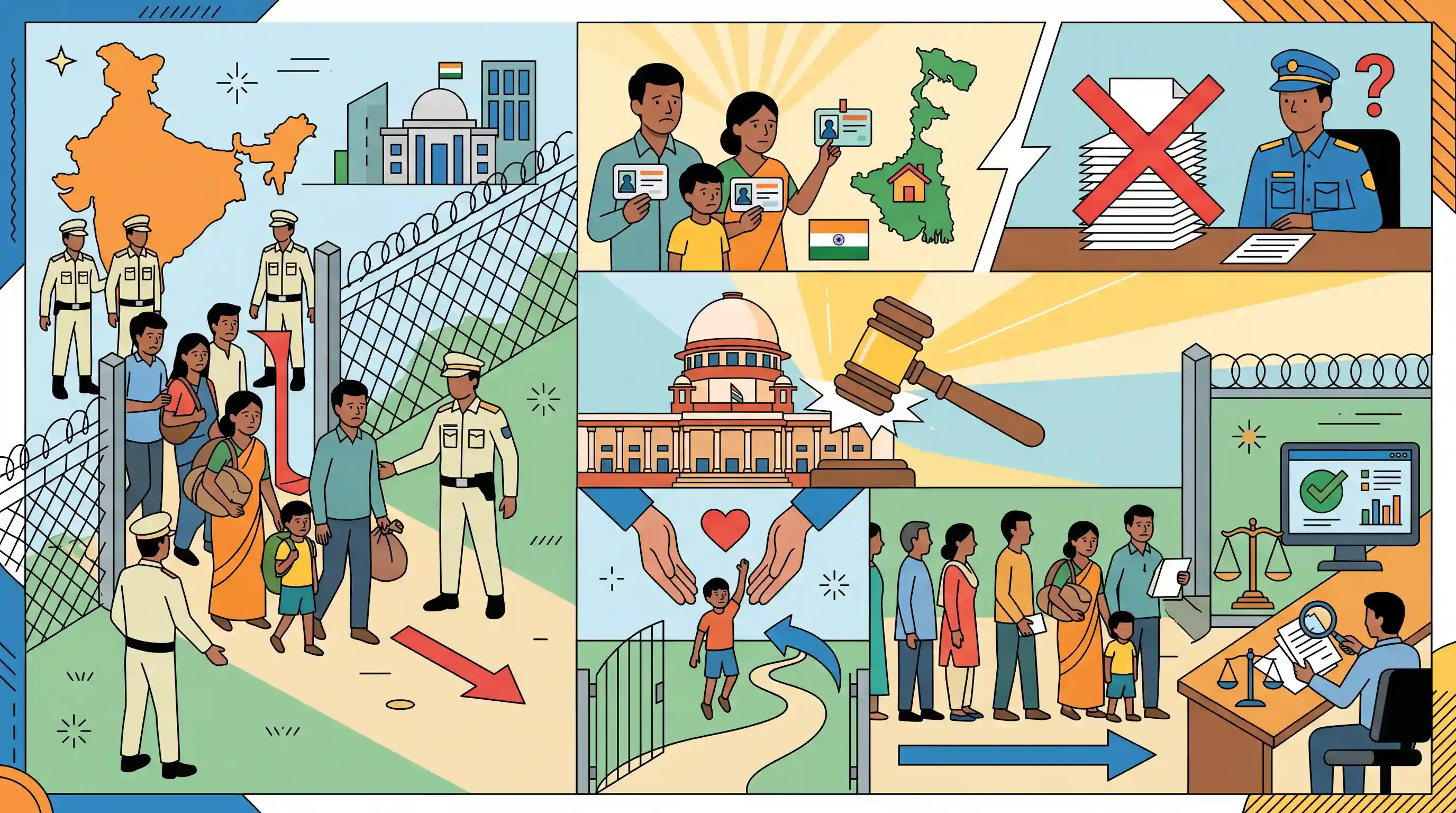
Why It Matters
The incident highlights the complex interplay between national security drives (such as deporting illegal immigrants) and the constitutional/human rights of individuals who claim citizenship. It tests the procedural safeguards under India's deportation policy and illustrates the humanitarian and legal challenges in resolving citizenship disputes along the porous India-Bangladesh border.
Summary
The Centre has assured the Supreme Court that it will bring back certain individuals who were allegedly "pushed" or deported to Bangladesh, in order to verify their claims of Indian citizenship. The individuals, including the family of petitioner Bhodu Sekh, were deported following an identity verification drive by the Home Ministry. While the petitioners claim they are permanent residents of West Bengal and Indian citizens by birth, the government had deported them citing a lack of documentary proof. The Supreme Court has permitted the temporary return of some individuals on humanitarian grounds pending the outcome of the verification.
Key Points
- The Union Government informed the Supreme Court that it will bring back persons allegedly deported to Bangladesh to verify their citizenship claims.
- The case stems from the alleged illegal deportation of a family during a Home Ministry identity verification drive in West Bengal.
- The Calcutta High Court had earlier set aside the Centre's decision to deport Sunali Khatun and others, terming it illegal.
- The Supreme Court allowed the entry of Sunali Khatun and her child on humanitarian grounds while the government examines their documentary proofs of citizenship.
Important Terms
Supreme Court of India

The highest judicial body in India and the final court of appeal under the Constitution. It possesses original, appellate, and advisory jurisdictions.
UPSC context
GS II: Judiciary. Tests knowledge of the Court’s role as the final arbiter of law and protector of constitutional rights.
Foreigners Act, 1946
The primary legislation empowering the Central Government to regulate the entry, presence, and departure of foreign nationals in India.
UPSC context
GS II/III: Citizenship & Internal Security. Key for understanding the legal framework governing illegal immigration and deportation.
Citizenship
The legal status of a person as a member of the Indian state, governed by Articles 5-11 of the Constitution and the Citizenship Act, 1955.
UPSC context
GS II: Indian Constitution. Tests understanding of the rights, duties, and acquisition/loss of status under Indian law.
Ministry of Home Affairs (MHA)
The nodal Union ministry responsible for internal security, border management, and the administration of citizenship and immigration laws.
UPSC context
GS II: Governance. Relevant for studying the executive's role in maintaining internal security and enforcing immigration policy.
Burden of Proof
The legal principle under Section 9 of the Foreigners Act, 1946, where the onus lies on the individual to prove they are not a foreigner.
UPSC context
GS II: Judiciary/Citizenship. A critical legal nuance often discussed in cases involving the National Register of Citizens (NRC).
Fundamental Rights
Basic human rights guaranteed by Part III of the Constitution, such as Article 21 (Right to Life), which sometimes extend to non-citizens.
UPSC context
GS II: Indian Constitution. Central to evaluating the legality of state actions against individuals, regardless of nationality.
Calcutta High Court
The high court with jurisdiction over West Bengal; it originally quashed the deportation orders in the Bhodu Sekh case as illegal.
UPSC context
GS II: Judiciary. Illustrates the High Court's power to issue writs and review executive decisions under Article 226.
Deportation
The formal removal of a foreign national from a country, typically for entering or staying without legal permission.
UPSC context
GS III: Internal Security. Relates to border management, demographic stability, and international humanitarian obligations.
Prelims Trap
"Foreigners facing deportation can claim protection under Article 19 to reside in India pending verification."
Only Article 21 (Life and Liberty) protects non-citizens against arbitrary executive action. Article 19(1)(e) (right to reside) is exclusive to citizens.
Static Concepts Connected
Which Fundamental Rights distinguish citizens from foreigners in India?
- Citizens Only: Articles 15, 16, 19, 29, and 30 are exclusively available to Indian citizens.
- Available to All: Articles 14, 20, 21, 21A, 22, 23, 24, 25, 26, 27, and 28 apply to both citizens and non-citizens (except enemy aliens).
Who holds the legal power to identify and deport illegal immigrants?
- Central Authority: Section 3 of the Foreigners Act, 1946 grants the Central Government absolute authority to prohibit entry and order deportation of foreign nationals.
- Delegated Powers: The Centre typically delegates powers to detect and deport illegal immigrants to State Governments and UT Administrations under Articles 258(1) and 239(1).
- Burden of Proof: Section 9 of the Foreigners Act places the burden of proving that one is not a foreigner strictly upon the person suspected.
Cross-Topic Patterns
Border Security vs. Judicial Due Process
The executive's mandate to curb illegal migration across porous borders repeatedly clashes with the judiciary's application of Article 21 to ensure due process and humanitarian rights during deportations.
Burden of Proof in Citizenship Verification
This links to broader demographic anxieties, NRC-style verifications, and Section 9 of the Foreigners Act, which places the burden of proof squarely on suspected migrants to establish their citizenship.

Expect a 2026 prelims statement contrasting Article 19 vs 21 applicability for suspected migrants under the Foreigners Act, 1946.
Linked PYQs · 4
Linked PYQs · 4
- 2020MainsGS3
Analyze internal security threats and transborder crimes along Myanmar, Bangladesh and Pakistan borders including Line of Control (LoC). Also discuss the role played by various security forces in this regard.
- 2014MainsGS3
How does illegal transborder migration pose a threat to India's security? Discuss the strategies to curb this, bringing out the factors which give impetus to such migration.
- 2023PrelimsGS1
Consider the following statements: 1. Recently, all the countries of the United Nations have adopted the first-ever compact for international migration, the 'Global Compact for Safe, Orderly and Regular Migration (GCM)'. 2. The objectives and commitments stated in the GCM are binding on the UN member countries. 3. The GCM addresses internal migration or internally displaced people also in its objectives and commitments. How many of the above statements are correct?
- 2019PrelimsGS1
Consider the following statements: 1. The United Nations Convention against Corruption (UNCAC) has a 'Protocol against the Smuggling of Migrants by Land, Sea and Air'. 2. The UNCAC is the ever-first legally binding global anti-corruption instrument. 3. A highlight of the United Nations Convention against Transnational Organized Crime (UNTOC) is the inclusion of a specific chapter aimed at returning assets to their rightful owners from whom they had been taken illicitly. 4. The United Nations Office on Drugs and Crime (UNODC) is mandated by its member States to assist in the implementation of both UNCAC and UNTOC. Which of the statements given above are correct?
