Government Refers FCRA Amendment Bill to Parliamentary Committee
Source:The Hindu ↗
কেন এটি গুরুত্বপূর্ণ
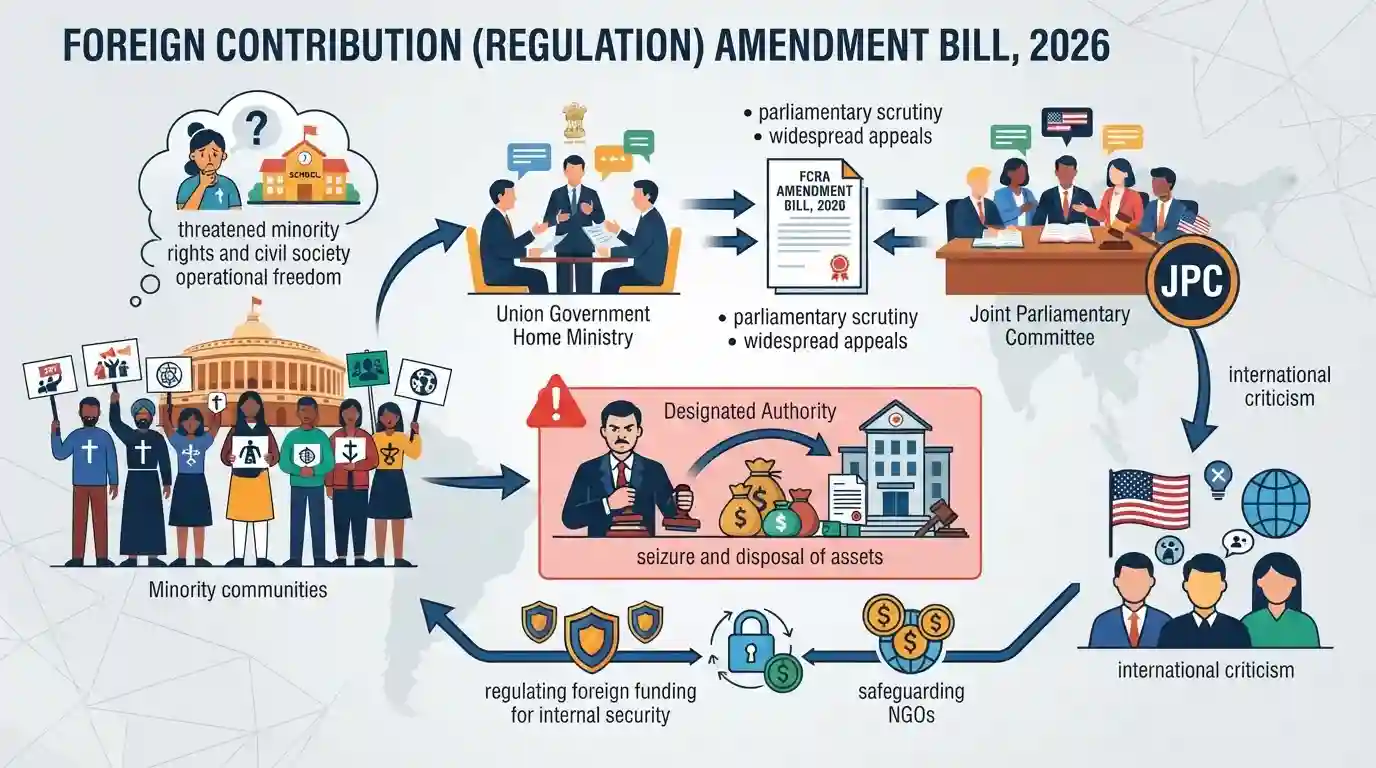
It illustrates the complex interplay between internal security imperatives (regulating foreign funding via FCRA), legislative oversight (the role of JPCs in scrutinizing bills), and the influence of civil society and minority groups in ensuring democratic checks on executive power.
সারসংক্ষেপ
The Union Government has decided to refer the controversial Foreign Contribution (Regulation) Amendment Bill, 2026, to a Joint Parliamentary Committee (JPC) following widespread appeals from minority groups, particularly Christian organizations. The Bill aims to create a 'designated authority' empowered to seize and dispose of assets of NGOs whose FCRA registrations are suspended or cancelled. Facing domestic backlash and international criticism—including from U.S. lawmakers—over potential threats to minority rights and civil society, the Home Ministry opted for parliamentary scrutiny. The move underscores the balance between regulating foreign funding for internal security and safeguarding the operational freedom of non-governmental organizations.
মূল বিষয়
- The Union Government has softened its stance on the contentious Foreign Contribution (Regulation) Amendment Bill, 2026, agreeing to refer it to a Joint Parliamentary Committee (JPC).
- The Bill proposes the appointment of a 'designated authority' with civil court powers to take over, manage, or dispose of assets created using foreign funds if an NGO's FCRA registration is cancelled or suspended.
- The decision follows strong backlash and appeals from minority groups, particularly Christian organizations like the CBCI and NCCI, who feared the Bill would unfairly target their institutions.
- The legislation also faced international criticism, including from U.S. lawmakers who viewed it as a direct attack on Christian groups and civil society in India.
- Sending the Bill to a JPC highlights the crucial role of parliamentary committees in scrutinizing legislation, ensuring stakeholder consultation, and resolving democratic deadlocks.
গুরুত্বপূর্ণ শব্দ
Foreign Contribution (Regulation) Amendment Bill, 2026

A proposed bill creating a 'designated authority' to take over, manage, and dispose of foreign-funded assets belonging to NGOs whose FCRA registrations are cancelled, surrendered, or not renewed.
UPSC context
GS2/GS3. Tests the balance between state regulation for internal security and safeguarding operational freedom for civil society organizations.
Foreign Contribution Regulation Act (FCRA)
An act administered by the Ministry of Home Affairs to regulate the receipt and usage of foreign funds by NGOs, ensuring they do not adversely affect India's sovereignty, internal security, or public order.
UPSC context
GS2 and GS3. Evaluates the regulation of NGOs, transparency in foreign funding, and protection against external security threats.
Joint Parliamentary Committee (JPC)
An ad-hoc parliamentary committee with members from both the Lok Sabha and Rajya Sabha, formed to deeply scrutinize complex legislation or investigate issues of high public importance. It dissolves after submitting its report.
UPSC context
GS2. Tests parliamentary functioning, legislative scrutiny mechanisms, and how consensus is built on controversial bills across party lines.
Ministry of Home Affairs
The nodal Union ministry responsible for maintaining India's internal security, managing borders, and administering the FCRA to regulate foreign contributions received by domestic entities.
UPSC context
GS3 (Internal Security) and GS2 (Governance). Tests executive responsibilities in managing domestic threats and regulatory oversight.
প্রিলিমস ফাঁদ
Foreign Contribution (Regulation) Act (FCRA) falls under the regulatory jurisdiction of the Ministry of Finance.
Because FCRA deals with foreign funds, aspirants mistakenly link it to the Finance Ministry. It is actually administered by the Ministry of Home Affairs to safeguard internal security.
সংযুক্ত স্থির ধারণা
What are the defining characteristics of a Joint Parliamentary Committee (JPC)?
- Ad-hoc nature: Constituted for a specific purpose like examining a complex Bill; ceases to exist once its final report is submitted to Parliament.
- Composition ratio: Members are drawn from both Houses, conventionally maintaining a 2:1 ratio of Lok Sabha to Rajya Sabha parliamentarians.
- Evidence powers: It functions akin to a civil court, empowered to summon witnesses, call for official documents, and record testimonies.
What are the core restrictions on NGOs under the FCRA 2020 amendments?
- Designated bank account: Foreign contributions must be received exclusively in an 'FCRA Account' at the SBI Main Branch in New Delhi.
- No sub-granting: Organizations are strictly prohibited from transferring received foreign contributions to any other person or NGO.
- Administrative cap: The limit on utilizing foreign contributions for administrative expenses is capped at 20%, down from the previous 50%.
আন্তঃবিষয় প্যাটার্ন
FATF regulations vs. Civil Society
Stringent FCRA amendments often align with FATF Recommendation 8 to curb terror financing, creating friction between internal security mandates and the fundamental right to form associations (Article 19).
Minority Rights & Administrative Autonomy
The backlash connects to Article 30 safeguards, where minority-run charitable and educational institutions resist heavy-handed state takeover of assets, fearing erosion of their constitutional autonomy.

Expect a multi-statement Prelims question merging FCRA provisions (SBI account, MHA control) with the ad-hoc nature and 2:1 ratio of JPCs.
সংযুক্ত PYQ · 4
সংযুক্ত PYQ · 4
- 2015MainsGS2
Examine critically the recent changes in the rules governing foreign funding of NGOs under the Foreign Contribution (Regulation) Act (FCRA), 1976.
- 2021MainsGS2
Do Department-related Parliamentary Standing Committees keep the administration on its toes and inspire reverence for parliamentary control? Evaluate the working of such committees with suitable examples.
- 2021MainsGS3
Analyse the multidimensional challenges posed by external state and non-state actors, to the internal security of India. Also discuss measures required to be taken to combat these threats.
- 2018PrelimsGS1
With reference to the Parliament of India, which of the following Parliamentary Committees scrutinizes and reports to the House whether the powers to make regulations, rules, sub-rules, by-laws, etc. conferred by the Constitution or delegated by the Parliament are being properly exercised by the Executive within the scope of such delegation?
