Jal Jeevan Mission 2.0: Centre and Bihar sign reform MoUs
Source:ddindia ↗
Why It Matters
The shift towards JJM 2.0 represents a crucial governance evolution from asset creation to asset management and decentralization via Gram Panchayats. In Bihar, the integration of state initiatives like Saat Nishchay with national frameworks illustrates federal synergy in rural public service delivery.
Summary
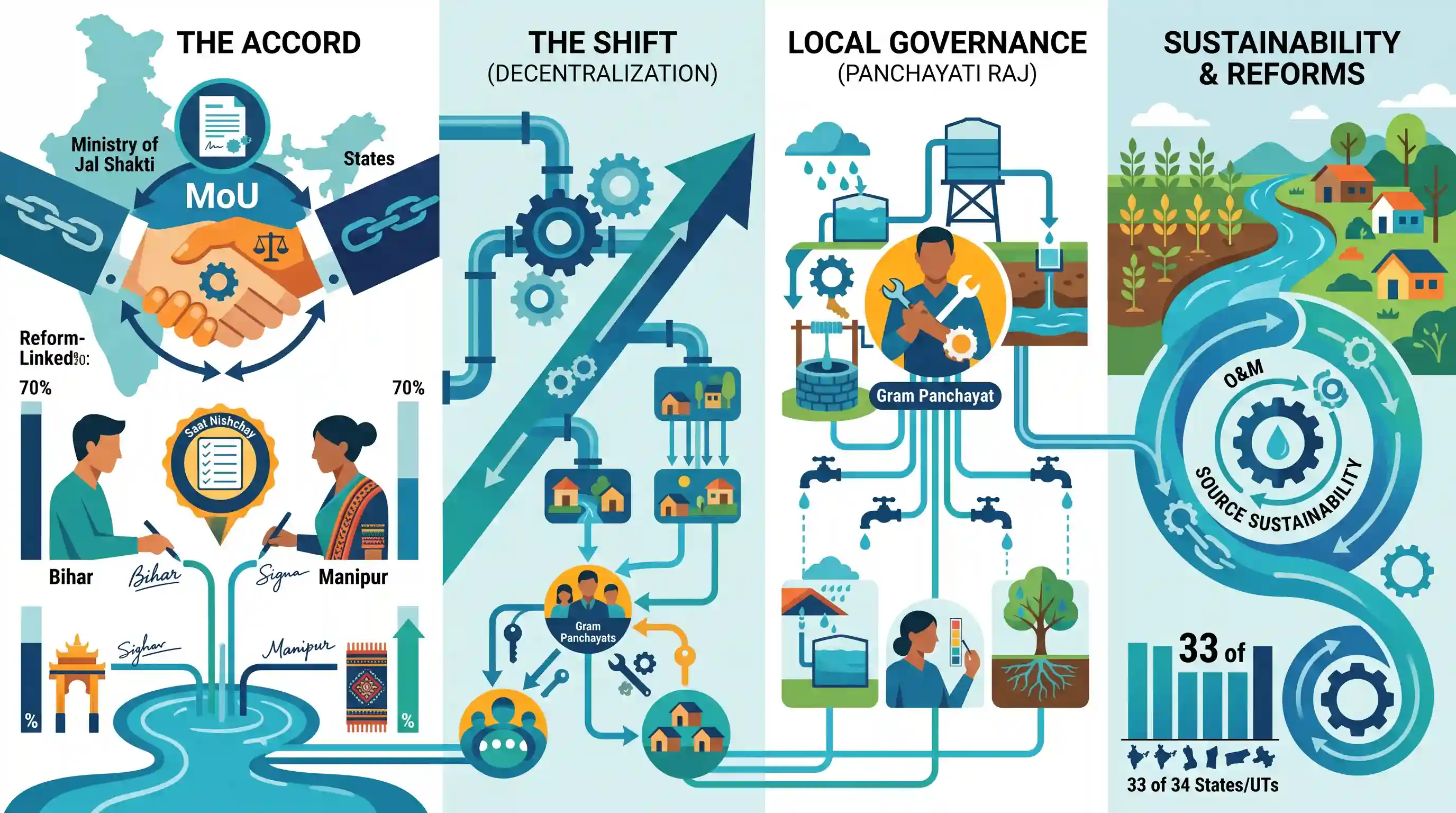
The Ministry of Jal Shakti has signed reform-linked MoUs with Bihar and Manipur under Jal Jeevan Mission 2.0 (JJM 2.0) to transition rural water supply from infrastructure creation to decentralized governance and long-term sustainability. Under JJM 2.0, local Gram Panchayats will lead operation, maintenance, and source sustainability. Bihar's participation is backed by its extensive coverage (>90% rural tap water connections) built since 2016 under its indigenous 'Har Ghar Nal Ka Jal' scheme of the Saat Nishchay program. With this, 33 of 34 eligible States/UTs have joined the JJM 2.0 framework.
Key Points
- The Union Ministry of Jal Shakti signed reform-linked Memorandums of Understanding (MoUs) with the governments of Bihar and Manipur under the Jal Jeevan Mission 2.0 (JJM 2.0).
- JJM 2.0 marks a transition from building infrastructure to sustaining the rural water supply systems, emphasizing water quality, operation and maintenance (O&M), and strengthening groundwater/source sustainability.
- The mission promotes a Gram Panchayat-led, service-based, and community-centered model of water governance, enhancing local ownership.
- With the signing of Bihar and Manipur, 33 out of 34 participating States and Union Territories have now signed these reform-linked MoUs with the Centre.
- Bihar has already achieved over 90% rural tap water coverage, largely driven by its state-level flagship 'Har Ghar Nal Ka Jal' program launched in 2016 under the Seven Resolves (Saat Nishchay) policy.
Important Terms
Jal Jeevan Mission 2.0

A restructured and extended phase (running till December 2028) of India’s rural drinking water initiative, shifting focus from infrastructure creation to decentralized, utility-based, and community-led sustainable water service delivery.
UPSC context
GS Paper II (Welfare Schemes) & GS III (Water Resource Management). Tests reform-linked Center-State fiscal governance.
Har Ghar Nal Ka Jal
A flagship drinking water initiative launched by Bihar in 2016 to provide clean, piped potable tap water to every household without discrimination across all rural and urban wards.
UPSC context
GS Paper II (State Schemes, Decentralized Governance). Tests knowledge of pioneering state-level public utility programs.
Saat Nishchay (Seven Resolves)
A multi-sectoral development roadmap launched by the Bihar Government in 2015, prioritizing key welfare resolves like youth empowerment, gender equality, sanitation, and basic electricity/water infrastructure.
UPSC context
GS Paper II (Federalism & State-led Planning). Tests regional socioeconomic development frameworks and governance strategies.
Ministry of Jal Shakti
The Union Ministry created in 2019 by merging existing water-related ministries, serving as the apex administrative department managing water resources, drinking water, sanitation, and river rejuvenation.
UPSC context
GS Paper II (Government Ministries/Departments). Tests knowledge of administrative consolidation for holistic resource management.
National Jal Jeevan Mission (NJJM)
The dedicated administrative entity under the Ministry of Jal Shakti tasked with executing, guiding, and monitoring the roll-out of the national Jal Jeevan Mission across Indian States/UTs.
UPSC context
GS Paper II (Executive/Implementing Bodies). Tests structural understanding of Center-State scheme coordination mechanisms.
Prelims Trap
Jal Jeevan Mission 2.0 maintains the original target timeline of 2024 for achieving 100% household tap water connections.
JJM 2.0 marks a structural shift that officially extends the 100% tap water saturation deadline to December 2028, moving away from the widely publicized initial target of 2024.
Static Concepts Connected
What is the constitutional distribution of legislative power regarding water in India?
- State List (Entry 17): Grants states primary jurisdiction over water supply, irrigation, drainage, embankments, water storage, and water power.
- Union List (Entry 56): Empowers the Union to regulate and develop inter-state rivers and river valleys to the extent declared by Parliament.
- Article 262: Enables Parliament to provide by law for the adjudication of any dispute relating to inter-state river waters.
How does the 11th Schedule empower Panchayats in water management?
- Drinking Water (Entry 11): Devolves the planning and management of rural drinking water supply directly to the Gram Panchayats.
- Watershed Management (Entry 12): Empowers Panchayats to execute minor irrigation, water management, and local watershed development works.
- VWSCs / Pani Samitis: Acts as the Gram Panchayat's executive arm to run and maintain village water supply systems.
Cross-Topic Patterns
Fiscal federalism and performance grants
Linking JJM 2.0 central funds to state-level utility reforms mirrors the 15th Finance Commission's tied grants, transforming traditional fiscal federalism into reform-incentivized devolution.
Digital infrastructure in resource governance
Integrating the Sujalam Bharat Digital Framework for asset mapping demonstrates how Digital Public Infrastructure (DPI) optimizes decentralized natural resource governance.

JJM 2.0's paradigm shift from asset creation to utility delivery, its 2028 extension, and reform-linked state MoUs will be tested in 2026.
Linked PYQs · 4
Linked PYQs · 4
- 2020BPSC_PRELIMSGS1
Which of the following is not included in Seven Resolves (Saat Nishchay) of Bihar Government?
- 2018BPSC_PRELIMSGS1
In which city of Bihar, Sulabh International. launched cheapest drinking water project 'Sulabh Jal?
- 2025BPSC_PRELIMSGS1
What is the main purpose of Panchayati Raj?
- 2024-IBPSC_PRELIMSGS1
What is the system of governance in the Panchayat Raj set-up?
