Centre Constitutes Panel to Examine Sugarcane Farmers Issues
Source:The Hindu ↗
কেন এটি গুরুত্বপূর্ণ
Sugarcane is a major cash crop involving complex pricing dynamics (FRP vs SAP), massive payment arrears, and water-intensive cultivation. Studying government initiatives to resolve these structural issues is crucial for GS3 Agriculture syllabus.
সারসংক্ষেপ
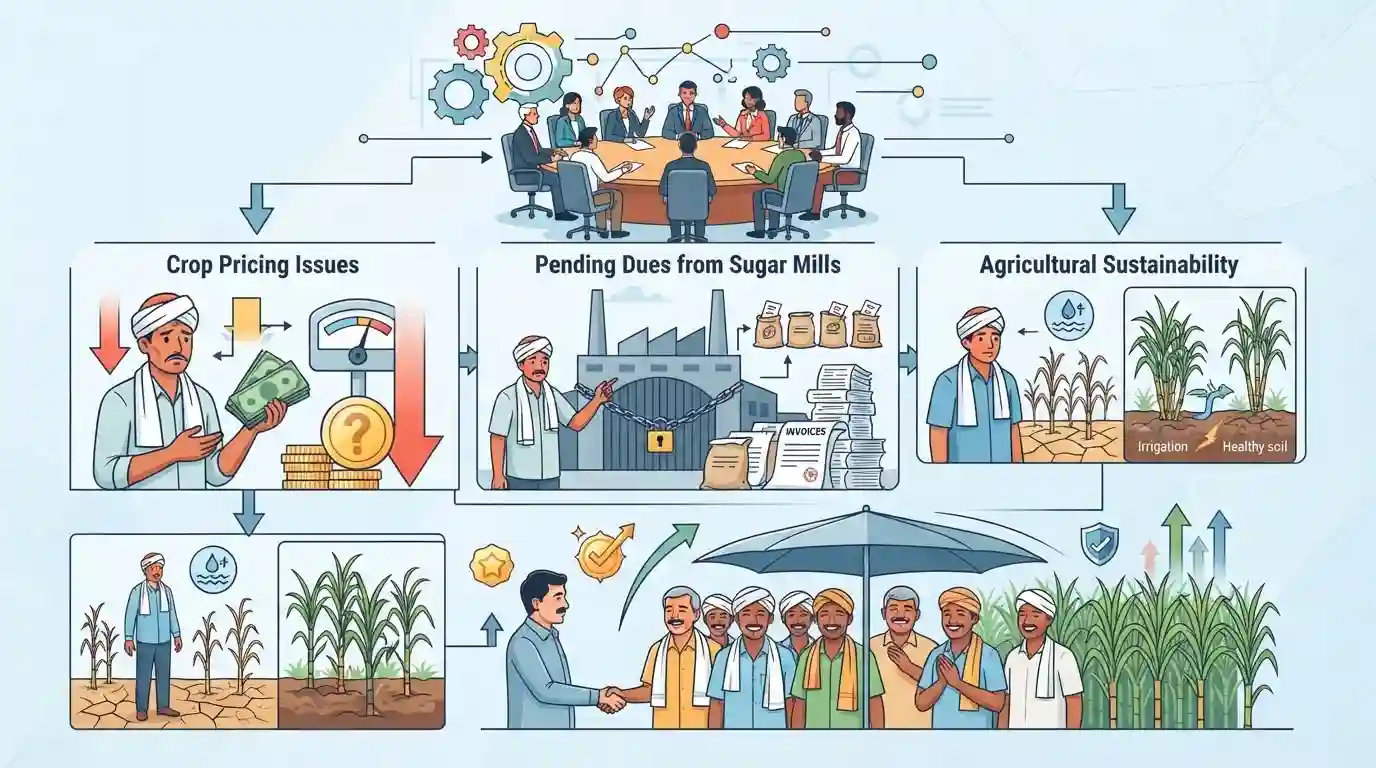
The Central government has set up a dedicated panel to study the multi-faceted problems faced by sugarcane farmers, including issues related to crop pricing, pending dues from sugar mills, and agricultural sustainability. The move aims to address structural bottlenecks in the sugar sector and protect farmers' livelihoods.
মূল বিষয়
- The Central government has constituted a specialized panel to thoroughly examine and address the long-standing economic and operational problems faced by sugarcane farmers.
- The committee will evaluate issues such as pricing mechanisms, timely payments by sugar mills, arrears, and ways to make sugarcane cultivation sustainably profitable.
- Sugarcane pricing in India is governed by the Fair and Remunerative Price (FRP) announced by the Central government and State Advised Prices (SAP) announced by certain states.
- Farmers frequently struggle with delayed payments from sugar mills, mounting dues, and high input costs, necessitating systematic policy interventions.
গুরুত্বপূর্ণ শব্দ
Fair and Remunerative Price (FRP)

The minimum price fixed by the Central government that sugar mills are legally mandated to pay sugarcane farmers, replacing the earlier Statutory Minimum Price (SMP).
UPSC context
Important for UPSC CSE GS Paper III (Agriculture - Pricing policy, MSP/FRP, and farmer welfare issues).
Commission for Agricultural Costs and Prices (CACP)
An apex advisory body that recommends pricing policies like MSPs and FRPs for various agricultural commodities based on comprehensive cost-of-production data.
UPSC context
Important for UPSC CSE GS Paper III (Agricultural pricing and institutional mechanisms).
Cabinet Committee on Economic Affairs (CCEA)
A high-level cabinet committee chaired by the Prime Minister that gives the final approval for agricultural prices like the FRP for sugarcane.
UPSC context
Important for UPSC CSE GS Paper II & III (Government policies, decision-making bodies, and economic governance).
প্রিলিমস ফাঁদ
Like the advisory Minimum Support Price (MSP), the Fair and Remunerative Price (FRP)...
Aspirants often confuse FRP with MSP, assuming both have identical statutory backing. Unlike MSP, sugarcane FRP has statutory backing under the Sugarcane (Control) Order, 1966.
সংযুক্ত স্থির ধারণা
What is the statutory framework governing the Fair and Remunerative Price (FRP) of sugarcane in India?
- Body & Approval: Recommended by the Commission for Agricultural Costs and Prices (CACP) and approved by the Cabinet Committee on Economic Affairs (CCEA).
- Statutory Backing: Unlike MSP, FRP has statutory backing under the Sugarcane (Control) Order, 1966, issued under the Essential Commodities Act, 1955.
- Payment Mandate: Sugar mills are legally mandated to make payment to farmers within 14 days of cane delivery, failing which interest becomes due.
আন্তঃবিষয় প্যাটার্ন
Sugarcane pricing vs. groundwater depletion nexus
Sugarcane requires immense water resources, connecting crop pricing policies directly to sustainable irrigation, groundwater depletion debates, and the promotion of alternate crops like millets in dry regions.
Statutory pricing and cooperative federalism in agriculture
The statutory backing of FRP through the Essential Commodities Act connects agricultural pricing disputes directly to industrial regulations and federal friction over State Advised Prices (SAP).

Expect a conceptual question contrasting the statutory backing of sugarcane FRP under the Essential Commodities Act with non-statutory MSP.
সংযুক্ত PYQ · 2
সংযুক্ত PYQ · 2
- 2015PrelimsGS1
The Fair and Remunerative Price (FRP) of sugarcane is approved by the
- 2018MainsGS3
What do you mean by Minimum Support Price (MSP)? How will MSP rescue the farmers from the low income trap?
