Centre seeks time extension for OBC creamy layer verdict
Source:Indian Express ↗
આ શા માટે મહત્વનું છે
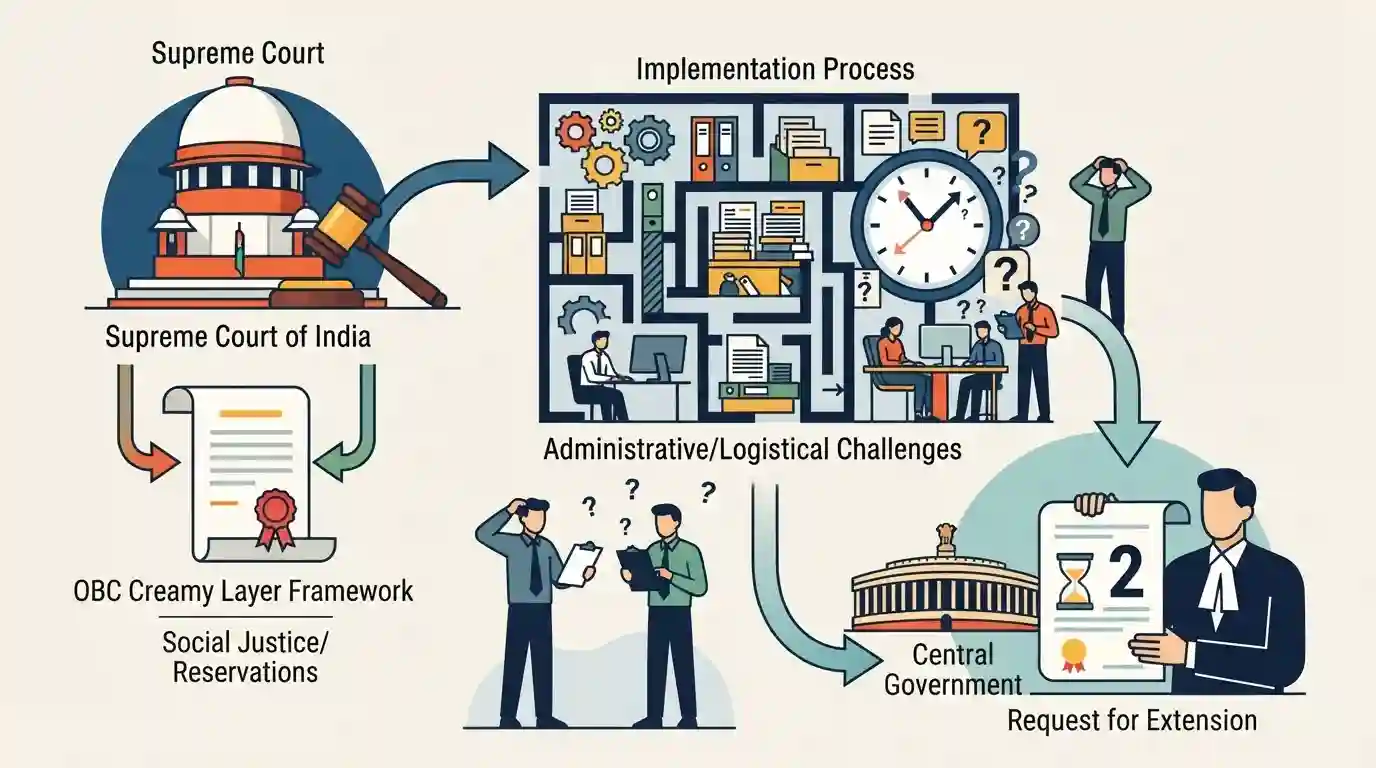
This development underscores the complex interplay between judicial directives on social justice and reservations (such as the OBC creamy layer) and the administrative realities faced by the executive in implementing them.
સારાંશ
The Centre has requested the Supreme Court for a two-year extension to comply with and implement its verdict concerning the OBC creamy layer framework, highlighting administrative and logistical challenges involved in executing judicial directives on social justice and reservations.
મુખ્ય મુદ્દા
- The Centre has approached the Supreme Court seeking a two-year extension to implement the verdict regarding the OBC creamy layer criteria.
- The creamy layer concept excludes economically better-off individuals within Other Backward Classes (OBCs) from availing reservation benefits.
- Implementing structural modifications or administrative data recalibrations based on judicial mandates often requires sufficient transition time for the executive.
મહત્વપૂર્ણ શબ્દો
Supreme Court

The apex judicial body of India, which interprets the Constitution, acts as the ultimate guardian of fundamental rights, and settles constitutional and legal disputes.
UPSC context
UPSC Prelims/Mains (GS Paper II): Tests knowledge of the judiciary's structure, powers, judicial review, and role in upholding constitutional governance.
Centre
The Union government of India, responsible for national executive administration, policy formulation, and the implementation of central laws and judicial directives.
UPSC context
UPSC Prelims/Mains (GS Paper II): Tests understanding of the executive branch, center-state relations, and administrative implementation of welfare and reservation policies.
પ્રિલિમ્સ ટ્રેપ
The creamy layer criteria for OBCs is explicitly defined and fixed under Article 16(4) of the Constitution.
Aspirants often confuse the 'creamy layer' threshold as being solely determined by salary income or constitutional amendment, whereas it originated from judicial interpretation in the Indra Sawhney case and executive criteria (DoPT).
સંલગ્ન સ્થિર ખ્યાલો
What are the key judicial milestones and constitutional provisions governing reservation and the creamy layer in India?
- Indra Sawhney Case: Introduced via the 1992 Indra Sawhney judgment, which upheld 27% OBC reservation but mandated the exclusion of advanced sections (creamy layer).
- Constitutional Basis: Article 16(4) empowers the State to make provisions for the reservation of appointments in favor of any backward class of citizens not adequately represented.
- EWS Parallel: The 103rd Constitutional Amendment Act introduced the creamy layer concept for Economically Weaker Sections (EWS), mirroring the OBC exclusion principle.
આંતર-વિષય પેટર્ન
Judicial Activism vs Executive Capacity
Executive delay in implementing judicial mandates touches upon the doctrine of separation of powers and the practical limits of judicial review in socio-economic policy.

OBC creamy layer criteria evolution + Indra Sawhney benchmarks frequently tested in polity match-the-following or statement-based questions.
સંલગ્ન PYQ · 2
સંલગ્ન PYQ · 2
- 2023PrelimsGS1
Consider the following statements: Statement-I: The Supreme Court of India has held in some judgements that the reservation policies made under Article 16(4) of the Constitution of India would be limited by Article 335 for maintenance of efficiency of administration. Statement-II: Article 335 of the Constitution of India defines the term 'efficiency of administration'. Which one of the following is correct in respect of the above statements?
- 2024PrelimsGS1
Under which of the following Articles of the Constitution of India, has the Supreme Court of India placed the Right to Privacy ?
