OBC Creamy Layer Verdict: Centre Seeks Extension for Implementation
Source:Indian Express ↗
Why It Matters
Understanding the executive-judicial interface on reservation policies, creamy layer criteria, and administrative challenges in implementing social justice measures is vital for civil services aspirants.
Summary
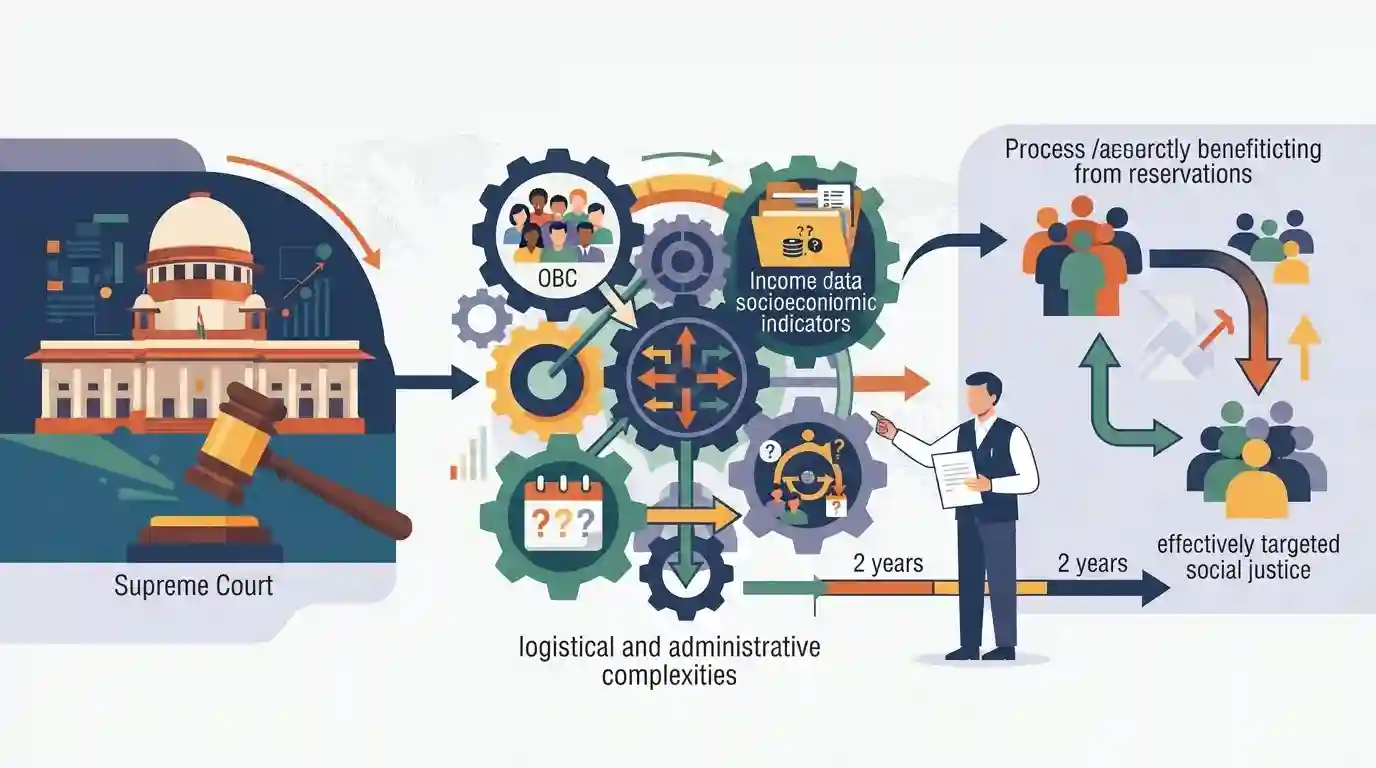
The Centre has moved the Supreme Court seeking a two-year extension to comply with and implement judicial directives concerning the OBC creamy layer criteria. The plea highlights the logistical and administrative complexities involved in redefining or restructuring the creamy layer benchmarks to ensure social justice is effectively targeted.
Key Points
- The Centre has approached the Supreme Court seeking an extension of two years to implement its verdict regarding the OBC creamy layer framework.
- The creamy layer concept excludes economically better-off individuals from Other Backward Classes (OBC) reservation benefits, ensuring equitable distribution to the genuinely needy.
- Implementing changes to criteria such as income ceilings, wealth accumulation, and sub-categorization requires extensive administrative consultations and data gathering.
Important Terms
OBC Creamy Layer Guidelines

An administrative income and status benchmark used to exclude socially and economically advanced individuals among Other Backward Classes (OBCs) from affirmative action benefits.
UPSC context
Important for GS Paper II (Polity and Governance - Social Justice, Reservations, and Judicial Pronouncements on affirmative action).
Supreme Court of India
The apex constitutional court of India, empowered to review executive and legislative actions, enforce fundamental rights, and interpret constitutional provisions regarding reservations.
UPSC context
Crucial for GS Paper II (Indian Constitution - Structure, Powers, and Functioning of Organs of Governance and Judicial Review).
Centre
The Union executive government of India responsible for framing nationwide policies, administering central legislation, and implementing judicial mandates across departments.
UPSC context
Relevant for GS Paper II (Polity and Governance - Executive, Federalism, and Administrative Implementation of Welfare Schemes).
Prelims Trap
creamy layer exclusion criteria apply uniformly to all reserved categories including SCs, STs, and OBCs
Aspirants often assume the creamy layer exclusion applies uniformly across all reservation categories (OBC, SC, and ST). In reality, it applies exclusively to OBC reservations.
Static Concepts Connected
What are the constitutional provisions and landmark judgments governing the OBC creamy layer framework in India?
- Indra Sawhney (1992):: Origin case established the concept of identifying advanced sections within backward classes to exclude them from reservations.
- Exclusive Applicability:: Exclusion principle applies solely to Other Backward Classes; it has no constitutional or legal application to SCs and STs.
- Rohith Nathan Case:: Mandated that parental income alone cannot be the sole determinant; social status and post equivalence must be factored in.
- Income Ceiling:: The income threshold has been periodically revised from an initial ₹1 lakh in 1993 to ₹8 lakh per annum.
Cross-Topic Patterns
Judicial Review vs. Administrative Feasibility
The creamy layer exclusion principle, born in judicial review, intersects with federal data gathering challenges in conducting caste and socio-economic censuses.
OBC vs. SC/ST Reservation Frameworks
Unlike OBCs, SC/ST reservations do not feature a creamy layer exclusion, creating a distinct constitutional design contrast tested in affirmative action questions.

Expect a statement-based question contrasting Indra Sawhney mandates, creamy layer criteria applicability, and constitutional exclusions.
Linked PYQs · 2
Linked PYQs · 2
- 2017MainsGS2
Critically examine the Supreme Court's judgement on 'National Judicial Appointments Commission Act, 2014' with reference to appointment of judges of higher judiciary in India.
- 2026PrelimsGS1
Consider the following statements about the provisions pertaining to the Scheduled Castes and the Scheduled Tribes in India : 1. Provisions regarding the administration of the Tribal Areas in the States of Assam, Meghalaya, Tripura and Mizoram are given in the Fifth Schedule of the Constitution of India. 2. Some tribes of India are entitled to exemption from paying Income Tax on certain incomes. 3. The Constitution of India provides for reservation of seats in Panchayats for women belonging to the Scheduled Castes and the Scheduled Tribes. Which one of the following conclusions based on the above statements is correct ?
