Transgender Identity Cards Validity under Legal Amendments
Source:The Hindu ↗
কেন এটি গুরুত্বপূর্ণ
This article highlights the ongoing legal battle surrounding the rights of transgender individuals, specifically focusing on the tension between legislative amendments and judicial precedents (like the 2014 NALSA ruling). It raises crucial questions on fundamental rights (Article 21), gender justice, and the principle of non-retrospective deprivation of identity rights.
সারসংক্ষেপ
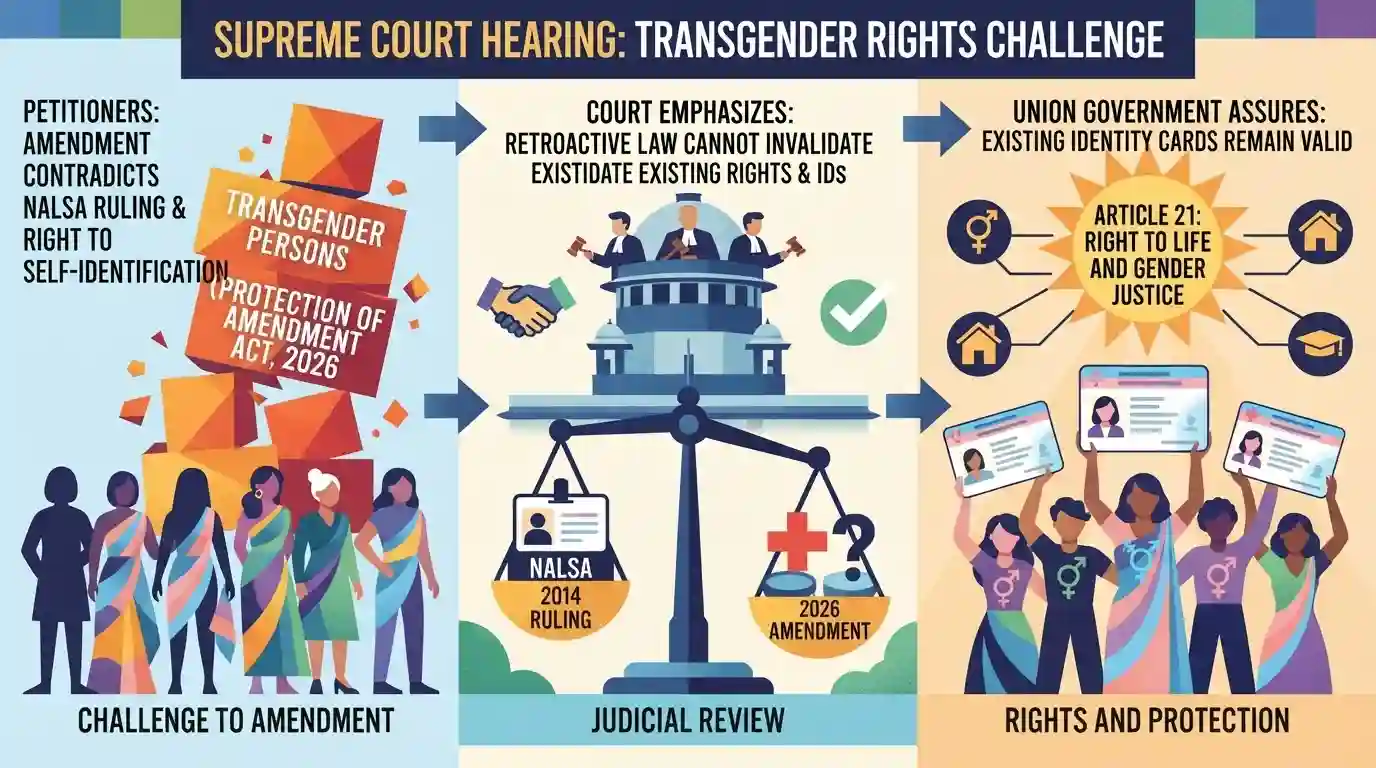
The Supreme Court of India heard a challenge to the Transgender Persons (Protection of Rights) Amendment Act, 2026, which petitioners argue dismantles the right to self-determination of gender identity. The Union Government assured the Court that transgender identity cards issued prior to the 2026 amendment will remain valid. The Court emphasized that retrospective application of the new law cannot invalidate existing rights, while petitioners argue the amendment contradicts the 2014 landmark NALSA ruling.
মূল বিষয়
- The Union Government assured the Supreme Court that transgender identity cards issued prior to the enactment of the Transgender Persons (Protection of Rights) Amendment Act, 2026, will continue to remain valid.
- A three-judge Bench headed by Chief Justice of India Surya Kant emphasized that subsequent changes in law cannot retrospectively strip away identity rights already granted to individuals.
- Petitioners have challenged the 2026 Amendment Act, arguing that Section 3 of the Act omits the right to self-perceived gender identity and gives the State 'unfettered authority' to determine gender identity.
- The challenge highlights that the 2026 Amendment works contrary to the landmark 2014 NALSA judgment of the Supreme Court, which recognized the right to self-determined gender identity under Article 21.
- Transgender identity cards are vital for official recognition, enabling trans individuals to change their name and gender across official records.
গুরুত্বপূর্ণ শব্দ
Transgender Persons (Protection of Rights) Amendment Act, 2026

A recent legislative amendment, challenged in the Supreme Court for allegedly dismantling the right to self-determination of gender identity, though the Union Government clarified that earlier issued identity cards remain valid.
UPSC context
GS Paper 2 (Social Justice). Tests knowledge of the evolving statutory framework for minority rights and related constitutional challenges.
Transgender Persons (Protection of Rights) Act, 2019
A principal statutory framework that legally recognizes transgender individuals, prohibits discrimination across various sectors like education and employment, and establishes procedures for obtaining a certificate of gender identity.
UPSC context
GS Paper 2 (Mechanisms for vulnerable sections). Frequently evaluated in terms of its implementation, welfare mandates, and structural gaps.
National Legal Services Authority (NALSA) v. Union of India (2014)
A historic Supreme Court verdict declaring transgender people the 'third gender' and affirming their fundamental right to self-determine their gender identity under Article 21 of the Indian Constitution.
UPSC context
GS Paper 2 (Fundamental Rights & Gender Justice). Serves as the constitutional bedrock for transgender rights and gender autonomy in India.
প্রিলিমস ফাঁদ
The 2026 Amendment retrospectively invalidates all transgender identity cards that were issued without a Medical Board recommendation.
The Supreme Court and the Union Government have explicitly clarified that the 2026 Amendment does not retrospectively invalidate existing identity cards issued under the 2019 self-determination framework.
সংযুক্ত স্থির ধারণা
What is the constitutional basis of the landmark NALSA v. Union of India (2014) judgment?
- Third Gender Recognition: Recognized transgender persons as a 'third gender' to ensure their rights under Part III of the Constitution.
- Article 21 expansion: Ruled that the right to self-determine one's gender identity is an essential aspect of personal liberty, dignity, and autonomy under Article 21.
- Articles 14 and 15: Held that discrimination on the ground of gender identity violates the guarantees of equality (Article 14) and non-discrimination (Article 15).
How does Indian jurisprudence view retrospective laws and vested rights?
- Presumption of Prospectivity: Statutes are generally presumed to operate prospectively unless the legislature explicitly or by necessary implication intends retrospective application.
- Vested Rights Protection: A retrospective law cannot easily take away vested civil rights, such as legally recognized identity or status, without violating the test of reasonableness under Article 14.
- Article 20(1) Bar: While civil and tax laws can be retrospective, Article 20(1) strictly prohibits retrospective criminal legislation (ex-post facto laws).
আন্তঃবিষয় প্যাটার্ন
Judicial Review vs Legislative Supremacy
The shift from the 2019 self-identification model to the 2026 medical-certification model illustrates the ongoing tension between judicial human rights mandates (NALSA) and legislative lawmaking.
Medical Model vs Human Rights Model
Mandating medical boards for identity verification mirrors debates in the Rights of Persons with Disabilities Act, shifting vulnerable groups from a human-rights model to a medicalized gatekeeping model.

The conflict between the 2026 medical-board model and NALSA's self-identity doctrine is a prime candidate for an Article 21 Mains question.
সংযুক্ত PYQ · 2
সংযুক্ত PYQ · 2
- 2023MainsGS2
Explain the constitutional perspectives of Gender Justice with the help of relevant Constitutional Provisions and case laws.
- 2024MainsGS2
Right to privacy is intrinsic to life and personal liberty and is inherently protected under Article 21 of the constitution. Explain. In this reference discuss the law relating to D.N.A. testing of child in the womb to establish its paternity.
