Viksit Bharat GRAM G Scheme Implementation in Rajasthan
Source:newsonair ↗
Why It Matters
This review highlights the financial progress of major rural development initiatives and water-use efficiency schemes in Rajasthan, which are vital areas of administrative, economic, and agricultural focus in the RPSC RAS syllabus (particularly regarding local planning, central-state financial coordination, and micro-irrigation success in an arid state).
Summary
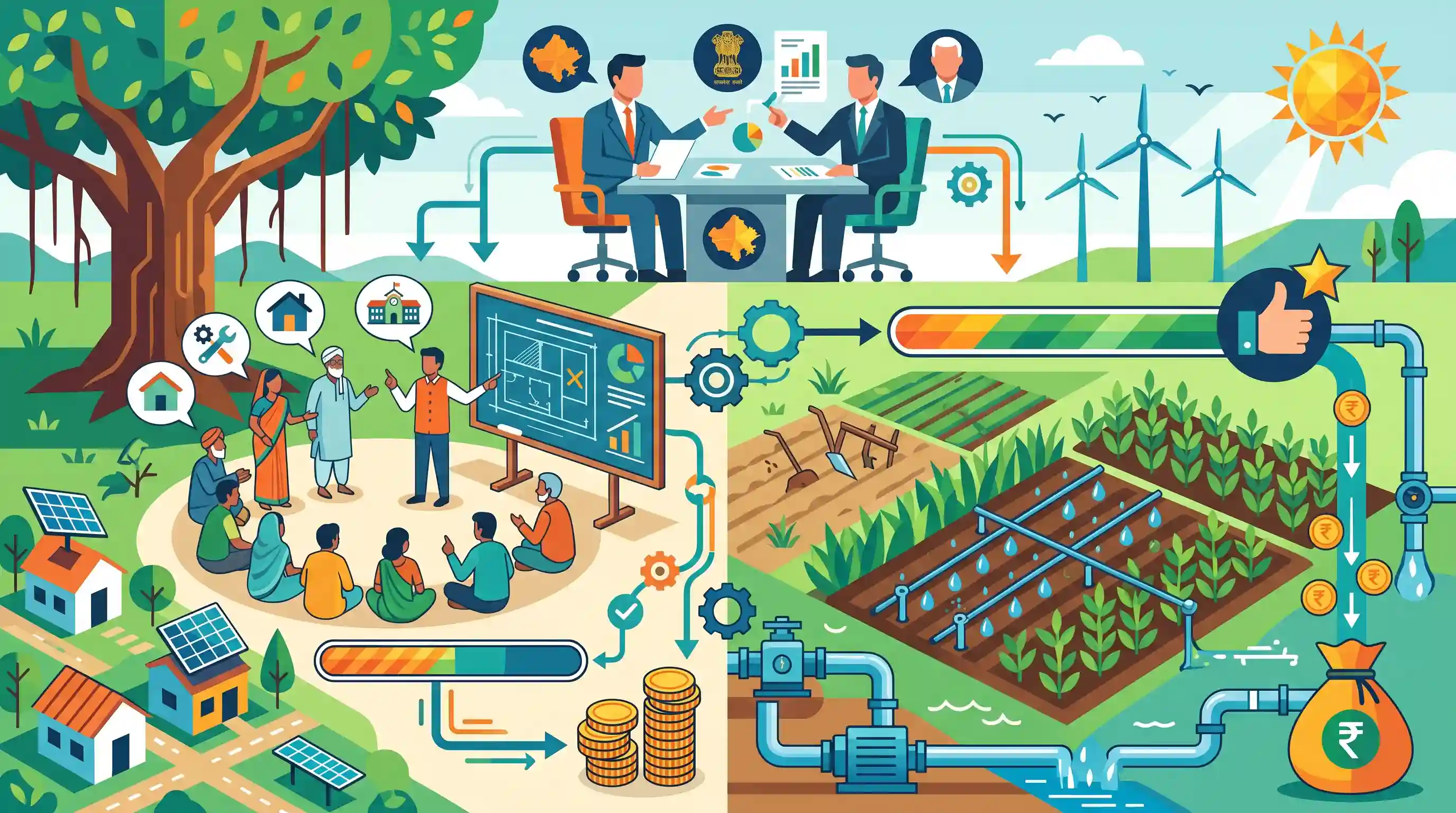
Union Minister of Rural Development Shivraj Singh Chouhan and Rajasthan Chief Minister Bhajan Lal Sharma reviewed the implementation of the Viksit Bharat GRAM G (VB-GRAM G) scheme and other rural development initiatives in the state. Rajasthan has utilized nearly Rs 200 crore out of the Rs 445 crore released under VB-GRAM G, with a second installment of Rs 180 crore on the horizon. The state's local governance focuses on the 'Gram Chaupal' model and Gram Sabha-led planning. Additionally, Rajasthan was praised for its full utilization of funds under the PM Micro Irrigation Scheme, paving the way for additional financial assistance.
Key Points
- Union Rural Development Minister Shivraj Singh Chouhan and Rajasthan Chief Minister Bhajan Lal Sharma reviewed the implementation of Viksit Bharat GRAM G (VB-GRAM G) and other rural development schemes.
- The Centre has released Rs 445 crore to Rajasthan under the VB-GRAM G scheme, of which nearly Rs 200 crore has been utilized. A second instalment of Rs 180 crore is proposed.
- Approximately Rs 12,000 crore is expected to be invested annually in rural development works across Rajasthan to boost rural employment and infrastructure.
- The Rajasthan government has prioritized participatory governance by utilizing the Gram Chaupal model and implementing plans identified directly by Gram Sabhas and Gram Panchayats.
- Rajasthan was commended for its exceptional performance under the PM Micro Irrigation Scheme, successfully utilizing its entire sanctioned allocation within the stipulated timeframe.
Important Terms
Viksit Bharat GRAM G (VB-GRAM G)

A rural employment scheme enacted in 2025 (effective July 2026) replacing MGNREGS. It guarantees 125 days of unskilled manual work per year to rural households, integrating spatial technology and Gati Shakti for decentralized planning.
UPSC context
GS Paper II (Welfare Schemes) & GS Paper III (Employment); tests safety nets and decentralized planning.
Pradhan Mantri Krishi Sinchayee Yojana (PMKSY)
Launched in 2015, this flagship central scheme aims to expand cultivated area under assured irrigation ("Har Khet Ko Pani") and improve water-use efficiency ("Per Drop More Crop") through watershed development and micro-irrigation.
UPSC context
GS Paper III (Agriculture & Irrigation); tests government programs for water security and resource resilience.
PM Micro Irrigation Scheme
The "Per Drop More Crop" component of PMKSY promoting water conservation at the farm level using drip and sprinkler systems. It provides credit-linked subsidies to small, marginal, and other farmers to optimize resource use.
UPSC context
GS Paper III (Irrigation & Water Management); tests micro-irrigation, climate-smart agriculture, and sustainable farming.
Gram Chaupal model
A participatory governance model in Rajasthan encouraging direct engagement between government representatives and villagers. It relies on Gram Sabha-led planning to address local grievances and prioritize development projects directly.
UPSC context
GS Paper II (Panchayati Raj & Local Governance); tests citizen-centric governance and bottom-up planning.
Rajasthan Panchayati Raj Act 1994
The legislative framework establishing Rajasthan’s three-tier Panchayati Raj system in compliance with the 73rd Constitutional Amendment. It delineates the powers, compositions, and structures of Ward Sabhas, Gram Sabhas, and local bodies.
UPSC context
GS Paper II (Local Self-Governance & Polity); tests provisions, amendments, and democratic decentralization.
Prelims Trap
The District Collector serves as the ex-officio Chairperson of the District Planning Committee (DPC) under state Panchayati Raj provisions.
Under the Rajasthan Panchayati Raj Act 1994, the elected Zila Pramukh (not the Collector) chairs the DPC, emphasizing democratic decentralization.
Static Concepts Connected
What is the constitutional framework and role of District Planning Committees (DPC)?
- Mandate: Article 243ZD of the Constitution mandates DPCs in every state to consolidate plans prepared by Panchayats and Municipalities.
- Composition: At least four-fifths (80%) of members must be elected by, and from amongst, elected members of district panchayats and municipalities.
- Integration role: Drafts a holistic district development plan covering spatial planning, water sharing, and infrastructure sharing between rural and urban local bodies.
How is the PMKSY 'Per Drop More Crop' (PDMC) component funded and targeted?
- Target beneficiaries: Provides 55% financial assistance for installing micro-irrigation to small/marginal farmers, and 45% to other farmers.
- Center-State sharing: Funded in a 60:40 ratio for general states, 90:10 for North Eastern and Himalayan states, and 100% for Union Territories.
Cross-Topic Patterns
Space technology + Decentralized planning
Integrating ISRO's Yuktdhara GIS portal with local-level Viksit Gram Panchayat Plans shifts rural development from analog registers to precise geo-spatial asset mapping.
Fiscal federalism + Agriculture schemes
Differential central-state funding models in PMKSY test cooperative federalism, rewarding high-performing states like Rajasthan with additional capital assistance.

VB-GRAM G's 125-day guarantee, Yuktdhara GIS integration, and DPC constitutional mandates under Art 243ZD will likely be merged in 2026.
Linked PYQs · 2
Linked PYQs · 2
- 2013RPSC_PRELIMSGS1
A Gram Sabha is formed in Rajasthan from:
- 2025RPSC_PRELIMSGS1
Who becomes the Chairman of the District Planning Committee in Rajasthan?
